‘Their icy blasts are refreshing and restorative. They tell you the worst. And having heard the worst, you feel less bad’ – Blake Morrison, poet and author
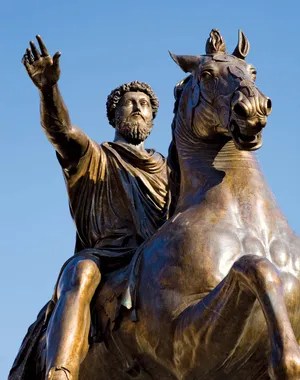
Marcus Aurelius was born during the reign of Hadrian and educated by a series of excellent tutors including Aurelius Antoninus, his uncle, who had been adopted by Hadrian as his heir. Marcus became his ward and Aurelius Antoninus changed Marcus’ name to his own and married him to his daughter Faustina. When Antoninus died in 161 AD, Marcus made his adoptive brother Verus his co-ruler, and for the first time in Roman history the Empire had two emperors. The Empire then entered a period of instability, barbarian invasions, plague, famine and floods, and Verus died in 161 AD, leaving Marcus as sole ruler. He left Rome for the Danube region to oversee the quelling of a Germanic rebellion, and during his time there he wrote a series of reflections he called To Himself. These writings are now called his Meditations, and show a great mind formed in the stoic tradition, which has long been admired around the world. He died in his camp, whilst on campaign in Germania, in March 180 AD most likely from the plague.
Marcus is known as one of the Five Good Emperors, along with Nerva, Trajan, Hadrian, and Antoninus Pius, men who ruled over the ‘best days’ of Rome selecting their successor not on bloodline but on who they thought was best to rule the Empire. The exception to this unfortunately was Marcus himself, who was succeeded by his son Commodus, who became something of a monster.
The Meditations are written in twelve books – here is a small selection
Book 2: 1. Say to yourself first thing in the morning: today I shall meet people who are meddling, ungrateful, aggressive, treacherous, maicious, unsocial. All this has afflicted them through their ignorance of true good and evil. But I have seen that the nature of good is what is right, and the nature of evil what is wrong: and I have reflected that the nature of the offender himself is akin to my own – not a kinship of blood or seed, but a sharing in the same mind, the same fragment of divinity. Therefore I cannot be harmed by any of them, as none will infect me with their wrong. Nor can I be angry with my kinsman or hate him. We were born for cooperation, like feet, like hands, like eyelids, like the rows of upper and lower teeth. So to work in opposition to one another is against nature: and anger or rejection is opposition.
Book 3: 14. No more wandering. You are not likely to read your own jottings, your histories of the ancient Greeks and Romans, your extracts from their literature laid up for your old age. Hurry then to the end, abandon vain hopes, rescue yourself, if you have any care for yourself, while the opportunity is still there.
Book 4: 7. Remove the judgement, and you have removed the thought ‘I am hurt’: remove the thought ‘I am hurt’, and the hurt itself is removed.
Book 4: 41. You are a soul carrying a corpse, as Epictetus used to say.
Book 5: 1. At break of day, when you are reluctant to get up, have this thought ready to mind: ‘I am getting up for a man’s work. Do I still then resent it, if I am going out to do what I was born for, the purpose for which I was brought into the world? Or was I created to wrap myself in blankets and keep warm?’ ‘But this is more pleasant’. Were you then born for pleasure – all for feeling and not for action? Can you not see the plants, birds, ants, piders, bees all doing their own work, each helping in their own way to order the world?
Book 6: 11. When circumstances force you to some sort of distress, quickly return to yourself. Do not stay out of rhythm for longer than you must: you will master the harmony the more by constantly going back to it.
Book 6: 17. Up, down, round and round are the motions of the elements, but the movement of active virtue follows none of these: it is something more divine, and it journeys on to success along a path hard to understand.
Book 6: 49. You do not resent your weight, do you? – that you weigh only so many pounds and not three hundred? So why resent either a life-span of so many years and not more? Just as you are content with the amount of matter allocated to you, so you should be content with your allocation of time.
Book 7: 8. Do not let the future trouble you. You will come to it (if that is what you must) possessed of the same reason that you apply now to the present.
Book 7: 21. Soon you will have forgotten all things: soon all things will have forgotten you.
Book 8: 2. Ask yourself this about each action: ‘How does this sit with me? Shall I regret it?’ In a short while I am dead and all things are gone. What more do I want, if this present work is that of an intelligent and social being, sharing one law with god?
Book 8: 24. Just as you see your bath – all soap, sweat, grime, greasy water, the whole thing disgusting – so is every part of life and every object in it.
Book 9: 21. The termination of an activity, the pause when an impulse or judgement is finished – this is a sort of death, but no harm in it. Turn now to the stages of your life – childhood, say, adolescence, prime, old age. Here too each change a death: anything fearful there? Turn now to your life with your grandfather, then with your mother, then with your father. And as you find many other examples of dissolution, change, or termination, ask yourself: ‘Was there anything to fear?’ So too there is nothing to fear in the termination, the pause, and the change of your whole life.
Book 9: 26. You have endured innumerable troubles by not leaving your directing mind to do the work it was made for. But enough.
Book 10: 10. A spider is proud to trap a fly. Men are proud of their own hunting – a hare, a sprat in the net, boars, bears, Sarmatian prisoners. If you examine their motives, are they not all bandits?
Book 10: 19. What sort of people are they when eating, sleeping, coupling, shitting, etc? Then what are they like when given power over men? Haughty, quick to anger, punishing to excess. And yet just now they were slaves to all those needs for all those reasons: and shortly they will be slaves again.
Book 11: 4. Have I done something for the common good? Then I too have benefited. Have this thought always ready to hand: and no stopping.
Book 11: 9. Just as those who try to block your progress along the straight path of reason will not be able to divert you from principled action, so you must not let them knock you out of your good will towards them. Rather you should watch yourself equally on both fronts, keeping not only a stability of judgement and action but also a mild response to those who try to stop you or are otherwise disaffected. To be angry with them is no less a weakness than to abandon your course of action and capitulate in panic. Both amount equally to desertion of duty – either being frightened into retreat, or setting yourself at odds with your natural kinsmen and friends.
Book 11: 39. Socrates used to question thus. ‘What do you want to have? The souls of rational or irrational beings? ‘Rational.’ ‘What sort of rational beings? The pure or the lower? ‘The pure.’ ‘Why then don’t you aim for that? ‘Because we have it.’ ‘Why then your fighting and disagreements?’
Book 12: 25. Jettison the judgement, and you are saved. And who is there to prevent this jettison?
Book 12: 29. The salvation of life lies in seeing each object in its essence and its entirety, discerning both the mterial and the casual: in applying one’s whole soul to doing right and speaking the truth. There remains only the enjoyment of living a linked succession of good deeds, with not the slightest gap between them.
Book 12: 31. What more do you want? To live on? Or is it to continue sensation and impulse? To wax and then to wane? To make use of your voice, your mind? What in all this strikes you as good cause for regret? But if every one of these objects is contempible, go on then to the final aim, which is to follow reason and to follow god. To value these other things, to fret at their loss which death will bring, militates against this aim.
References
Marcus Aurelius, Meditations, Penguin Classics, Translated with notes by Martin Hammond, Introduction by Diskin Clay – © 2006


Leave a Reply