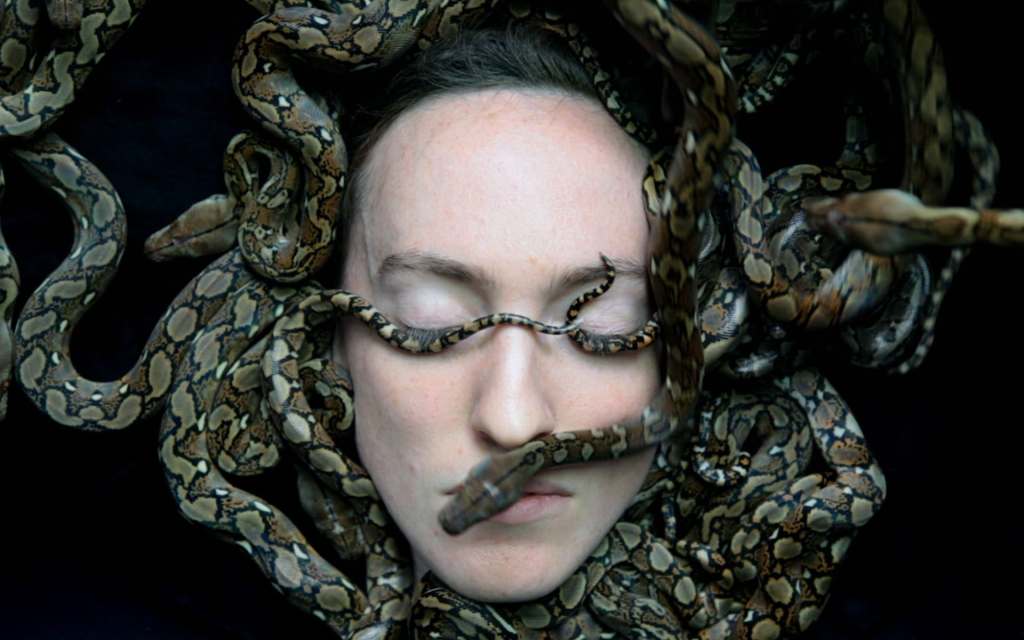
Juul Kraijer’s Spawn (2019)
Ovid, Metamorphoses 15.877–9
Funny, devastating, flip, throat-catching – the moods of the Metamorphoses are as various as the hundreds of stories that form the poem’s subject-matter. The title of the poem, Metamorphoses, is the Greek word for ‘transformations’, and the myths that provide the source material for Ovid’s torrent of stories are all linked together by this theme of transformation, which Ovid, with an insight of characteristic genius, had at some moment realised to be the single potential unifying thread that ran through the chaotically diverse bundles of stories in the Greek and Roman traditions.
Metamorphoses has…always appealed to iconoclastic readers, who have responded to its energy, verbal wit and subversive intelligence… It is a totally unexpected masterpiece…cover[ing] an extraordinary range of experience…display[ing] a penetrating psychological knowledge of the variety of human motivations and delusions – David Raeburn, in his Introduction to Metamorphoses by Ovid 2004.
The above paragraphs by David Raeburn neatly sum up what many describe as the greatest poem ever written, by a man who constantly arouses varying emotions in his readers. However, in light of the #MeToo movement, the Epstein scandal and too many others, there have been some noteworthy research that tries to show other perspectives on how to read the incredible work that is Metamorphoses.
Ovid’s epic work provides us with a multitude of myths that have undergone their own metamorphosis throughout the centuries, constantly evolving to meet different cultural expectations. Written to provide both entertainment and highlight his mistreatment at being exiled, Metamorphoses remains a benchmark of what was fascinating and mysterious in Roman literature; that different beings, certainly gods, could inhabit different forms and experience the world.
Fiona Cox, professor and author of Ovid’s Presence in Contemporary Women’s Fiction, says “Ovid’s obsession with fluidity, plasticity and change enabled him to explore the limitations of bodies, the boundaries of gender and of sexuality, and the relationship between humans and the Earth as well as the animal kingdom.”
The god’s controlling attitude towards mortals is seen in the metamorphosis of a human into a tree in the myth of Daphne, when Peneus’ daughter flees the advances of Apollo, his lust fired by Cupid’s arrow. Ovid’s writing displays conventionally sexist language designed to portray Daphne as Apollo’s innocent quarry, and increase the sexual tension in the scene ‘…as her limbs were exposed by the wind…[it] managed also to flutter her dress…Flight made her all the more lovely…the god in his youthful ardour…spurred on by desire…followed the trail with new vigour’ (Ovid, Met. 1.527-532), Ovid highlights Apollo’s youth to represent the emperor Augustus’ age and supposed virility.
With Apollo’s desperate advances ‘…about to close in with his jaws; he believes he is almost there…grazing the back of her heels with the tip of his muzzle’ (Ovid, Met. 1.535-536), Ovid describes Daphne as prey, again conventionally sexist, and she begs her father to change her form to protect her from dishonour. He duly complies by turning his daughter into a laurel ‘…ringed in a layer of bark, her hair was turned into foliage, her arms into branches…’ (Ovid, Met. 1.548-549).
As compensation for her loss of agency, a thwarted Apollo, still unwilling to let Daphne go ‘…pressed his lips to the wood…’ (Ovid, Met. 1. 556), and bestows on her the ‘honour’ of providing future victorious Roman generals with their laurel wreaths. The now transformed Daphne is still unresponsive to the god ‘…the wood still shrank from his kisses’ (Ovid, Met. 1. 556).
The rise of misogyny and gender-based violence is reflected in the multiple assaults suffered by the female characters in Metamorphoses. Ovid himself seen to be dismissive of these attacks, but many female writers have sought to redress this wrong.
In the myth of Caenis, the young woman is raped by the sea-god Neptune, just one of several rapes by gods of mortals in the Metamorphoses, and after stating ‘The wrong you have done me is great…’ (Ovid, Met. 12.201) requests ‘…the greatest of favours…If you will make me a woman no more…’ (Ovid, Met. 12.202-203). Notably Caenis does not ask to become a man, and it would have been in the god’s power to grant her request but transform her into a tree, an animal, or a constellation as he would choose, but Neptune gave her a male body that could not be ‘…wounded or fall at a swords point’ (Ovid, Met. 12.207), wounded being possibly a metaphor for never again having to suffer penetration as a result of sexual assault, which may be Ovid’s way of highlighting what women were often subjected to.
When Caeneus goes into battle against the Centaurs, he is subjected to a tirade of abuse regarding his former sex from Látreus, a centaur of great physical stature ‘…you will always be female and Caenis to me…[what of] the price you paid to achieve this specious masculine body?’ (Ovid, Met. 12. 470-473). Látreus represents the physical might and established male order of Rome, including its disregard of anything female in public life, outside perhaps of religion.
Metamorphoses contains several unusual stories of gender shifting, such as Teiresias who was changed from a man to a woman, to settle a wager laid by an inebriated Jupiter, when he broke apart two copulating snakes in the forest, and back to a man again when eight years later he again chanced upon and struck the same two snakes with his staff. Here we can read Teiresias as Ovid, breaking apart a sexual tryst involving the emperor, and suffering a loss of identity i.e. his banishment, as a result. His second meeting with the same two snakes, and his striking them could be seen as Ovid’s interpretation of bisexuality, well attested to in Greek and Roman culture.
Ovid deals with same-sex relationships which were attested to in both Greek and Roman life in Iphis, the girl who fell in love with ‘…a fair-haired girl called Ianthe’ (Ovid, Met. 9. 715) who was unaware of her sweethearts true sex. Iphis ‘…loved without hope…’ (Ovid, Met. 9. 724) and ‘Almost in tears, she sighed…I’m possessed by…a new kind of passion, a monstrous desire!’ (Ovid, Met. 9. 726-727). Iphis’ mother, despairing as her daughter’s wedding day drew near prayed fervently to Isis for help and miraculously her daughter transformed into a man. Ovid gives us this transgender myth with a welcome unusual and happy ending.
The British author Natalie Haynes reimagined the story of Medusa in her book Stone Blind in 2022. “By far the longest version of the story of Medusa is in Ovid’s Metamorphoses,” Haynes says, but it left Haynes furious. The story tells how Medusa was once beautiful, but after she was raped by Poseidon (Neptune) in Athena’s (Minerva) temple, the goddess punishes Medusa by turning her into a monster with snakes for hair, whose gaze turns her enemies into stone. Despite her anger at Ovid’s treatment in the way Medusa was treated, Haynes is pleased to see the recent changes in perspective. “Mostly she’s become a symbol of survivors of sexual assault, and that is an extraordinary thing,” Haynes says.
Most of Ovid’s work tells of shattering physical transformations that terrify the recipient, and none more so than that of Actaeon, transformed into a stag by the goddess Diana, because he made the fatal mistake of seeing her naked. In his poem, Ovid’s women are usually objectified and in a state of undress when caught unawares like Diana, or he uses their innocence, or flimsy clothing, as with Daphne, to emphasise their sexuality and the thrill of the chase. In Metamorphoses Actaeon innocently ‘…sauntered aimlessly through…unfamiliar woodland’ (Ovid, Met. 3.176), and chanced upon Diana bathing naked in a pool guarded by her attendant nymphs. Incandescent with rage, the goddess’ revenge is swift and devastating when Actaeon suddenly ‘…sprouted the horns of a lusty stag …the neck expanded, the ears were narrowed…his hands [changed] into hooves and his arms into…slender forelegs…’ (Ovid, Met. 3.194-196). Transformed, Actaeon’s feeble attempts to speak ‘Oh, dear god!’ he was going to say; but no words followed’ (Ovid, Met. 3.201), show the state of victimhood he now inhabits, and his complete inability to control the situation.
On the surface this is a tale about virginity and modesty, but Ovid is perhaps telling his own story of banishment from Rome in 8 AD at the hands of the emperor Augustus. Ovid takes the role of Actaeon, and Augustus is Diana, and Actaeon’s ‘…crime…a pure mistake’ (Ovid, Met. 3.142) was written to display to all his innocence, to no avail. ‘Now you may tell the story of seeing Diana naked – If story telling is in your power!’ (Ovid, Met. 3.192) the goddess screams at him, and as Greta Hawes says in her 2014 work on the Metamorphoses, ‘Diana’s wrath focuses on his [Actaeon’s] potential role as an informant; her punishment seeks to control his characteristic eloquence and loquacity’ (Metamorphosis and Metamorphic Identity), her excessive fury abating ‘Only after his life was destroyed…’ (Ovid, Met. 3.251). Ovid uses the transformation from human to hunted animal to show himself as the victim, unable to speak to defend himself.
‘Perhaps the most outstanding and ubiquitous aspect of Ovid’s Metamorphoses is the recurring abuse of mortals by the gods (Hughes, 2007), abuse characterised by rape and terrifying transformations of one bodily form to another. Ovid’s poem highlighted his exile and the misuse of patriarchal power; its fundamental lesson being do not meddle in the affairs of the gods. The Metamorphoses undoubtably portrays the negative in Roman socio-cultural standards, the abuse of power, rape, and male domination of women, but also shows same-sex relationships and gender fluidity in literature, and theatrical performance as positives. Using constant shifts of gender to tell his story, Ovid knew he would get his message heard. Whether he was writing to highlight how poorly women and other marginalised groups were often regarded or not, is debatable, and another perspective is that Ovid wrote the more risqué and grotesque stories for the coarser elements of his audience as a compromise to getting his work favourably received. Myths that included gender-swapping roles, monstrous transformations, and creatures half-man and half-beast were well known to the Romans, who would have related to them, understood their meaning, and quite probably any messages Ovid had planted in them.
References
Ovid (2004) Metamorphoses: a new verse translation. Translated from the Latin by D. Raeburn. London: Penguin
Paul H. Hughes, 2007, Transforming Ovid’s Metamorphoses: Classical Literature Contextualized
Greta Hawes, 2014, Metamorphoses and Metamorphic Identity: The Myth of Actaeon in Works of Ovid, Dante and John Gower
The Abuse of Patriarchal Power in Rome: The Rape Narratives of Ovid’s Metamorphoses by Katie Tinkler, 2018, University of Canterbury
BBC Culture: Climate change to identity: The vital lessons in Metamorphoses, Ovid’s 2,000-year-old poem


Leave a Reply