
To the Romans, like the ancient Greeks before them, the laurel was sacred. The Greeks believed the laurel groves were the sacred dwelling places of the gods and nymphs. The Romans adopted the laurel wreath, and it became a symbol of military victory, worn by generals leading their troops in a triumph, on their arrival back in Rome. A slave accompanied these generals in the leading chariot, whispering “Memento mori (remember you are mortal)” in their ear to ensure that the general wouldn’t get too bombastic and start behaving like a megalomaniac.
Julius Caesar famously wore a laurel wreath more and more as he took command of the republic, as the historian Suetonius said the wreath served a practical purpose by covering up his baldness, about which the great leader was touchy. Real crowns were associated with royalty which was despised by the Romans, and the laurel made Caesar look regal without causing anger in diehard republicans.
During Augustus’ reign, to wear the laurel wreath became an exclusive right of his. A story from the time tells us how the emperors future wife and Empress, Livia, watched as an eagle dropped a hen’s chick in her lap. In its beak, the chick held a branch of a laurel tree, which Livia, after taking advice from her haruspices (soothsayers), planted in the garden of her villa at Prima Porta, north of Rome, called Ad Gallinas, which means ‘chicken pen’. This laurel branch, so obviously sent by the gods, grew into a laurel grove, which supposedly provided the laurel leaves for the wreaths worn during a triumph by all members of the Julio-Claudian dynasty. It is said the entire laurel grove died just before Nero, the last emperor of the dynasty, was overthrown and committed suicide under pressure by the senate, in 69 AD.
The emperor Tiberius, the stepson of Augustus, wore a laurel wreath to protect him from being struck by lightning (Augustus himself had a particular fear of lightning), as he believed that lightning never struck a laurel tree, which is entirely false. This belief apparently comes from the cracking sound the laurel makes when being burnt.
In ancient Greece, the laurel tree was the sacred tree of the sun god Apollo, the god of archery, medicine, music and healing. Delphi was the seat of the world famous oracle, which was where Apollo slew the Python, a monstrous creature that terrorised the people in the area.
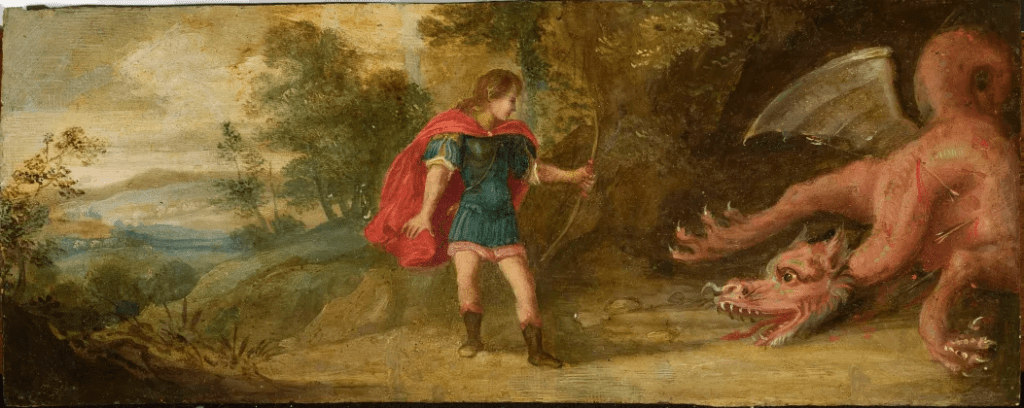
According to the poet Ovid in his Metamorphoses ‘In order that time should never destroy the fame of this exploit, Apollo established the sacred games…’ (Ovid, Met. 1.445-6). He named these games the Pythian Games, which together with the Olympic Games, were the greatest games played in Greece. Poetry was included in the competition, with the winning poets awarded laurel wreaths, Apollo being the god of poetry.
Apollo’s high priestess was called Pythia, and gave readings to those who sought advice from the gods about future events. Pythia allegedly prophesied in a trance, possibly induced by subterranean vapours filling the cave, through fissures in the rock. Other sources have her chewing on laurel leaves, which some say were the source of the her trance and gave her the ability to prophesise. Laurel leaves do contain a very small trace of hydrogen cyanide, but are not hallucinogenic.
The people who received advice from the oracle wore wreaths made of laurel leaves when they returned to their native lands, to deliver the words that had been given by Apollo. Also, wearing the laurel wreath gave them protection from being robbed during the trip home, as harming travellers who had been given Apollo’s protection was to incur his wrath.
Greek mythology gives us the myth of Apollo and Daphne, which explains how the laurel came to be prized by Rome’s leaders. Ovid’s Metamorphoses tells us that Daphne was a beautiful nymph, the daughter of the river god Peneus. Apollo falls in love with her after Eros fires an arrow of passion at him, and one of abhorrence at Daphne.
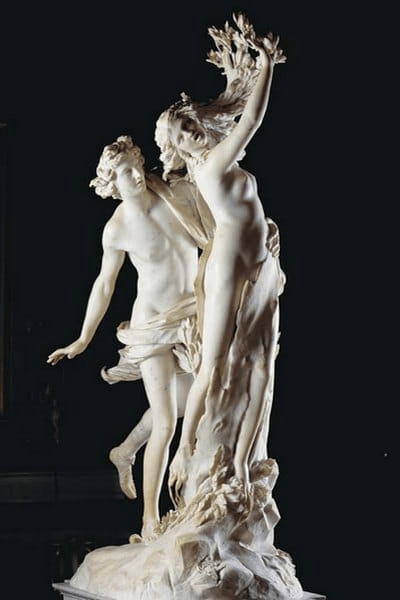
made by the Italian artist Gian Lorenzo Bernini and executed in 1622-1625.
Apollo lustily pursues Daphne who, revolted at the thought of him, pleads with her father to help transform her into anything in order to escape. Peneus obligingly changes his daughter into a laurel tree, leaving Apollo devastated at his loss but still unwilling to relinquish control, saying ‘Since you cannot be mine…you must at least be Apollo’s tree…The generals of Rome shall be wreathed with you, when the…triumph is raised and…ascends the Capitol’ (Ovid, Met. 1. 557-61).
In Greek, daphne (δάφνη) means laurel. Her transformation was supposed to have happened in the Vale of Tempe in Thessaly, located between the towering peaks of Mount Olympus and Mount Ossa, and is famous both for being Apollo’s sanctuary, and its laurel groves.
In todays world, the laurel wreath remains a symbol of academic achievement. It is seen most notably in university graduations, and official titles like the UK’s Poet Laureate.


Leave a Reply