
The Meroe head of Augustus – British Museum, London
Augustus had a ruthless reputation. What he could not eliminate with the strength of arms, he did so by manipulation – Alvin Ang
Augustus transformed Rome from a bitterly-divided, war weary republic into an empire in a series of superb strokes of political manipulation. Emerging victorious from civil war, Rome’s first emperor built around himself a system in which he had almost complete control, whilst seemingly continuing the republic and it’s structures of power, such as the army and the senate. Augustus was canny enough to craft an image that portrayed benevolence and morality, and in doing so he created a new political system that would last for centuries.
Octavian’s path to emperor started with his adoption by Julius Caesar and becoming the heir to his fortune. This money was vitally important for his political survival, and seizing on his new status as Divi Filius – Son of the Deified One, Octavian, though only nineteen and lacking military experience, quickly began currying favour with Caesar’s legions and veterans. Shrewdly, he understood he had to show reverence for religion, duty and the existing status quo, and set about transforming himself from an unknown obscurity into the legal, responsible, and capable heir to Caesar. He did this by cultivating an image of youthful piety, civic responsibility and the occasional instance of sheer bravery, which at that time he probably struggled to summon.
His slow but steady rise to power involved first aligning with, and then destroying Rome’s most powerful figures, namely Mark Antony and Marcus Amelius Lepidus. The three of them formed the Second Triumvirate in 43 BC under Lex Titia, which gave them equal power for five years. During this period, the Triumvirate’s bloody proscriptions (that included the execution of Cicero which Octavian agonised over, but relented to appease Antony, who hated him), served him well because it not only eliminated the political enemies who were trying to eliminate him, it gave him great wealth from the proceeds of their confiscated estates, money he needed to ‘buy’ the loyalty of Caesar’s troops.
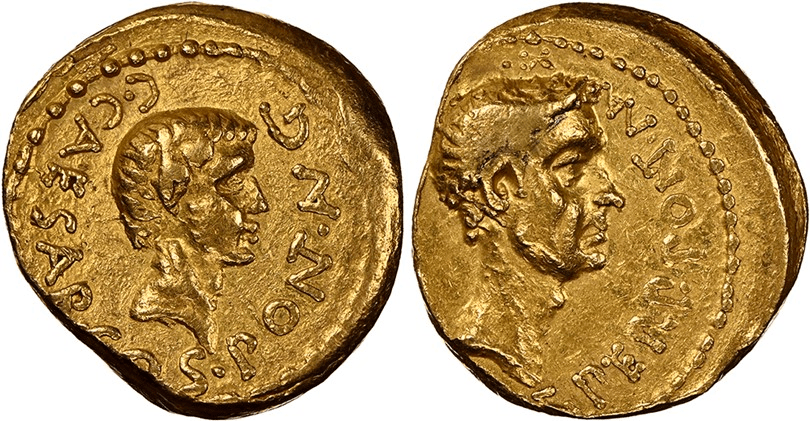
Octavian was displaying shrewd political instincts for someone of his age. He aligned himself with the god Apollo, known as the god of philosophy and the enemy of barbarism, positioning himself as avenger and restorer of Rome’s golden age. He courted his divine affiliation with the newly deified Caesar, which was recognized by the Senate in 42 BC, and he also displayed respect to republican norms, which enabled him to appeal to both the elite and the plebs, restoring order after the chaos surrounding Caesar’s murder. Coins issued now featured his adoptive father’s image on one side and his own on the other, linking both his ancestry with the god Caesar, and the old regime with the new.
Octavian lacked military experience, but he was quick to learn from people like his old friend, the seasoned commander Agrippa. After the defeat of Caesar’s assassins in the Battle of Philippi, Antony and Octavian were by far the more powerful of the Triumvirate and Octavian was eager to get rid of Lepidus. When the Sicilian revolt was over, Lepidus wanted control of the mediterranean island, or Spain and Gaul, as was legally his right under Lex Titia. Octavian refused, accusing him of formenting rebellion and when several of his legions defected to Octavian, Lepidus was forced to admit defeat and was driven out of politics and confined to the city of Circeii, although Octavian declined to remove his title of Pontiflex Maximus, only taking it for himself when Lepidus died in 13 BC.
Finally Octavian confronted and beat the combined naval and land forces of Antony and Cleopatra at the Battle of Actium in 31 BC, and he was at the ultimate stage in his acquisition of power. Octavian presented the conflict as a defense of Roman decency and values against Eastern decadence and monarchy, signified by Antony’s louche behaviour, and because Cleopatra was a foreign queen she must yield to Rome. By portraying Antony as having been corrupted and enthralled by a foreign power, and a woman at that, Octavian had won through. This representation also allowed him to reinforce the pretence that he had fought solely for the Republic.
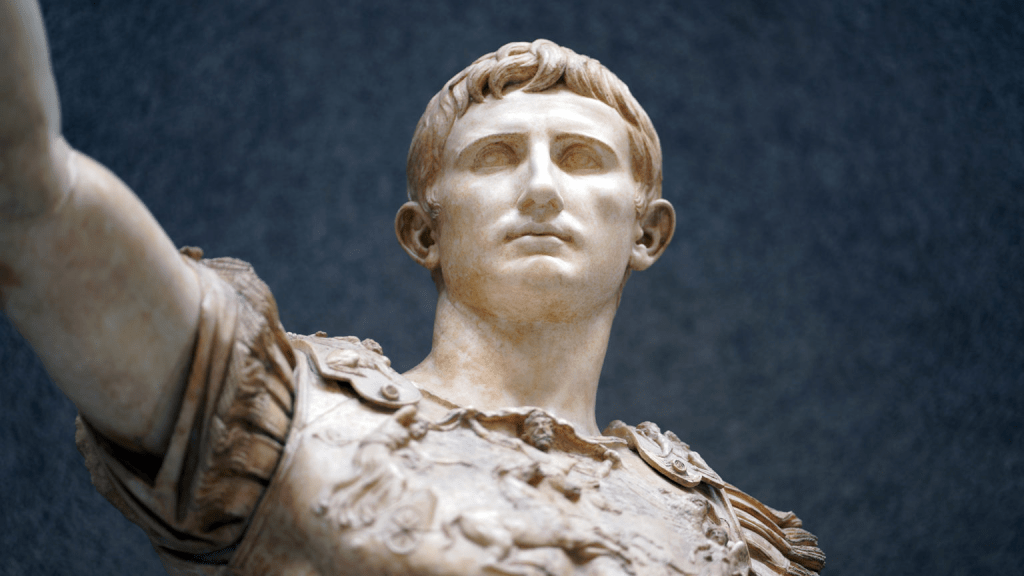
After the Battle of Actium, Octavian returned to Rome as a saviour. In 27 BC the Senate granted him the title Augustus. His campaign that ended with total supremacy over the Roman world was not simply down to military strength; he had proved himself as both a leader of men and a defender of tradition, and it was the result of a propaganda campaign involving the gods, and his deference towards them that helped shape Roman culture. He knew that brute force alone could not win outright, so he created an image of himself as one of reconciliation, moral order, and traditional Roman values. This campaign began long before the defeat of Antony, and it’s outcome eventually permeated all aspects of society, using symbols, monuments, literature, and even religion that would ensure his name would be known across the world for thousands of years.


Leave a Reply