
”In around A.D. 64, Marcus Valerius Martialis (A.D. 31-41 to 103), better known as Martial, arrived in Rome aged 26 from his Spanish hometown of Bilbilis, famous then for its iron mines and for the manufacture of steel, and a center of Roman culture, ” writes Steve Coates in the New York Times. ”He spent the next four decades composing short topical verse about life in the big city, an urban panorama as broad, as varied and as full of depraved humanity as any to have survived from classical times. In conventional but nimble Latin meters, he wrote gory epigrams about the Colosseum, sycophantic ones to flatter the ruler of the day, tender ones about such topics as a slave girl’s early death and, above all, comic ones aimed squarely at Roman society’s foibles. Preoccupations including comb-overs, stingy hosts, medical quacks, the poetry racket, the futility of cosmetics, consumptive heiresses and one-eyed women lend his books the ambience of a front-row seat at the Roman carnival.”

“You have to be impressed by a plucky Spanish provincial, in the dangerous days of [the emperors] Nero and Domitian, who could manage to earn a handsome living writing dirty poems for the urban sophisticates of ancient Rome. Modern readers, however, are drawn to Martial mostly for his scorpion-tailed epigrams of sexual invective, written, limerick- and graffiti-like, as raunchy entertainment. Even by today’s standards, many are grotesquely obscene; Martial takes us down some of Rome’s sleaziest streets (“I write, I must confess, for dirtier readers, / My verse does not attract the nation’s leaders”).’
“If Martial’s poems weren’t saintly, though, they were all in good fun (“My poetry is filthy — but not I,” he insisted). His targets were types, not real people, and many of his outrageous sketches, it has been rightly said, “come no closer to plausible reality than a Victorian Punch cartoon.” In this spirit, Martial riffs endlessly on prostitution, marital infidelity, lesbian sex, oral sex, pederasty, exhibitionism, unapproved modes of homosexuality, and incest (“Of course we know he’ll never wed. / What? Put his sister out of bed?”). Steve Coates, December, 2008.
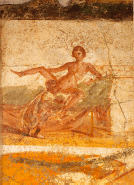
It has to be said that many early translators of Martial into English have declined to translate the sexually explicit epigrams, either leaving those onsidered too risque in Latin or else giving them an Italian translation. The publisher and art collector Henry G. Boehn in his 1897 edition of Martials work had this to say on his omission of some of the epigrams: ‘I do not believe that most people who read Martial will feel any sorrow at these omissions. To read Martial is to walk with him along the streets of ancient Rome; but few of us need accompany him when he bathes in the sewers.‘
However times have changed, and I know many of you will probably feel different about the poets lasciviousness today, so here’s a few to be going on with:
“Epigram I.90:
Bassa, I never saw you hang with guys —
Nobody whispered that you had a beau.
Girls surrounded you at every turn;
They did your errands, with no attendant males.
And so, I guess I naturally assumed
That you were what you seemed: a chaste Lucretia.
But hell no. Why, you shameless little tramp,
You were an active humper all the time.
“You improvised, by rubbing c***s together, and using that bionic clit of yours
To counterfeit the thrusting of a male.
Unbelievable. You’ve managed to create
A real conundrum, worthy of the Sphinx:
Adultery without a co-respondent.
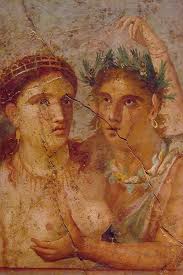
Epigram IX.67:
I had this really horny broad all night,
A girl whose naughty tricks are unsurpassed.
We did it in a thousand different ways.
Tired of the same old thing, I asked to buttfuck —
Before I finished speaking, she said Yes.
Emboldened, I then blushed a bit, and laughed,
And asked for something even dirtier.
The lusty wench agreed without a blink.
Still, that girl was pure in my eyes, Aeschylus —
But she won’t be for you. To get the same,
You’ll have to grant a nasty stipulation.
Wife, leave my house or adopt my ways!
I am not a Curius, a Numa or a Tatius.
Nights made happy with drink please me:
But you hurry to leave with water to drink.
You love the shadows, but I’m happy to play
With a lamp as witness or with light let in on my ‘bulge’.
Tunics and obscuring robes must cover you:
But no girl could ever be naked enough for me!
Kisses to mimic eager doves delight me;
But you give those from a grandmother’s ‘good morning’.

“It is beneath you to help out with movement or voice,
Not even fingers, as if you were readying incense and wine.
Phrygian slaves used to masturbate outside the door
Whenever the wife sat atop her Hectorean ‘horse’;
Chaste Penelope always used to keep her hand down there,
Even when the Ithacan was snoring!
You won’t abide anal sex! Cornelia permitted this to Gracchus!
Julia allowed Pompey; Porcia bent for you, Brutus!
When the Dardanian was not yet his servant mixing sweet wine,
Juno was Jupiter’s Ganymede.
If you want to be grave, then be Lucretia all day
But at night I want a Lais.”

1.
Hosts always invite you to dinner, Phoebe,
but are you merely an éclair to the greedy?
2.
Hosts always invite you to dinner, Phoebe,
but are you tart Amaro to the greedy?
3.
Hosts always invite you to dinner, Phoebe,
but are you an aperitif to the greedy?
4.
Hosts always invite you to dinner, Phoebe,
but they’re pimps to the seedy.
Translated by Michael R. Burch
Masturbation in the Roman Empire by Paige Blackwell
‘Masturbation is generally thought to be derived from manu stuprare – to defile with the hand. Whether it be written on the walls in the city of Pompeii or inscribed in the poetry of some of the most famous Roman poets, one thing is very obvious: the Romans masturbated. While there is very little serious literature on the subject in Ancient Rome, they made it incredibly obvious that everyone was doing it. Masturbation has a tricky history in Ancient Rome and was seen as an act for slaves. The Romans did not see it as something that the wealthy elites were to participate in, as they participated in activities that are far more problematic by today’s standards. It was often the point of ridicule and joke.’
Catullus
Bald heads forgetful of their sins, Old, learned, respectable bald heads Edit and annotate the lines That young men, tossing on their beds, Rhymed out in love’s despair To flatter beauty’s ignorant ear.
All shuffle there; all cough in ink; All wear the carpet with their shoes;
All think what other people think; All know the man their neighbour knows. Lord, what would they say Did their Catullus walk that way? – Stephen Akey
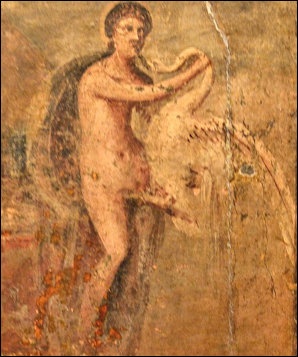
– c 150 b.C
Martial’s Epigram 33 reads:
“’Cause thou dost kiss thy boy’s soft lips with thy
Rough chin, and with strip’d Ganymede dost he,
Who does deny thee this? ’tis well. At least
Frig not thyself with thy lascivious fist,
This in light toys more than the prick offends,
Their fingers hasten and the man up sends,
Hence Goatish rankness, sudden hairs, a beard
Springs forth to wond’ring mothers much admired.
Nor do they please by day when in the bath
They wash their skins. Nature divided hath
The males: half to the girls born to be shown
The other half to men: use then thy own.
translated by Robert Fletcher
Female Homoerotic Poem from Region IX of Pompeii – Anonymous – Ancient Graffiti Project
Oh, would that it were permitted to grasp with my neck your little arms
as they entwine [it] and to give kisses to your delicate little lips.
Come now, my little darling, entrust your pleasures to the winds.
(En)trust me, the nature of men is insubstantial.
Often as I have been awake, lovesick, at midnight,
you think on these things with me: many are they whom Fortune lifted high;
these, suddenly thrown down headlong, she now oppresses.
Thus, just as Venus suddenly joined the bodies of lovers,
daylight divides them and if…
‘Here, Catullus considers Lesbia’s pet sparrow in a playful and charming poem. In true Catullan style, there is an acute corporeal focus at the start of the poem, with a decidedly erotic description of Lesbia’s play with her pet bird. Indeed, it has been suggested that passer (sparrow) might be directly representative of the genitalia of Catullus or even of Lesbia, but I’ll leave it to you to decide how explicit you think Catullus is being here!
The genre of discussing a lover’s pet was not uncommon in antiquity, and another notable example is Ovid’s elegy for his mistress’ parrot (amores 2.6)’.
James Green in The Classical Anthology, May 27th 2019
Sparrow, my girlfriend’s delightful pet,
with whom she often plays or holds to her chest,
to whom she gives her fingertip as you peck away,
and whose sharp bites she is wont to provoke
whenever it pleases the object of my glistening desire
to play some dear little game
(it’s a small relief for her longing, I think, so that her profound passion might quieten down).
Oh – if only I could play with you as she does,
and alleviate the troubles of my melancholy mind!
Translation by James Green
I would be crazy not to give all the herds of the Cyclopes
in return for drinking one cup [of that wine]
and throwing myself from the white rock into the brine,
once I am intoxicated, with eyebrows relaxed.
Whoever is not happy when he drinks is crazy.
Where it is allowed to make this thing stand up erect,
to grab the breast and touch with both hands
the meadow [1] that is made all ready. And there is dancing
and forgetting of bad things.
Euripides Cyclops 163-172
- Euphemism for female genitalia
Catullus again
I hate and love. You wonder, perhaps, why I’d do that?
I have no idea. I just feel it. I am crucified.
Life is really a bitch for your Catullus,
Cornificius, and (my god!) so boring.
Ameana, that fucked-out little scrubber,
just had the nerve to ask me for ten thousand.
What’s left, Catullus? Why not die right here and now?
That pustule Nonius occupies a curule chair – Stephen Akey
Book VII:30 Hard to please
You do Germans, and Parthians, and Dacians, Caelia,
you don’t scorn Cappadocian, Cilician beds;
and fuckers from Memphis, that Pharian city,
and Red Sea’s black Indians sail towards you.
You’d not flee the thighs of a circumcised Jew,
not an Alan goes by, with Sarmatian horse too.
What’s the reason, then, since you are a Roman,
not one Roman member pleases you, woman?
Decimus Junius Juvenalis (circa 55 – 127 AD), is known to us in English as Juvenal, a Roman poet who is the author of the collection of satirical poems known to us as the Satires.
Satire, has played a massive part in society’s humour going as far back as the Greeks, and the Romans were masters of it.

Satire VI:25-59 You’re Mad To Marry!
Are you, in this day and age, ready for an agreement,
A contract, the wedding vows, having your hair done
By a master-barber, your finger already wearing the pledge?
Postumus, you were sane once. Are you really taking a wife?
Which Tisiphone is it, with her snakes, driving you mad?
You surely don’t have to endure it, with so much rope about,
Those vertiginous windows open, the Aemilian bridge at hand?
If none of these multiple exits please you, wouldn’t a boyfriend
Suit you better, one who would share your bed, a boyfriend
Who wouldn’t quarrel all night; wouldn’t demand from you
As he lies there, little gifts; and wouldn’t complain that your
Body was idle, that you weren’t breathing hard, as ordered.
‘But Ursidius is marrying, he approves of the Julian Law,
He intends to raise a sweet heir, and forgo his plump doves,
His bearded mullet, all his hunts through the meat market.’
Well nothing’s impossible, then, if Ursidius is wedding
Someone! If he, who was once the most noted of seducers,
He, so often concealed in a chest, like Latinus in the farce,
Is placing his foolish head in the marital halter! And that’s
Not all, you say, he seeks a wife with traditional virtues?
O, good doctor, relieve the pressure on that swollen vein!
What a fastidious man! Go prostrate yourself in worship
At the Tarpeian shrine, go sacrifice a gilded heifer to Juno,
If you should happen to find a woman whose life is chaste.
There are so few of them fit to touch Ceres’ sacred ribbons,
Whose kisses wouldn’t appal their fathers. Fasten a garland
To your doorpost if you do, deck the lintel with marriage ivy.
Is one man enough for Hiberina, then? She’d sooner confess
Under torture to being happy with only one of her eyes.
‘There’s a girl on her father’s estate in the country whose
Reputation is good.’ Try her at Gabii, not in the country,
Try her at Fidenae, then I’ll grant you the father’s farm.
Who says she’s not been carrying on in the caves or on
The hills? Have Jupiter and Mars gone into retirement?
Publius Ovidius Naso, known to us today as Ovid, was was a Roman poet who lived during the reign of Emperor Augustus. He was a younger contemporary of Virgil and Horace, with whom he is ranked as one of the most important poets in Latin literature, his work now classed as high-culture literature.
He was considered the last of the Latin love elegists, and although Ovid enjoyed enormous popularity during his lifetime, the emperor Augustus exiled him to Tomis, (now Constanța, a city in Romania) on the Black Sea, where he remained for the rest of his life. Ovid himself said little about his exile, except it was due to a “poem and a mistake” (alledgedly involving Augustus’ granddaughter), but longed to be allowed to return to Rome. The first five-book collection of the Amores, a series of erotic poems addressed to a lover, Corinna, is thought to have been published in 16–15 BC, and his Ars Amatoria (The Art of Love) is an instructional elegy series in three books written in 2 AD.
He is most famous for the Metamorphoses, a continuous mythological narrative in fifteen books written in dactylic hexameters, that was brilliantly translated by the poet Laureate Ted Hughes and published in his book Tales from Ovid in 1997. Along with Homerian epic, The Metamorphoses remains one of the most important sources of classical mythology in the west today.

Ovid
Book I Elegy V: Corinna in an Afternoon
It was hot, and the noon hour had gone by:
I was relaxed, limbs spread in the midst of the bed.
One half of the window was open, the other closed:
the light was just as it often is in the woods,
it glimmered like Phoebus dying at twilight,
or when night goes, but day has still not risen.
Such a light as is offered to modest girls,
whose timid shyness hopes for a refuge.
Behold Corinna comes, hidden by her loose slip,
scattered hair covering her white throat –
like the famous Semiramis going to her bed,
one might say, or Lais loved by many men.
I pulled her slip away –not harming its thinness much;
yet she still struggled to be covered by that slip.
While she would struggle so, it was as if she could not win,
yielding, she was effortlessly conquered.
When she stood before my eyes, the clothing set aside,
there was never a flaw in all her body.
What shoulders, what arms, I saw and touched!
Breasts formed as if they were made for pressing!
How flat the belly beneath the slender waist!
What flanks, what form! What young thighs!
Why recall each aspect? I saw nothing lacking praise
and I hugged her naked body against mine.
Who doesn’t know the story? Weary we both rested.
May such afternoons often come for me!
“Either she was foul, or her attire was bad“
By Ovid
Translated by Christopher Marlowe
In this poem, Ovid writes about not being able to get an erection while lying with a beautiful woman – and he explores this deflating episode in detail. It was translated by the spy and dramatist Christopher Marlowe into sixteenth-century English.
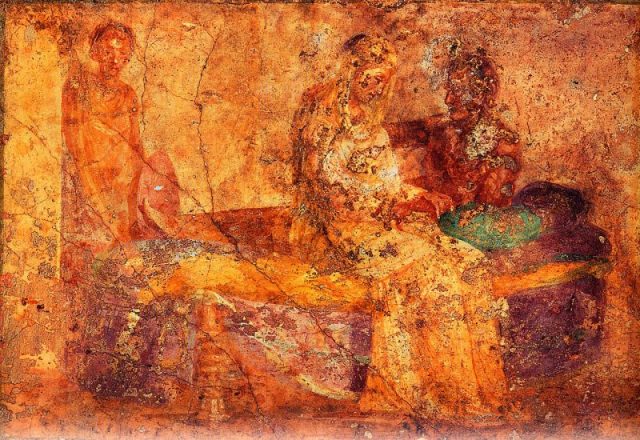
Either she was foul, or her attire was bad,
Or she was not the wench I wished t’have had.
Idly I lay with her, as if I loved not,
And like a burden grieved the bed that moved not.
Yet though both of us performed our true intent,
Yet I could not cast anchor where I meant.
She on my neck her ivory arms did throw,
Her arms far whiter than the Scythian snow.
And eagerly she kissed me with her tongue,
And under mine her wanton thigh she flung.
Yea, and she soothed me up and called me sir,
And used all speech that might provoke and stir.
Yet, like as if cold hemlock I had drunk,
It mockèd me, hung down the head, and sunk.
Like a dull cipher or rude block I lay,
Or shade or body was I, who can say?
What will my age do, age I cannot shun,
When in my prime my force is spent and done?
I blush, that being youthful, hot and lusty,
I prove neither youth nor man, but old and rusty.
Pure rose she, like a nun to sacrifice,
Or one that with her tender brother lies.
Yet boarded I the golden Chie twice,
And Libas, and the white-cheeked Pitho thrice.
Corinna craved it in a summer’s night,
And nine sweet bouts we had before daylight.
What, waste my limbs through some Thessalian charms?
May spells and drugs do silly souls such harm?
With virgin wax hath some imbaste my joints
And pierced my liver with sharp needles’ points?
Charms change corn to grass and make it die.
By charms are running spring and fountains dry.
By charms mast crops from oaks, from vines grapes fall,
And fruit from trees when there’s no wind at all.
Why might not then my sinews be enchanted,
And I grow faint, as with some spirit haunted?
To this add shame: shame to perform it quailed me
And was the second cause why vigour failed me.
My idle thoughts delighted her no more
Than did the robe or garment which she wore.
Yet might her touch make youthful Pylius fire
And Tithon livelier than his years require.
Even her I had, and she had me in vain;
What might I crave more if I asked again?
I think the great gods grieved they had bestowed
The benefit which lewdly I for-slowed.
I wished to be received in. In I get me
To kiss. I kiss. To lie with her, she let me.
Why was I blessed? Why made king to refuse it?
Chuff-like had I not gold and could not use it?
So in a spring thrives he that told so much,
And looks upon the fruits he cannot touch.
Hath any rose so from a fresh young maid,
As she might straight have gone to church and prayed?
Well I believe she kissed not as she should,
Nor used the sleight and cunning which she could.
Huge oaks, hard adamants might she have moved,
And with sweet words cause deaf rocks to have loved.
Worthy she was to move both gods and men,
But neither was I man, nor lived then.
Can deaf ear take delight when Phaemius sings?
Or Thamiras in curious painted things?
What sweet thought is there but I had the same?
And one gave place still as another came.
Yet, notwithstanding, like one dead it lay,
Drooping more than a rose pulled yesterday.
Now, when he should not jet, he bolts upright
And craves his task, and seeks to be at fight.
Lie down with shame, and see thou stir no more,
Seeing thou wouldst deceive me as before.
Thou cozenest me, by thee surprised am I,
And bide sore loss with endless infamy.
Nay more, the wench did not disdain a whit
To take it in her hand and play with it.
But when she saw it would by no means stand,
But still drooped down, regarding not her hand,
‘Why mockst thou me?’ she cried. ‘Or, being ill,
Who bade thee lie down here against thy will?
Either thou art witch, with blood of frogs new dead,
Or jaded camest thou from some other bed.’
With that, her loose gown on, from me she cast her –
In skipping out her naked feet much graced her.
And, lest her maid should know of this disgrace,
To cover it, spilt water on the place.
Text sources
Outlines of Roman History by William C. Morey, Ph.D, The Private Life of the Romans by Harold Whetstone Johnston, revised by Mary Johnston, Scott, Foresman and Company, and many others including the Metropolitan Museum of Art, National Geographic, Smithsonian magazine, The New York Times, The Times of London, Natural History magazine, Archaeology magazine, Encyclopædia Britannica, The Discoverers and The Creators by Daniel Boorstin, and Greek and Roman Life by Ian Jenkins from the British Museum, Brendan Kennelly, in his translations Martial Art, and Steve Coates.


 everythinglatin.co.uk
Leave a comment