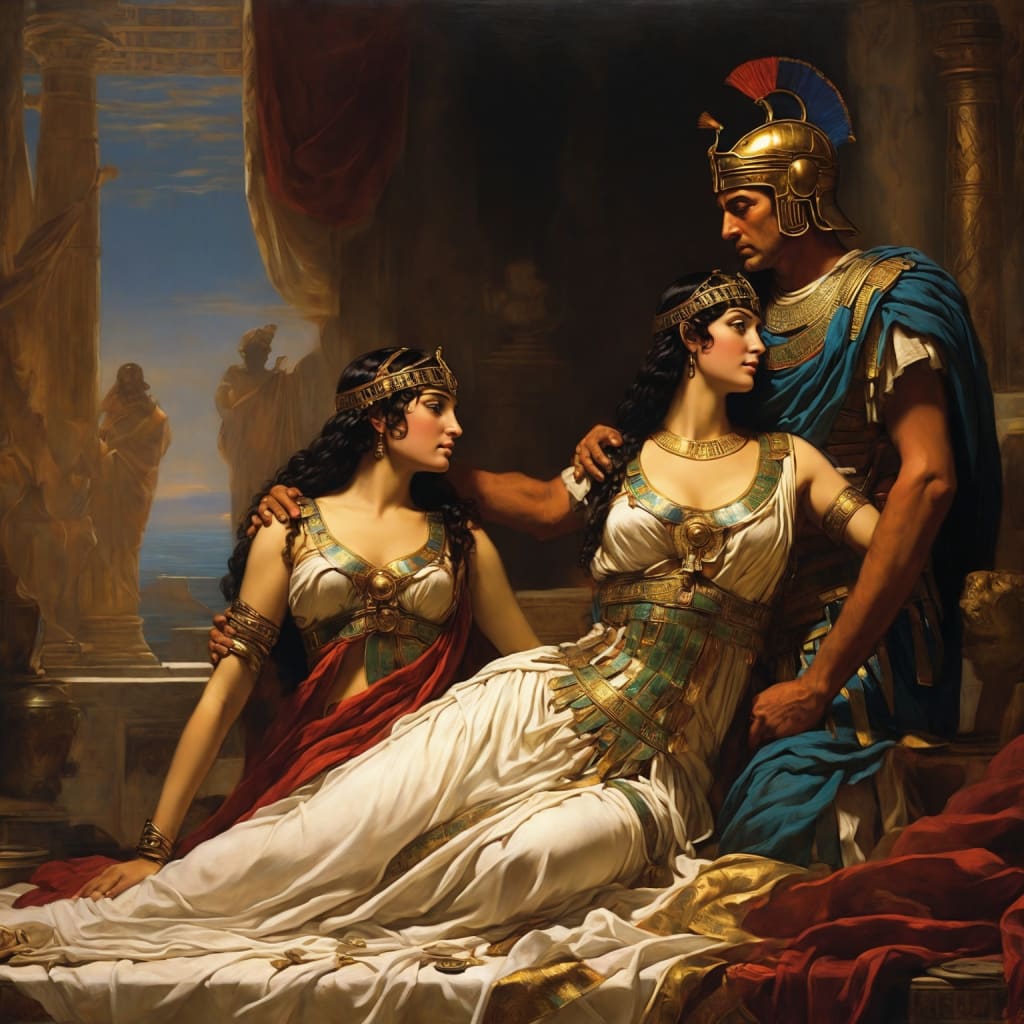
O Cleopatra, I am not distressed to have lost you, for I shall straightaway join you; but I am grieved that a commander as great as I should be found to be inferior to a woman in courage – as recorded by Plutarch, when Antony was told of Cleopatra’s (supposed) death
The Roman politician and general Marcus Antonius was a friend and ally of Julius Caesar, and the main rival of his successor Octavian (later the Emperor Augustus). He played a pivotal part in the catastrophe that was the civil war that foresaw Rome’s transition from republic to empire. His romantic and political alliance with the Egyptian queen Cleopatra was his ultimate undoing, and after his defeat by Octavian at the Battle of Actium in 31 BC he committed suicide. His dramatic life and death provided inspiration for Shakespeare when he wrote his tragedy Antony and Cleopatra.
Marc Antony’s life reads at times like a blockbuster, a thrilling novel about a headstrong and brave soldier who had a gift for military leadership, one who adorded women, and wore his heart on his sleeve. He came from a good, but less than wealthy family, and in 55 BC when he was 25 years old, he played a small role in the Roman invasion of Eygpt that was intended to restore an unpopular king, Ptolemy XII Auletes to the throne, casting his eyes for the first time on a fourteen year old princess called Cleopatra. The historian Appian says Antony was ‘provoked by the sight of her’.
Back home in Rome he soon became a favourite lieutenant to Julius Caesar, the two becoming firm friends (he was also related to Caesar, Antony’s mother Julia being his cousin), and he fought and won many battles in Gaul under his command. He was broad, strong, handsome, wearing a dark beard, and many called him Herculean in his looks and behaviour. He wore his tunic low, a cloak wrapped around his shoulders and he carried a large, heavy sword at his side. He drank, often heavily, sometimes brawled and loved the company of his men, eating with them, and on campaign, sleeping on the ground alongside them. He was a generous man, sharing his money with hard up friends and bestowing gifts to his soldiers. Boisterous and lustful, Antony loved beautiful women, marrying three times before finally sucumbing to the ‘luxurious and decadent East’, to meet with his destiny.
After Caesar’s assassination the country lurched towards civil war, and Antony unwillingly joined an uneasy truce, called the Triumvirate (tri meaning three and vir meaning man) in 43 BC with Marcus Aemilius Lepidus and Caesar’s nephew Octavian (the future Emperor Augustus) to rule the Roman Republic. None of them alone was strong enough the take complete power. Antony was given the Empire’s rowdy Eastern territories, namely Egypt. In order to discuss matters and build a coalition, he sent for Cleopatra, who was by now ruling her country as Queen.
Cleopatra was the divine Ptolemaic ruler of the fertile and prosperous Egypt, she was academically brilliant, silver-tongued, charming, scholarly and the probably the richest person, or one of them at least, in the Mediterranean world.

The meeting took place at Tarsus on the coast of what is now Turkey. She knew of Antony’s love of spectacle, and of Rome’s interest in her wealth, so she organised an entrance into Tarsus designed to overawe him. She sailed into the harbour and Antony’s view beneath billowing purple sails:
She reclined beneath a gold-spangled canopy, dressed as Venus in a painting, while beautiful young boys, like painted Cupids, stood at her sides and fanned her. Her fairest maids were likewise dressed as sea nymphs and graces, some steering at the rudder, some working at the ropes. Wondrous odors from countless incense-offerings diffused themselves along the river-banks
Stacy Shiff in Cleopatra: A Life
The Greek historian Appian wrote that “The moment he saw her, Antony lost his head to her like a young man,” it had worked, Cleopatra had got her man. Their attraction was real, but it was also a political necessity, Antony needed Cleopatra to help keep Egypt secure (and keep Egyptian grain, so vital to fend of starvation in Rome, being shipped to the ports of Italy), and to help fund his military endeavors elsewhere in the East. Cleopatra needed Rome, and therefore him for military protection in case she was deposed for a ruler friendlier towards the Romans, and to further the rights of her son Caesarion by Julius Caesar, his true heir.
Antony and Cleopatra decamped to the Egyptian city of Alexandria, which was going through an artistic and cultural revival under the Queen. The two rulers partied hard, drinking and entertaining guests, Plutarch said;
“[They] entertained one another daily in turn, with an extravagance of expenditure beyond measure or belief,”
A famous story has it that at one party, Cleopatra bet Antony she could spend 10 million sesterces on one banquet. The Roman historian Pliny the Elder wrote:
”She ordered the second course to be served. In accordance with previous instructions, the servants placed in front of her only a single vessel containing vinegar. She took one [pearl] earring off, and dropped the pearl in the vinegar, and when it wasted away, she swallowed it”.
In 40 BC Cleopatra gave birth to their twins, Alexander Helios and Cleopatra Selene, and by 37 BC, she ruled over almost all the entire eastern Mediterranean coast, from what is today eastern Libya, Tunisia, north through Israel, Lebanon, and Syria, to southern Turkey, excepting only the province of Judaea.
With the Triumvirate still holding, Antony successfully conquered the kingdom of Armenia, and triumphantly returned to Alexandria with the Armenian royal family in chains. In a provocation to Octavian, Antony distributed the captured lands to his and Cleopatra’s children, making it abundantly clear that their family was the dynasty of the East.
This snub further stoked tensions between Rome and Egypt until war broke out in earnest, culmulating in the sea battle at Actium in 31 BC where the navies of a combined Antony and Cleopatra fought against Octavians forces. It ended decisively for Octavian, his men resolutely beating Antonys troops, with many deserting to Octavians side as soon as they realised future resistance was futile. Octavian had already forced Lepidus out of the Triumvirate and into exile, and was now the undisputed ruler of the Roman Empire.
Antony and Cleopatra both returned to Alexandria, the Eygptian queen retiring to her Royal Palace, Antony staying on the walls of the city awaiting Octavians arrival, where in a rage after hearing yet more Egyptian troops had deserted to the Roman side, he cried out that Cleopatra had abandoned him to his enemy. In a fright, she had word sent to Antony that she had killed herself, knowing that he would probably do the same. She was right.
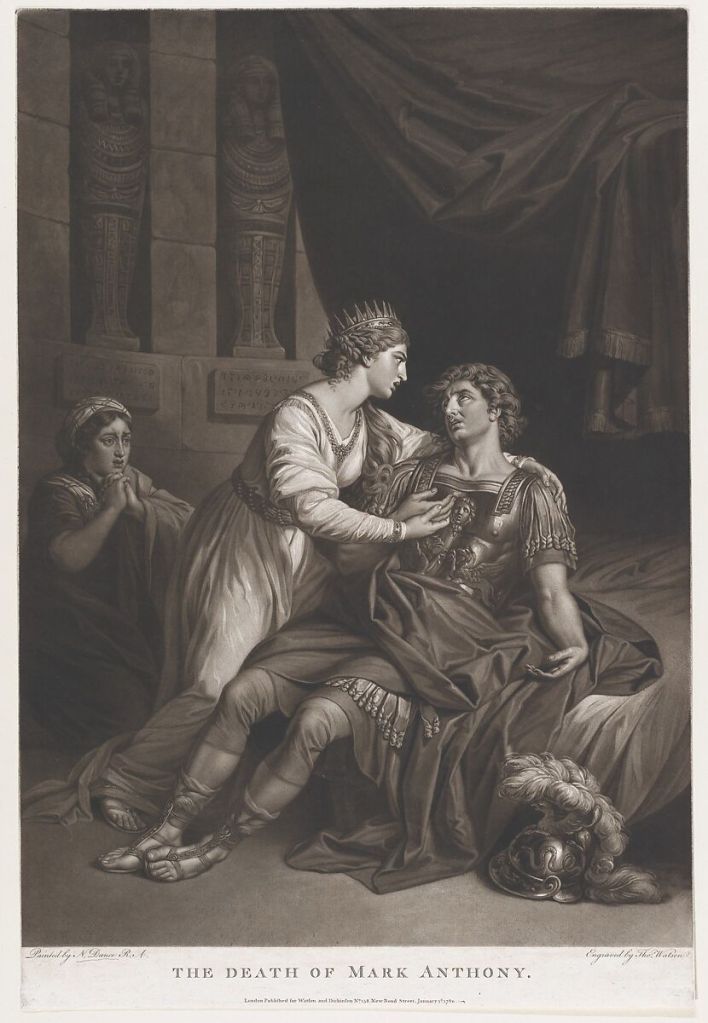
Antony stabbed himself with his sword, and although terribly injured, the wound failed to kill him. Cleopatra heard what had happened and hurrriedly had him brought to her. The palace was sealed and locked shut so she and her two female maid-servants pulled the dying Antony up through a first storey window using ropes. He was smeared in his own blood and in agony, dying shortly after, leaving Cleopatra distraught.
Octavian soon arrived at the palace and found the queen in her bedchamber. Plutarch again:
She had abandoned her luxurious style of living, and was lying on a pallet bed wearing only a tunic, but, as he entered, she sprang up and threw herself at his feet, her hair was unkempt and her expression wild, while her eyes were shrunken and her voice trembled uncontrollably…
Cleopatra begged Octavian for her life, but he gave her no firm answer. During this private meeting with her, he gave her two days in which to kill herself, or be taken to Rome as a prisoner and executed. This was presented as an honourable way out for the Egyptian Queen, and perhaps she took it. It is most likely Octavian didn’t want to parade her in chains as a prisoner of war on his triumphant return to Rome, as this would have probably aroused the sympathy of the Roman citizens, who liked Cleopatra even though she had fought against them.
The Queen of Eygpt saw no other choice. The following day she asked one of her attendants to bring her an Egyptian cobra hidden in a basket of figs, which she then allowed to bite her.
When Octavian heard what had happened, he sent soldiers to burst into the palace. There they found Cleopatra dead, her two attendants, Charmion and Iras, both near death through taking poison.
With Cleopatra dead, Egypt became part of the Roman Empire. Octavian had Caesarion executed, Antonys seventeen year old son by Fulvia, called Antyllus, who was living with his father in Alexandria at the time, was also hunted down and killed, while Alexander Helios, Cleopatra Selene and Ptolemy Philadelphus were brought to Rome to be raised by Octavia the Younger, sister of Octavian. The future Emperor erased all traces of the once glorious couple, no surviving member of Marc Antony’s family was allowed to bear the name Marcus again, and all statues of him in Rome were removed. But Octavian did make one final concession. Honouring her last request, he agreed to allow Cleopatra to be buried in Alexandria, alongside Antony.


 everythinglatin.co.uk
Leave a reply to Mark Cancel reply