
Praise for Tales from Ovid:
‘A breathtaking book…To compare his versions with the Latin is to be awestruck again and again by the range and ingenuity of his poetic intelligence…He rescues the old gods and goddesses from the classical dictionaries and gives them back their terror. There should be a copy of his book in every school’. John Carey Sunday Times
Taken from Tales from Ovid, 24 Passages from the Metamorphoses, published by Faber and Faber Ltd 1997. Copyright Ted Hughes, 1930 -1998
Destiny, not guilt, was enough
For Actaeon. It is no crime
To lose your way in a dark wood.
It happened on an mountain where hunters
Had slaughtered so many animals
The slopes were patched red with the butchering places.
When shadows were shortest and the sun’s heat
hardest
Young Actaeon called a halt
‘We have killed more than enough for the day.’
‘Our nets are stiff with blood,
Our spears are caked, and our knives
Are clogged in their sheaths with the blood of a
glorious hunt.
‘Let’s be up again in the grey dawn –
Back to the game afresh. This noon heat
Has baked the stones too hot for a human foot.’
All concurred. And the hunt was over for the day.
A deep cleft at the bottom of the mountain
Dark with matted pine and spikey cypress
Was known as Gargaphie, sacred to Diana,
Goddess of the hunt.
In the depths of this goyle was the mouth of a cavern
That might have been carved out with deliberate art
From the soft volcanic rock.
It half-hid a broad pool, perpetually shaken
By a waterfall inside the mountain,
Noisy but hidden. Often to that grotto,
Aching and burning from her hunting,
Diana came
To cool the naked beauty she hid from the world.
All her nymphs would attend her.
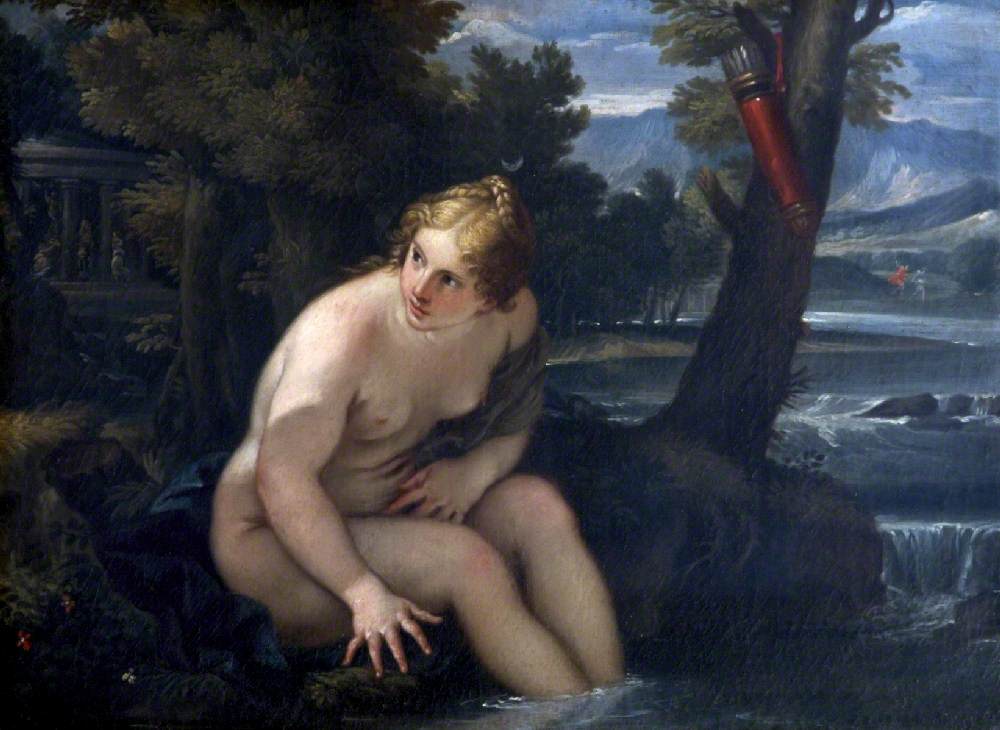
One held her javelin,
Her quiverful of arrows and her unstrung bow.
Another folded her cape.
Two others took off her sandals, while Crocale
The daughter of Ismenus
Whose hands were the most artful, combing out
The goddess’ long hair, that the hunt had tangled,
Bunched it into a thick knot,
Though her own hair stayed as the hunt had scattered it.
Five others, Nephele, Hyale, Phiale
Psecas and Rhanis, filled great jars with water
And sluiced it over Diana’s head and shoulers.
The goddess was there, in her secret pool,
Naked and bowed
Under those cascades from the mouths of jars
In the fastness of Gargaphie, when Actaeon,
Making a beeline home from the hunt
Stumbled on this gorge. Suprised to find it,
He pushed into it, apprehensive, but
Steered by a pitiless fate – whose nudgings he felt
Only as surges of curiosity.
So he came to the clearing. And saw ripples
Flocking across the pool out of the cavern
He edged into the cavern, under ferns
That dripped with spray. He peered
Into the gloom to see the waterfall –
Byt what he saw were nymphs, their wild faces
Screaming at him in a commotion of water.
As his eyes adjusted, he saw they were naked,
Beating their breasts as they screamed at him.
And he saw they were crowding together
To hide something from him. He stared harder.
Those nymphs could not conceal Diana’s whiteness,
The tallest barely reached her navel. Actaeon
Stared at the goddess, who stared at him.
She twisted her breasts away, showing him her back.
Glaring at him over her shoulder
She blushed like a dawn cloud
In that twilit grotto of winking reflections,
And raged for a weapon – for her arrows
To drive through his body.
No weapon was to hand – only water.
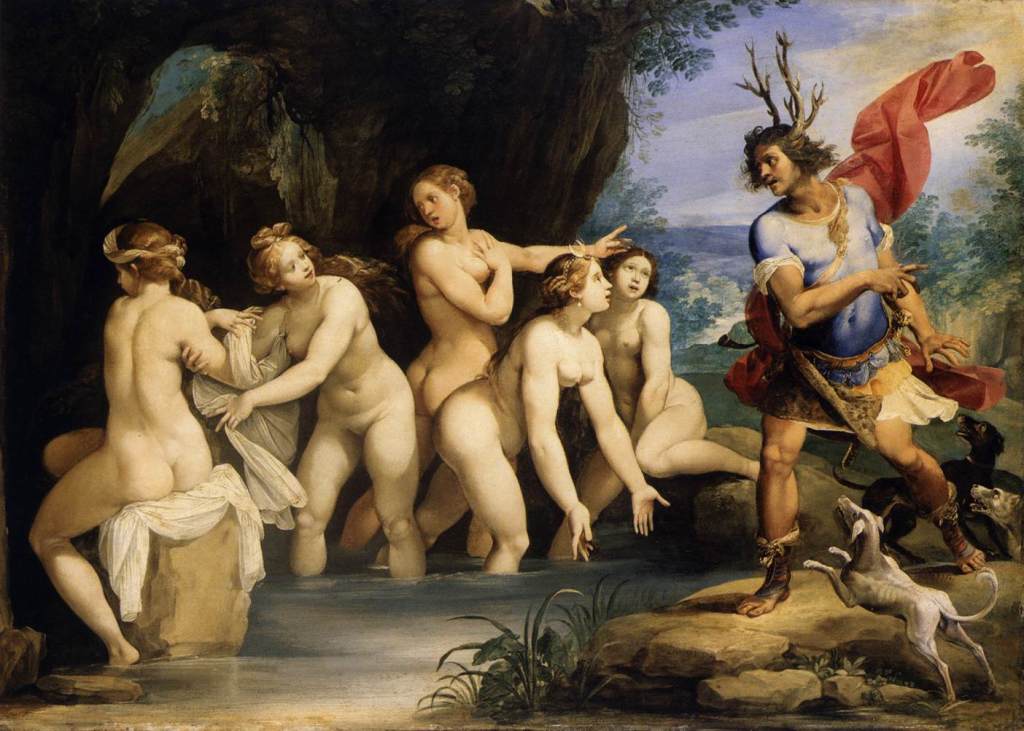
So she scooped up a handful and dashed it
Into his astonished eyes, as she shouted:
‘Now, if you can, tell how you saw me naked.’
That was all she said, but as she said it
Out of his forehead burst a rack of antlers.
His neck lengthened, narrowed, and his ears
Folded to whiskery points, his hands were hooves,
His arms long slender legs. His hunter’s tunic
Slid from his dappled hide. With all this
The goddess
Poured a shocking stream of panic terror
Through his heart like blood. Actaeon
Bounded out across the cave’s pools
In plunging leaps, amazed at his own lightness.
And there
Clear in the bulging mirror of his bow-wave
He glimpsed his antlered head,
And cried; ‘What has happened to me?’
No words came. No sound came but a groan.
His only voice was a groan.
Human tears shone on his stags face
From the grief of a mind that was still human.
He veered first this way, then that.
Should he run away home to the royal palace?
Or hide in the forest? The thought of the first
Dizzied him with shame. The thought of the second
Flurried him with terrors.
But then, as he circled, his own hounds found him.
The first to give tongue were Melampus
And the deep thinking Ichnobates.
Malampus a Spartan, Ichnobates a Cretan.
The whole pack piled in after.
It was like a squall crossing a forest.
Dorceus, Pamphagus and Oribasus –
Pure Arcadians. Nebrophonus,
Strong as a wild boar, Theras, as fierce.
And Laelaps never far from them. Pterelas
Swiftest in the pack, and Agre
The keenest nose. And Hylaeus
Still lame from the rip of a boars tusk.
Nape whose mother was a wolf, and Poemenis –
Pure sheep dog. Harpyia with her grown up pups,
Who still would never leave her.
The lanky hound Ladon, from Sicyon
With Tigris, Dromas, Canace, Sticte, and Alce,
And Asbolus, all black, and all-white Leuca.
Lacon was there, with shoulders like a lion.
Aello, who could outrun wolves, and Thous,
Lycise, at her best in a tight corner,
Her brother Cyprius, and black Harpalus
With a white star on his forehead.
Lachne, like a shaggy bear cub. Melaneus
And the Spartan-Cretan crossbreeds
Lebros and Agriodus. Hylactor,
With the high, cracked voice, and a host of others,
Too many to name. The strung out pack,
Locked on to their quarry,
Flowed across the landscape, over the crags,
Over cliffs where no man could have followed,
Through places that seemed impossible.
Where Actaeon had so often strained
Every hound to catch and kill the quarry,
Now he strained to shake the same hounds off –
His own hounds. He tried to cry out:
‘I am Actaeon – remember your master,’
But his tongue lolled useless, while the air
Belaboured his ears with hounds ‘voices.
Suddenly three hounds appeared, ahead,
Raving towards him. They had been last in the pack.
But they had thought it out
And made a short cut over a mountain.
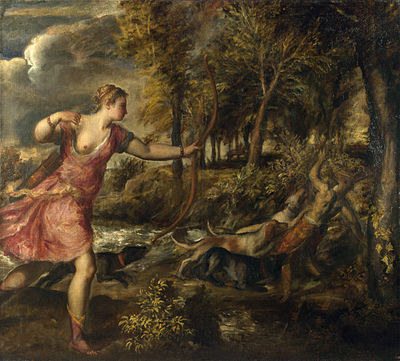
As Actaeon turned, Melanchaetes
The ringleader of this breakaway trio
Grabbed a rear ankle
In the trap of his jaws. Then the others,
Theridamus and Oristrophus, left and right,
Caught a foreleg each, and he fell.
These three pinned their master, as the pack
Poured onto him like an avalanche.
Every hound filled its jaws
Till there was hardly a mouth not gagged and crammed
With hair and muscle. Then began the tugging and the
ripping.
Actaeon’s groan was neither human
Nor the natural sound of a stag.
Now the hills he had played on so happily
Toyed with the echoes of his death-noises.
His head and antlers reared from the heaving pile.
And swayed – like the signalling arm
Of somebody drowning in surf.
But his friends, who had followed the pack
To this unexpected kill,
Urged them to finish the work. Meanwhile they
shouted
For Actaeon – over and over for Actaeon
To hurry and witness this last kill of the day –
And such a magnificent beast –
As if he were absent. He heard his name
And wished he were as far off as they thought him.
He wished he was amongst them
Not suffering this death but observing
The terrible method
Of his murderers, as they knotted
Muscle and ferocity to dismember
Their own master.
Only when Actaeon’s life
Had been torn from his bones, to the last mouthful,
Only then
Did the remorseless anger of Diana
Goddess of the arrow, find peace.
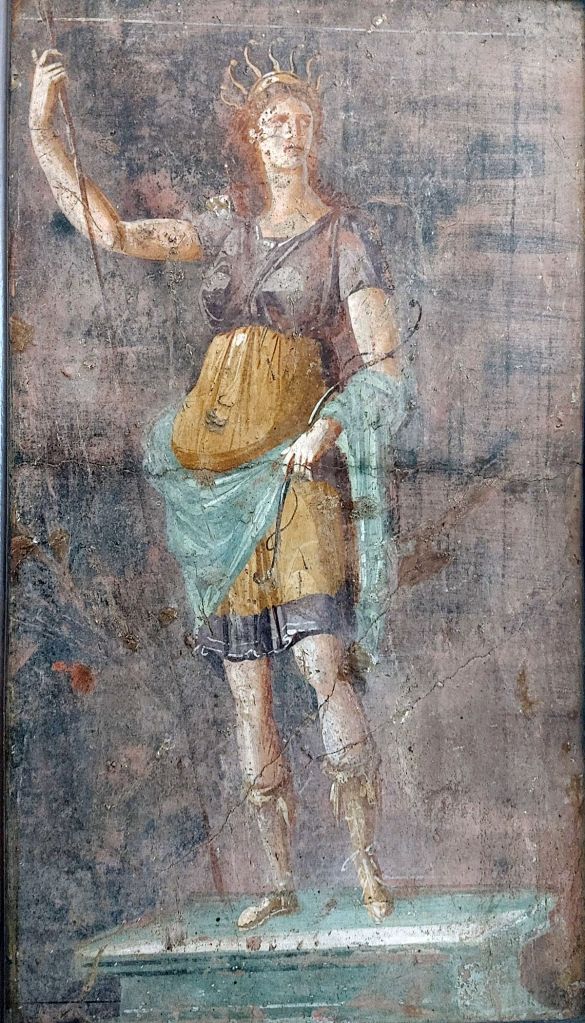
Roman fresco showing Diana, the goddess of hunting, animals and forests.
National Archaeological Museum in Naples


Leave a Reply