
A thermal bath complex is latest discovery among ruins of Italian city destroyed by Vesuvius eruption in AD79
Angela Giuffrida in Rome, 17th January 2025
A large and sophisticated thermal bath complex that was believed to have been used by its owner to pamper well-heeled guests has been discovered among the ruins of ancient Pompeii.
The baths were found during excavations of a home on Via di Nola in Regio IX, a wealthy district of the city before it was destroyed by the AD79 eruption of Mount Vesuvius.
The home spa is one of the largest of a handful of its kind found so far at the Pompeii archaeological park in southern Italy.
The complex was connected to an exquisite banquet room replete with frescoes depicting characters inspired by the Trojan war that was unearthed last year, leading experts to conclude that the dwelling, believed to have belonged to a member of Pompeii’s elite, was used as a stage for the owner to affirm their social status, possibly even to promote candidacy in elections.

“It’s an example of how the Roman domus served as a stage for an art and culture show, which the owner staged in order to gain votes or ingratiate himself with the goodwill of the guests,” said Gabriel Zuchtriegel, the director of Pompeii archaeological park.
The spa complex was equipped to host up to 30 people, who would have moved between three pools: the caldarium (hot), the tepidarium (lukewarm) and the frigidarium (cold). The cold room, which contained a courtyard with a portico, was particularly impressive, the experts said.
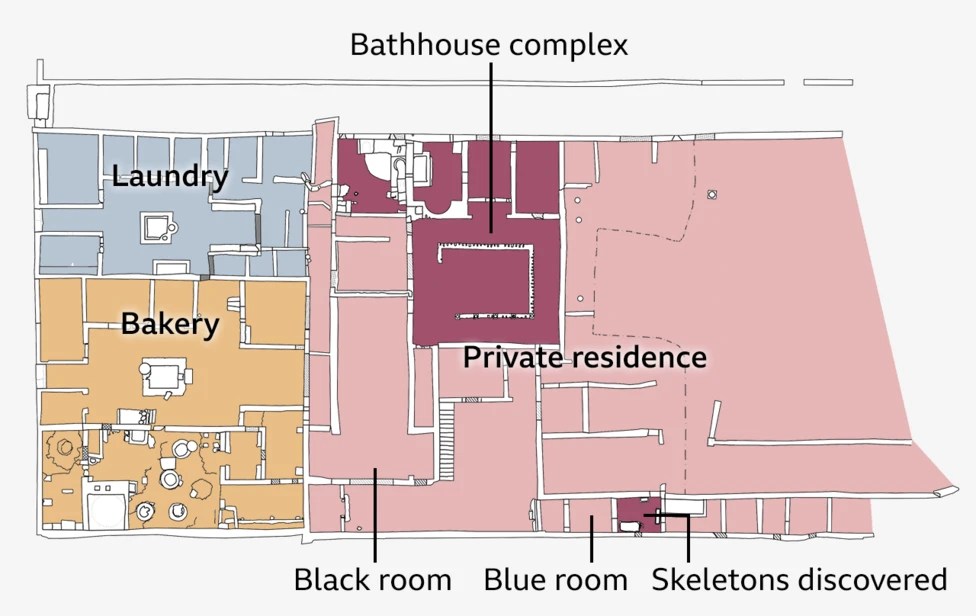
The baths are believed to have provided guests with an opportunity to relax after the sumptuous banquets. “Everything was functional to the staging of a ‘show’, at the centre of which was the owner himself,” Zuchtriegel said.
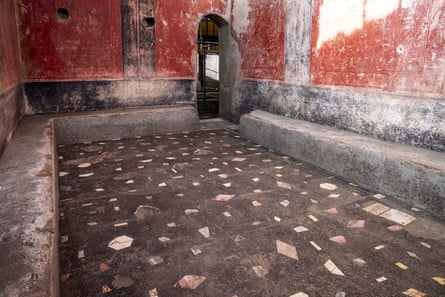
The banquet room is known as the black room because of the colour of its walls, which were probably intended to mask the soot from burning oil lamps. The walls are adorned with artworks featuring mythical Greek characters, including one of Helen of Troy meeting Paris, the prince of Troy, for the first time.
The room also opens on to a courtyard with a long staircase leading to the property’s first floor. On the arches of the staircase, there is a charcoal drawing of two pairs of gladiators and what archaeologists said appeared to be “an enormous stylised phallus”.
Excavations in Regio IX have yielded plenty of other discoveries since they began in February 2023, including a home containing a cramped bakery where enslaved people were believed to have been imprisoned and made to produce bread.
In one room, the skeleton of a woman was found lying on top of a bed, curled up in a foetal position. The body of a man was in the corner of this small room.
“The pyroclastic flow from Vesuvius came along the street just outside this room, and caused a wall to collapse, and that had basically crushed him to death,” explains Dr Sophie Hay, an archaeologist at Pompeii.
“The woman was still alive while he was dying – imagine the trauma – and then this room filled with the rest of the pyroclastic flow, and that’s how she died.”

Analysis of the male skeleton showed that despite his young age, his bones had signs of wear and tear, suggesting he was of lower status, possibly even a slave. The woman was older, but her bones and teeth were in good condition.
“She was probably someone higher up in society,” says Dr Hay. “She could have been the wife of the owner of the house – or maybe an assistant looking after the wife, we just don’t know.”
An assortment of items were found on a marble table top in the room – glassware, bronze jugs and pottery – perhaps brought into the room where the pair had tucked themselves away hoping to wait out the eruption.
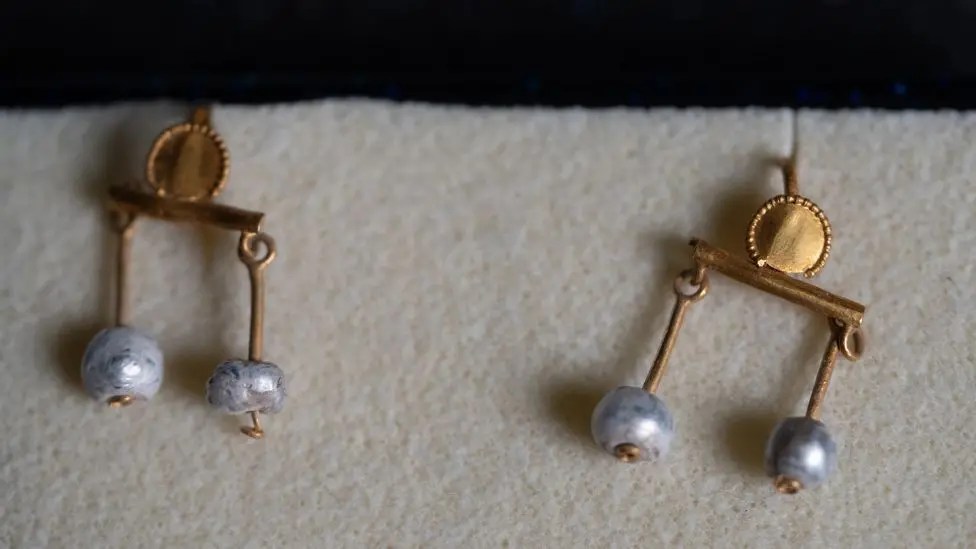
But it’s the items clutched by the victims that are of particular interest. The younger man held some keys, while the older woman was found with gold and silver coins and jewellery.
“The most powerful thing from these excavations is that stark contrast between the lives of the slaves and the very, very rich. And here we see it,” says Dr Sophie Hay.
“The difference between the sumptuous life of the bathhouse, compared to the furnace room, where the slaves would be feeding the fire toiling all day.
“A wall is all that could divide you between two different worlds.”

The excavation is in its final weeks – but new discoveries continue to emerge from the ash. Limited numbers of visitors are allowed to visit the dig while it’s ongoing, but eventually it will be fully opened to the public.
“Every day here is a surprise,” says Dr Anna Onesti, director of the excavation.
“Sometimes in the morning I come to work thinking that it’s a normal working day – and then I discover we found something exceptional.
“It’s a magic moment for the life of Pompeii, and this excavation work offers us the possibility to share this with the public.”
 everythinglatin.co.uk
Leave a comment