
Caligula Appointing His Horse Incitatus to the Consulship, unknown author, 1616–1669, The Art Institute Chicago.
Caligula, who lived from 12 BC to 24 AD is one of the most well known Roman emperors, but for all the wrong reasons. Everyone has heard the horror stories, from his incestuous relationship with his sister, his madness, and most bizarrely of all naming his horse a Roman consul and declaring himself a living god. But those stories come from a few prominent senators who utterly despised Caligula’s autocratic style of rule. Caligula was a boy-emperor who was unprepared for the throne, and his name was forever blackened by his enemies for ridiculing them and the traditional order.
He was named Gaius Julius Caesar, and was born to the popular Roman general Germanicus and Agrippina the Elder, who belonged to the prestigious Julio-Claudian dynasty. Germanicus was the adopted son of the emperor Tiberius, (who was the adopted son of the late emperor Augustus – confusing isn’t it!) and Agrippina was the daughter of Marcus Vipsanius Agrippa and Julia the Elder, the daughter of the first emperor Augustus. Gaius was, therefore, the great-great-grandson of Julius Caesar.
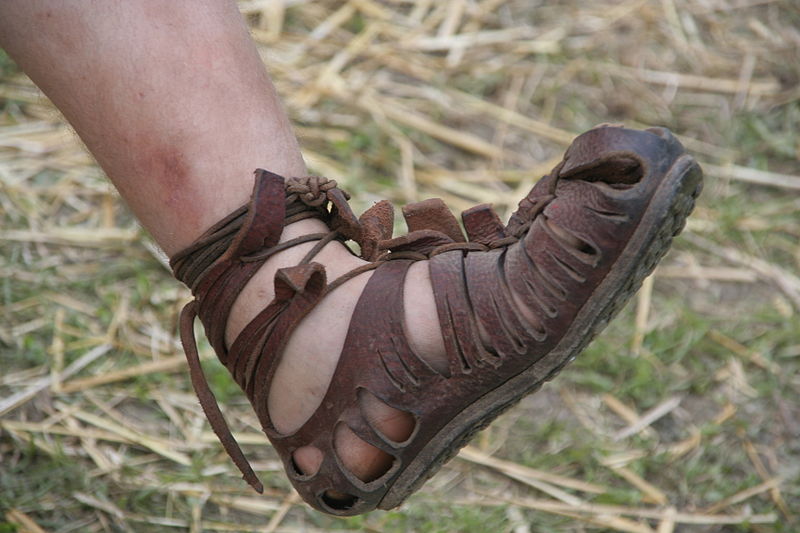
As a child Gaius spent his childhood accompanying his father on military campaigns, and soon became a favourite of the legionnaries. They dressed him up in a little soldier’s outfit, and a small pair of the boots they wore on campaign – caligae. From then on, Gaius was known as Caligula – “little boots.” But as he grew up he hated the nickname and demanded to be called by the name he shared with his famous ancestor – Gaius Julius Caesar.
Caligula’s father Germanicus was hugely popular but when he arrived in Egypt in AD 19 he subsequently fell ill with malaria, although he was convinced he had been poisoned by a fellow army general Piso. Germanicus died on the 10th October his death arousing great suspicion, and believing he would be found guilty and executed, Piso killed himself while facing trial. Tacitus writes that Tiberius was involved in a conspiracy against Germanicus, and his jealousy and fear of his adopted son’s popularity was the motive. Germanicus’ death affected Tiberius’s popularity in Rome, and helped lead to the creation of a climate of fear.
Tiberius then ordered the imprisonment and execution of Agrippina and her other two sons. The main culprit was most probably Sejanus, a member of the Praetorian Guard, who convinced Tiberius that Caligula’s entire family was threatening his position as emperor. Only the young Caligula now survived.
Tiberius now summoned the young lad to his grand villa on the island of Capri where, while Caligula was held hostage, he was drawing up plans to make him his heir. For the next six years Caligula lived under the watchful eye of the paranoid Emperor, terrifying times for a young man who had seen his whole family murdered, and who could not leave his island prison. Then on 17th March 37 AD, Tiberius died. Suddenly, Caligula was no longer a hostage, but Emperor of Rome.
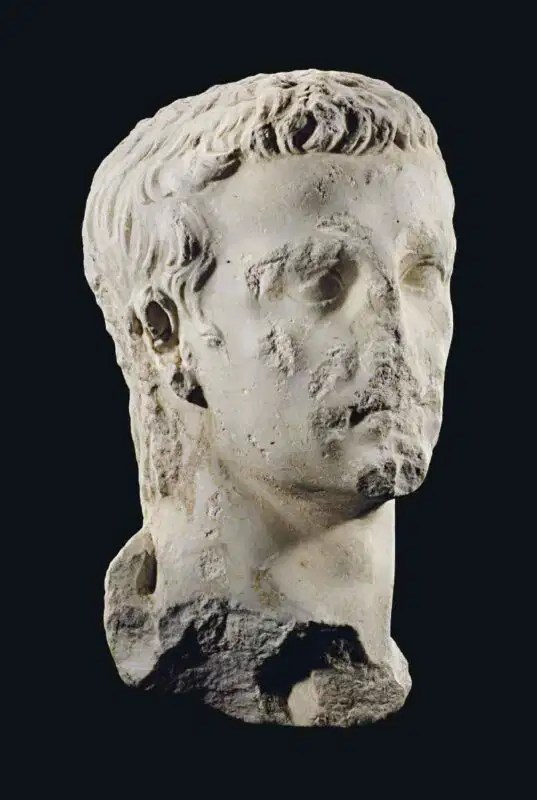
The first year of his reign went well. As an ancestor of Caesar, Caligula was extremely popular with the ordinary people. Better still, unlike the paranoid and secluded Tiberius, the new Emperor made Rome his base and became a charismatic leader. Upon taking the throne, he ended some unpopular trials, granted amnesties, and abolished unfair taxes. He also organised gladiatorial games and chariot races, which the people loved him for. The Hellenistic Jewish philosopher Philo of Alexandria said, Caligula was the first emperor admired by everyone ”in all the world, from the rising to the setting sun.”
Infastructure building began immediately, he built temples, began the construction of new aqueducts to ensure the water supply of the rapidly growing capital city, and built a new amphitheater in Pompeii. Caligula also improved the port at Ostia near Rome, to ensure more grain could be imported from Egypt in case of famine, a recurrring theme in Rome.
However, things soon went quickly wrong when Caligula fell seriously ill. He may have suffered from epilepsy, a condition that plagued both Julius Caesar and Emperor Augustus, and for which there was no cure. Caligula remained bedridden for three months, and the whole of Rome prayed for his recovery. Yet, when Caligula finally arose from his sickbed, he was a different man. Something in his character had changed, his moods were darker, and the rest of his reign was marked by paranoia and instances of cruelty.
Caligula despised the Senate. Because of his illustrous ancestry, he saw the Senate as too powerful, and responsible for his great-great-grandfather’s death. Determined to flex his muscles, the emperor abandoned policies of his predecessors, and had executed individual senators he perceived as a threat to his rule. Although he was not acting any differently to either Augustus or Tiberius, who had each imprisoned and executed political opponents they thought dangerous, his obvious hatred of the Senate put him on a fatal collision course with some very powerful and unscrupulous men.
Caligula now started to seriously upset people in positions of power. The story of promoting his horse, Incitatus (meaning swift) to a consul, was seen as a snub – it was meant to show the senators how meaningless their job was, even a horse could do it! Humorous to us nowadays, but in ancient Rome it was scandalous and very insulting. Another scandal involved Caligula having sex with his sister at a banquet while the mortified guests looked on. His favourite sister was Drusilla, whom upon her early death, he proclaimed a goddess, but according to the historian Tacitus, born fifteen years after Caligula’s death, the incestual relationship was nothing but a nasty rumour. Again, it is Philo of Alexandria, a guest at the banquet in question, who sheds some light on what really happened (or didn’t), as he never mentioned any such kind of behaviour. It is very likely that the senators who hated Caligula so much saw the natural closeness of their relationship and exploited it, spreading this vicious propaganda solely to vilify him.
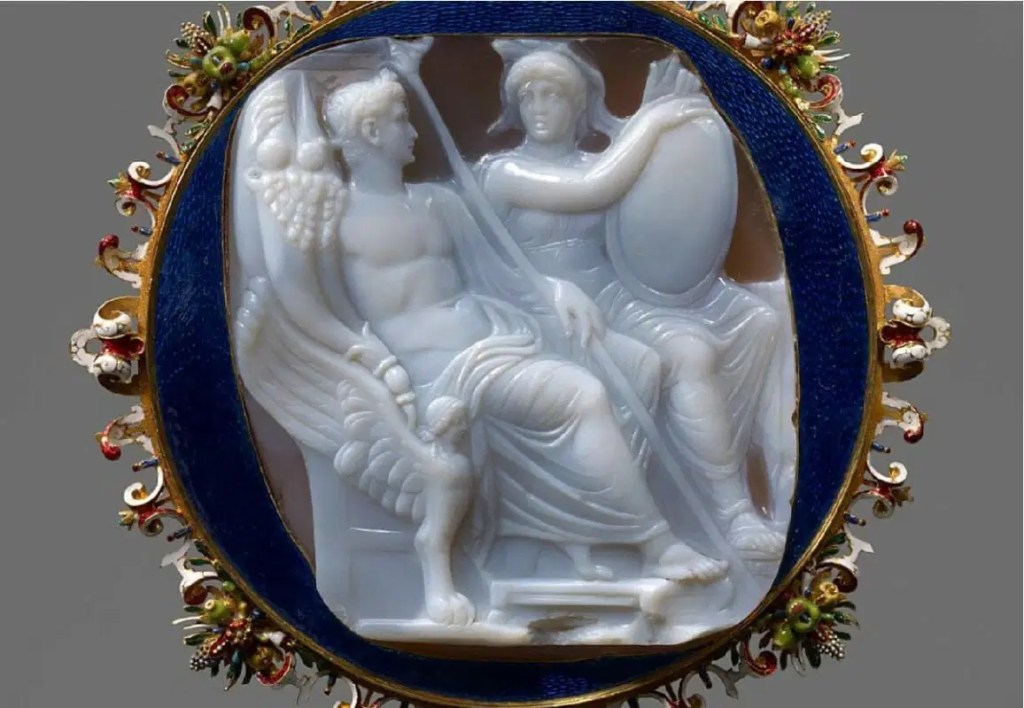
Caligula, known now as “the Living God,” had the support of the people and the army, but was too inexperienced in the savagery of Roman politics to fight the Senate. The senators had connections, and although Caligula was emperor, they had behind the scenes a vice like grip on power. The Senate however could do nothing as long Caligula was protected by the Praetorian Guard. But, when Caligula insulted one of the Praetorians, an experienced officer named Cassius Chaerea, whom Caligula was said to have frequently taunted for his weak, effeminate voice, the Senate got a rare opportunity to go on the offensive. His killers, led by Chaerea, confronted him in an underground corridor at the imperial palace, where he had been hosting the Palatine Games.

Allegedley, Caligula was stabbed 30 times, that being the number of knife wounds it was believed were inflicted on Julius Caesar, his famous ancestor. Caligula’s killers also stabbed his wife to death and killed his two year old daughter by bashing her head against a wall, thereby preventing any possibility of a legitimate succession. With Caligula and his family lying dead, the senators briefly considered the abolition of the monarchy and the restoration of the Republic. But then one of the Praetorian Guards found Caligula’s uncle, the 50 year old Claudius cowering behind a curtain and bizarrely (although some stories say Claudius, in fear of his life, promised the Praetorians a hefty pay rise) proclaimed him the new emperor.
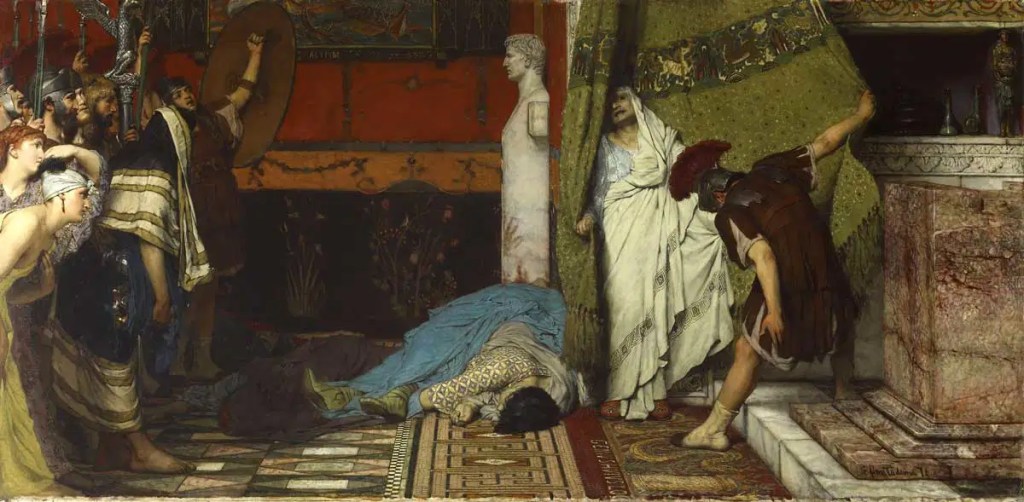
The Senate’s plan to reinstate the Republic failed, and Chaerea and three of the other guards involved in the murder were executed, along with an innocent senator who had somehow got mixed up in the affray and had managed to get bloodstains from Caligula’s corpse onto his toga. The new emperor Claudius proved a relatively able ruler, despite at times being quite ill (he was possibly suffering from cerebral palsy, he had a limp and a speech impediment, which his family considered a sign of weakness, his mother calling him “a monstrosity of a human being, one that nature began and never finished”), overseeing amongst other things the invasion of Britannia.
Yet the Senate had the final say, and the same with Caligula’s nephew the emperor Nero, because the men behind the scenes were the ones who wrote, or rewrote history, and they continued to blacken the name of the ill-fated rulers they set out to destroy, to strengthen their own positions either in the Senate or the Praetorian Guard. Such were the politics of ancient Rome. Thus Gaius Julius Caesar, an ordinary, capable, but very ill and damaged young man was painted as cruel, perverted, insane, therefore unfit to be emperor, and so was marked down for killing.


 everythinglatin.co.uk
Leave a reply to jdstayt Cancel reply