
The Ides of March (15th) 44 BC, was the day Julius Caesar was assassinated in Rome by a group of disgruntled Senators, and is one of the most consequential dates in history, an event that lead to thirteen years of calamitous civil war, and the subsequent founding of the Roman Empire.
Rome’s republican government had been created with a city-state in mind, not an empire, and as Rome expanded overseas, first in it’s conquest of Sicily, then against the Carthagenians, and the later campaigns in Gaul and Parthia, her system started to collapse under the strain of trying to cope. She was constantly bullied by ambitious men who has amassed great wealth and loyal armies abroad, and who were unwilling to give up those trappings of power when they returned home. The last, and the greatest of these, was Julius Caesar.
His crossing of the Rubicon on January 10th, 49 B.C, on his recall to Rome after being declared an enemy of the state, was an event that practically declared civil war, eventually resulting in the defeat of his adversary Pompey the Great at The Battle of Pharsalus in August 48. The civil war was not only Caesar’s fault, the conflict had been brewing for decades. It was the system, quite literally collapsing.
Caesar held dictatorship in 48 and 47, and then he became dictator for ten years in 46. Throughout this period he defeated the remaining pockets of resistance that held out to him, but after their surrender he frequently showed them clemency (clementia), giving them pardons for having stood against him. When he advocated mercy for Catiline during the famous conspiracy trial, after Cicero had advocated the conspirators execution, it enraged his opponents.
His position secure, he was named dictator perpetuo (dictator for life) in January 44 BC. Caesar’s fellow aristocrats and members of the powerful senate, strongly believed that the Republic should be based upon competition for office among social and political equals. His becoming dictator perpetuo stood against all they had ever fought for.
As Dictator, Caesar was at first, very popular with the ordinary citizens of Rome, having been born in the poor part of the city, the Suburra, and having courted them throughout his political and military career. His bloody conquest of Gaul, and his short, but fascinating diversions to Britain were also received well back home. This annoyed the senate further, this rousing of the plebs for someone whom they saw as an ambitious upstart, against their established rule.
Caesar made probably his greatest mistake at the festival of the Lupercalia in February 44. Whilst he sat in a gilded chair, he allowed his closest ally Mark Antony, to pretend to crown him, drawing derision from Cicero who mocked Antony in one of his Phillipics, and jeers from the crowd. Although Caesar refused to accept the crown, saying ‘I am not king, I am Caesar’, the inference was clear to many, the man was becoming a tyrant.
The public support for Caesar was starting to wane: he was seen dealing with official papers at the games instead of enjoying them as he should of done, and the historians Plutarch, Appian, and Cassius Dio all reported at this time, seeing graffiti glorifying Marcus Junius Brutus’ ancestor, Lucius Junius Brutus (who expelled the last king of Rome in 509 BC), and rude and derogatory comments were made to him in the open-air courts of Rome that he was failing to live up to his ancestor’s example.
Despite the growing resentment against him, Caesar ignored his friends’ pleas to employ a bodyguard, in fact he had earlier dismissed his retinue. This attitude reflected his confidence in his political power, and a stated preference not to dodge death when it came, but to meet it head on, and hope it was a swift end. The irony was that it later transpired, many of his killers had been former opponents of his in the civil war, men he had pardoned.
Some have said that perhaps Caesar was growing weary of life, such was his disregard for the opinion of others. He seemed to realise at last, that the authority on which he claimed his legitimacy was nothing but his own bravado and the shortcomings of the Republic. Or perhaps he thought he had achieved all he could, and his success was unfulfilling to him, and no longer of importance. Either way, it couldn’t last.
The discontent that led to a plot to murder Caesar had been brewing for months, but a serious plan was now hatched by a group of senators, led by Marcus Brutus and Cassius Longius, both of whom Caesar had pardoned, and who were determined to kill him, as they believed he had become a despot. The number of conspirators is unknown, but possibly 60 people knew of the plot, although only about 15 of them were present at the time of the murder.
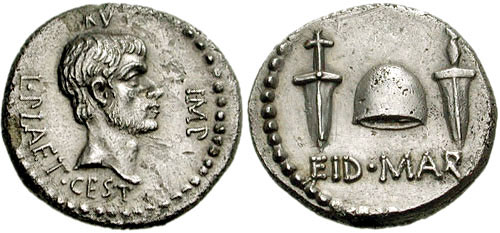
A meeting of the senate was due to take place on 15 March, 44. The venue was the Temple of Venus, a building attached to the grand theatre complex built by Pompey in 55, as the usual meeting house, the Curia Julia was closed for renovation.
Caesar had received warnings before of threats to his life, but ignored them. The night before his assassination, his wife Calpurnia dreamed that Caesar had been stabbed, and lay bloodied and dying in her arms. That morning, she begged him not to leave the house, and he decided to remain at home. But Decimus Junius Brutus, one of Caesar’s closest friends, whom he had recently appointed Praetor Peregrinus (magistrate), and secretly one of the conspirators against him, came to his house and persuaded him to ignore the omens, and go to the senate. The soothsayer Spurinna foresaw danger in a sacrifice Caesar had made earlier, and slipped him a note as he passed him in the street, telling him to be wary of the Ides of March (the 15th). Caesar jokingly said out loud that the Ides had arrived and all was well, but did not read the note. Spurinna quipped back that they had arrived, but were not yet over.
Mark Antony attempted to attend the meeting, but Decimus Brutus deliberately waylaid him in conversation on the Temple steps, so that he would not be able to aid Caesar.
As the meeting started, one of the conspirators, Lucius Tillius Cimber, approached Caesar as if to speak with him, but grabbed his toga by both shoulders and pulled it down to hold Caesar in his chair. Caesar exclaimed ‘truly, this is violence!’ At that point, another conspirator, Casca, stabbed him in the throat. Caesar attempted to defend himself using his stylus, stabbing Cimber in the arm with it, but it was in vain. The other assassins began their attack.
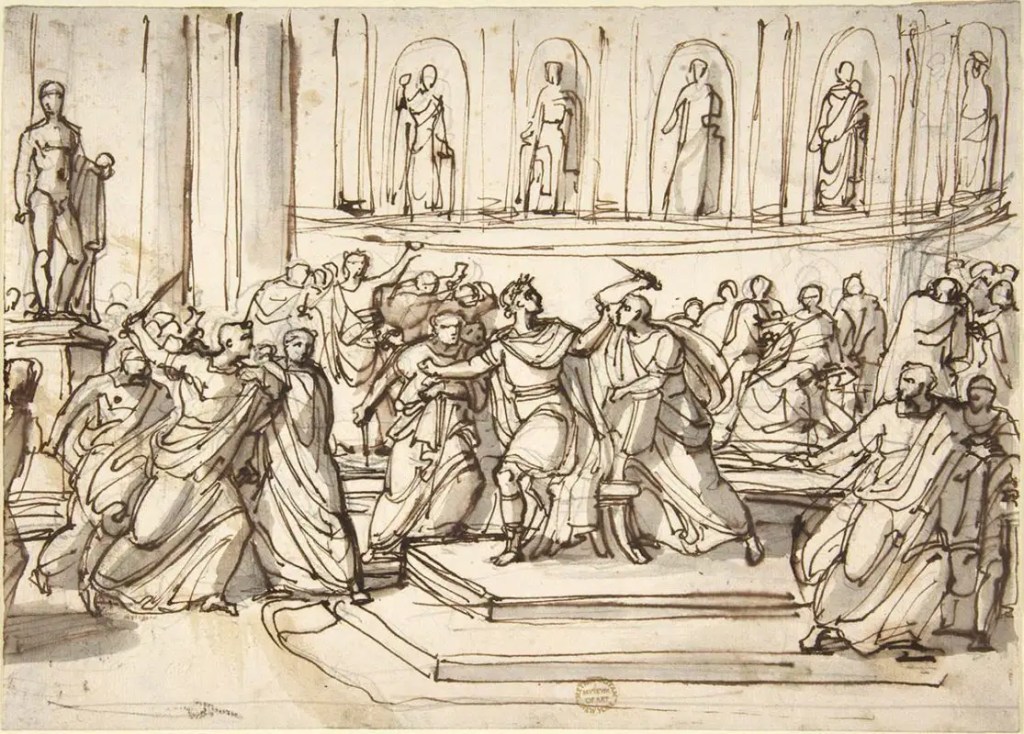
Caesar, surrounded by his assailants, covered his face with his toga, seemingly resigned to his fate. It is said that he was stabbed 23 times, with each assassin landing at least one blow, but only one of them, the one that hit Caesar in the groin, and believed to have been delivered by Marcus Brutus, was fatal. Caesar bled to death beneath the statue of his old rival, Pompey.
The killers fled the scene, and Caesars body lay undisturbed for hours. Finally, the only ones with the courage to walk out onto the deserted streets were the slaves from the home Caesar shared with Calpurnia. Only young boys, rather than grown men, they nonetheless braved the situation and recovered his corpse, placing a sheet over it whilst leaving the face exposed. They then lifted it onto a litter and bore it back to the forum to be cremated. The bones were later collected up and given to Calpurnia.
After the death, an amnesty was temporary declared for the killers. However, Mark Antony whipped the public into a frenzy at Caesar’s funeral by displaying a wax effigy of the brutalized corpse during his funeral oration. The wax statue was then erected at the Forum displaying the 23 stab wounds, and the crowd that had gathered there expressed their fury at the assassins by burning the Senate House down. These Roman lower classes, with whom Caesar was so popular, became enraged that a small group of aristocrats had sacrificed Caesar for, as they saw it, their own ambitions. Antony seized on the grief of the Roman mob and threatened to unleash it on Rome itself, with him installed as it’s new leader, no doubt. But the Dictator had named his grand-nephew Gaius Octavius his sole heir, bequeathing him the immensely popular name Caesar, as well as his personal fortune.
Caesar had also left 300 sestertii, as a token of goodwill, to each citizen of Rome in his will, further increasing their grief and anger at his death. Subsequently the people of Rome flocked to Octavian, the conspirators fled Rome, and a civil war ensued between the new Caesar and Marc Antony.
The assassins, including Marcus Brutus, Cassius Longius, Pacuvius Labeo, Pontius Aquila, Gaius Trebonius, Lucius Tillius Cimber, Minucius Basilus, Cassius Parmensius, and the brothers Casca would all be subjected to a manhunt over the next ten years, tracked down, captured and killed by Octavian, either in cold-blood or on the battlefield, in a pitiless revenge, “visiting with retribution all, without exception,” says Plutarch. Octavian would not be showing them any of his uncle’s famous clementia.
Peter Stothards book The Last Assassin is a great read on Octavians hunt for Caesar’s killers.


 everythinglatin.co.uk
Leave a reply to Octavian Cancel reply