
Romans liked to scrawl their jokes, political opinions, wants and desires, complaints, insults, and their sometimes inane ramblings on the walls of communal toilets and private buildings. Both politicians and prostitutes would advertise there. Much like nowadays then, really. Their graffiti is usually bawdy, lewd, profane, and quite often vulgar, but at the same time they were being brutally honest. A Roman life, for many was often short and tough, especially if you were poor. Whereby today we do not condone graffiti, in ancient times such behaviour was observed not as an act of vandalism but as means of the self-expression of citizens. Not everyone it seems, was so appreciative of that observation.
The Greek historian Plutarch wrote in 100 AD : “There is nothing written in them (graffiti), which is either useful or pleasing – only so-and-so ‘remembers’ so-and-so, and ‘wishes him the best’, and is ‘the best of his friends’, and many things full of such ridiculousness”.
Pompeian walls reveal some of the most private thoughts from the lives of its inhabitants up to it’s destruction in AD 79. More than 11,000 wall writings have been revealed, making it the largest collection of graffiti ever discovered. A lot of the writings do not, as one might imagine come from the seedier part of town, (every town has one), but from wealthy residences.
A team of over 50 researchers from the Ancient Graffiti Project (a digital resource and search engine), have been painstakingly preserving these writings for posterity. So, lets take a look at what the Romans enjoyed writing (and painting) on the walls of their towns and cities, in a selection of the frescos found at Pompeii, and the grafitti scrawled on the walls in and around Pompei, Herculaneum, Rome, and even Athens (which I know isn’t in Italy, but…).
And please be warned, the content of this post is adult in nature.
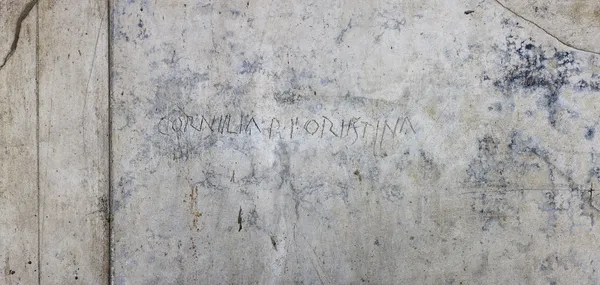
Is this Imperial graffiti? The name of Empress Cornelia Orestina, Caligula’s second wife, scratched on the wall of an antechamber at House of the Centaur Credit: The Archaeological Park of Pompeii
Terry Madenholm, Haaretz – Archaeology, 2021
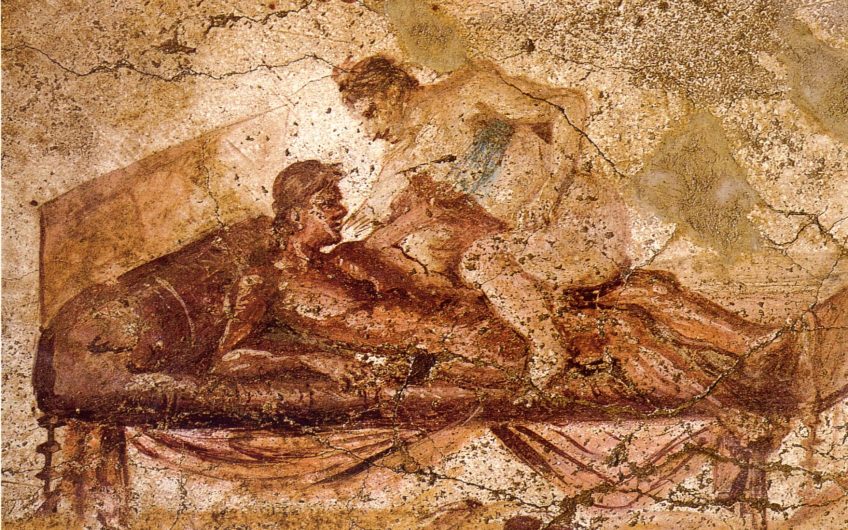
”I screwed a lot of girls here”, and “On June 15th, Hermeros screwed here with Phileterus and Caphisus” – VII.12.18-20 (the Lupinare); 2175: From the walls of the brothel in Pompeii
On the walls of one Pompeii building, a man scribbled “multa mihi curae cum esserit artus has ego macinas, stagna refusa, dabo” – when my worries oppress my body, with my left hand, I release my pent-up fluids
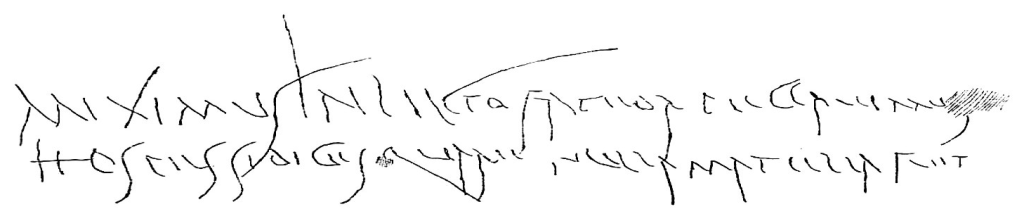
Reproduction of a Pompeian graffiti. The elegiac couplet reads: miximus in lecto, fateor, peccavimus. hospes, / si dices quare, nulla matella fuit. “We’ve pissed the bed; we’ve messed up, truth be told. Visitor, if you ask why, there was no pisspot.”
This one I like:
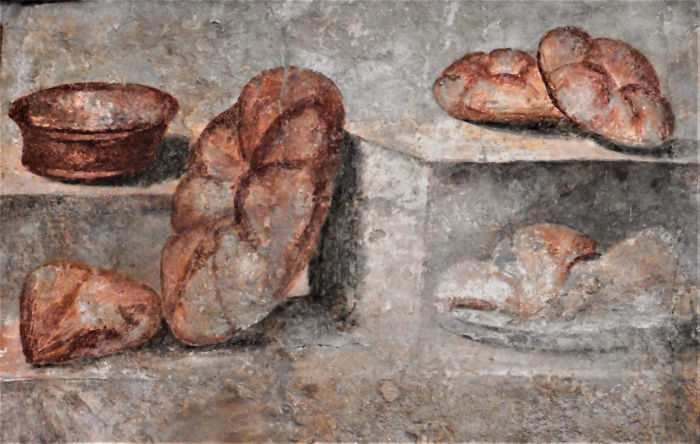
On April 19th, I made bread
This was found in the gladiator barracks of all places!
II.7 ; 8792. Ancient graffit project.
Here’s a wit:
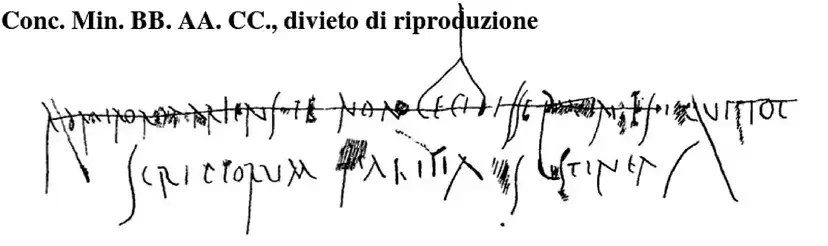
“I’m amazed, oh wall, that you haven’t fallen into ruins since you hold the boring scribbles of so many writers”
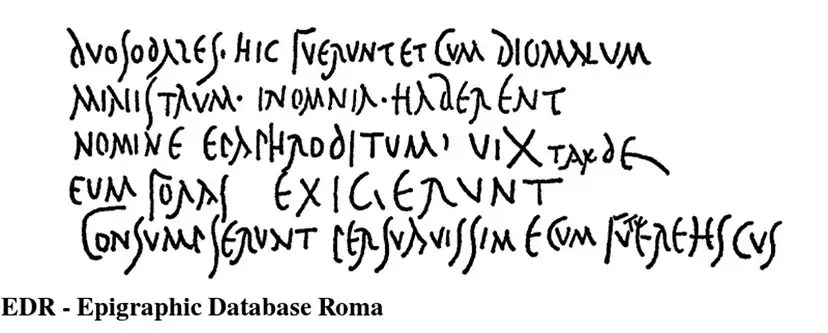
“Two friends were here. While they were, they had bad service in every way from a guy named Epaphroditus. They threw him out and spent 105 and half sestertii most agreeably on whores” – ancient graffiti project

VIII.1 (above a bench outside the Marine Gate); 1751: ‘If anyone sits here, let him read this first of all: if anyone wants a screw, he should look for Attice; she costs 4 sestertii’. Ancient Graffiti Project
A Lover’s Threat – Anonymous
Crescens! – If any rival fucks my woman friend
I pray a bear will bite him in the end.
I mean, I hope the taste of her little fountains
Gives him a taste for walking in the mountains
And as he daydreams of her pulls and pushes
A bear bites off his prick and eats him in the bushes.
Or he goes to the Circus, sits in front, and falls
Onto the sand, and the bear bites off his balls.
[An inscription found in Rome on the Palatine, on the south side of the Slope of Victory, on the fifth arch as you come from the Velabrum. (CIL IV.1645)]
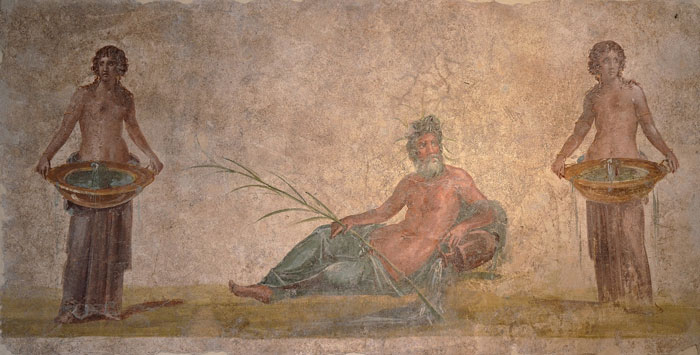
‘In the middle of the night, a slightly inebriated young man, accidentally gets into bed with his own grandmother. When his father finds him there, he gives him a beating for this, but the young man protests, ‘All this time you’ve been fucking my mother, and I never said a word! Now you’re angry at having caught me just the once with your mother?’.
From the fourth century, by Hierocles and Philagrius
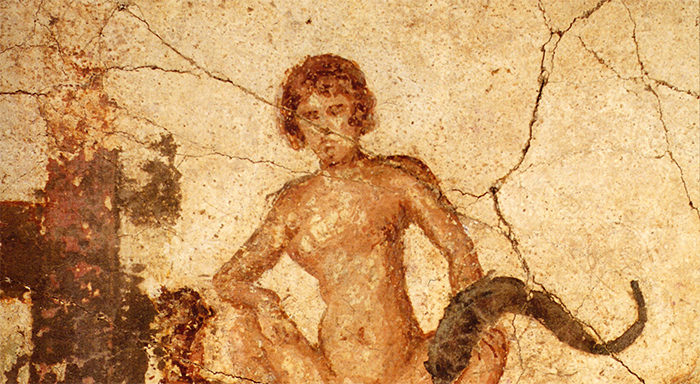
Of the graffiti on the walls of Pompeii, almost two dozen refer to human waste, and the majority of them use some form of the Latin word cacare, which can be translated as “to shit”. The residents of Pompeii (approx. 15,000) produced around half a metric ton of excrement every single day. Taking a poop was usually a communal activity, and so, the average person would have been exposed to quite a lot of faeces on a daily basis.
Scatological Graffiti by Kristina Killgrove on Forbes
“Apollinaris, the doctor of the emperor Titus, shat well here” – The public latrines at Herculaneum
On a water distribution tower in Herculaneum: ‘Anyone who wants to shit in this place is advised to move along. If you act contrary to this warning, you will have to pay a penalty. Children must pay [the number is missing] silver coins. Slaves will be beaten on their behinds’
In the public latrines at Pompeii;
Shitter, may everything turn out okay so that you can leave this place.
Some homeowners living near Pompeii’s amphitheate were obviously getting fed up with people going to the toilet next to their homes. As there weren’t enough public toilets for fans coming to see the gladiatorial bouts, some of the crowd apparently did their business behind the neighbouring houses.
So, some homeowners painted the warning cacator cave malum – ”shitter, beware of misfortune” outside their houses. On one wall, this warning was written in letters almost a meter high.
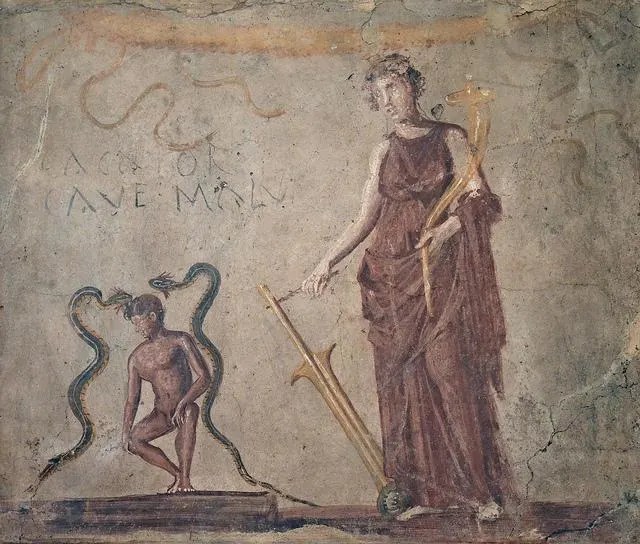
and the words ‘Cacator cave malum’ (Shitter beware of misfortune)
Naples Archaeological Museum, Image by Carole Raddato
The Pompeian citizen Fabius Ululitremulus doing his laundry:
‘Fullones ululamque cano, non arma virumque’ (‘I sing of launderers and howling, not arms and a man’)
Fabius was mis-quoting the most famous line in Roman poetry, the opening to Virgil’s Aeneid:
‘Arma virumque cano’ – ‘I sing of arms and a man’.
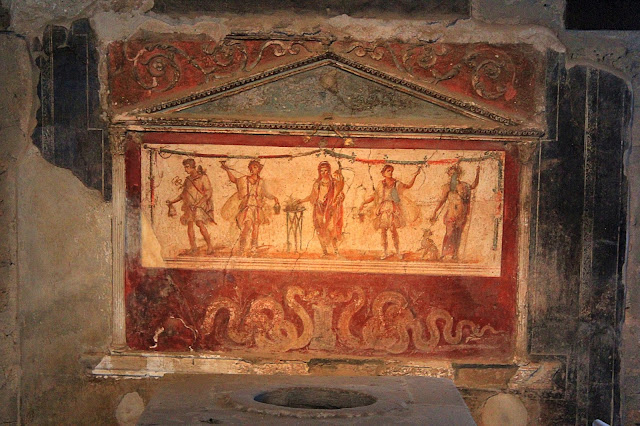
‘Nihil durare potest tempore perpetuo;
Cum bene Sol nituit, redditur Oceano,
Decrescit Phoebe, quae modo plena fuit,
Ventorum feritas saepe fit aura levis’.
Nothing can last for ever;
Once the sun has shone, it returns beneath the sea.
The moon, once full, eventually wanes;
The violence of the winds often turns into a light breeze
One passage on the staircase in the House of Maius Castricius at Pompeii reads:
vasia quae rapui, quaeris formosa puella
accipe quae rapui non ego solus; ama.
quisquis amat valeat
Beautiful girl, you seek the kisses that I stole.
Receive what I was not alone in taking; love.
Whoever loves, may she fare well.
This particular description was found at the marketplace in the Roman Agora in Athens, and is a curse placed on a woman by a former lover:
I bind you, Theodotis, daughter of Eus, to the tail of the snake and to the mouth of the crocodile, and the horns of the ram and the poison of the asp, and the whiskers of the cat and the forepart of the god, so that you cannot ever have intercourse with another man nor be fucked nor be buggered nor fellate, and not do anything for pleasure with another man, if it is not me alone, Ammonion, son of Hermitaris.
Roman graffiti is where criticism, complaints and humour are found bound together. It’s an eclectic mix of the humorous and provocative elements that were present, not only in the Roman world, but also in ours today.
So to finish, let’s quote Ovid’s Metamorphoses, ‘omnia mutantur nihil interit’ – ‘everything changes, nothing perishes’.

 everythinglatin.co.uk
Leave a comment