
Image Credit: Egisto Sani-Flickr
Publius Helvius Pertinax was born of a fairly low status on the 1st August 126 AD. The son of a freed slave, he joined the legions, and after commanding in Syria, Britain, and earning distinction on the Danube and the Rhine during the invasion by German tribes in 169 AD, he found himself promoted with alacrity.
Given senatorial rank he was promoted to the consular commands of Moesia (present-day Serbia), Dacia (present-day Romania), and Syria, but under the egotistical and somewhat demented emperor Commodus, he fell from favour together with his friend Septimius Severus, and both were demoted.
In the last years of Commodus’ life, Pertinax regained some authority and became prefect of the city of Rome, while Severus commanded the armies of the upper Danube. Pertinax also became a member of the Roman Senate, serving at the same time as the historian Cassius Dio.
Although becoming urban prefect, the praetorian prefect Sextus Tigidius Perennis, who had an undue influence over Commodus, forced Pertinax out of the senate, and he had to retire from public life.
Due to his increasingly violent and erratic behaviour, Commodus was assasinated at the age of just 31 in December, 192 AD, by his mistress and two government officials, who employed a professional wrestler named Narcissus to strangle him, after their attempt to poison his food failed. The Senate met hurriedly before dawn and proclaimed Pertinax emperor.
His first job was to attempt to clear the deficit in the public finances by selling of the luxury items amassed by Commodus. Marcus Aurelias, Commodus’ father, had done something similar when he was emperor, when the state required finance after the expense of the war in Germany. Pertinax also attempted to reform the alimenta, a Roman welfare program that existed from around 98 AD to 272 AD. Introduced by Nerva, and later expanded by Trajan, it was designed to subsidise orphans and poor children throughout Italy with an income, food and education, but he faced stiff opposition to his plan.
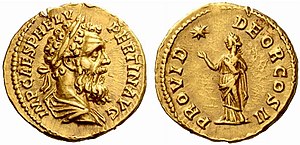
Roman aureus struck during the rule of Pertinax
Unfortunately because he tried to limit the power and privileges of the Praetorian Guard (stationed in Rome, the hand-picked military force established by Augustus protected the civic administrations and rule of law imposed by the Senate, and guarded the emperor and his family), a group of them, worried they were going to be disbanded, broke into the imperial palace and confronted the emperor. Pertinax did not seek refuge and spoke bravely to the soldiers; but one of their number would not listen to reason and attacked him, killing him before cutting off his head and parading it on a spear.
The soldiers then sold off the Empire to the highest bidder, one Didius Julianus, a promising young officer who had been unfairly demoted under Commodus along with Pertinax, who offered 25,000 sesterces to each of the guards (which was over ten years pay), if they would install him as emperor. They gleefully agreed, and upon taking office he reversed the policies of Pertinax, giving back to the Praetorian Guards the privileges that had been recently removed.
This led to a period of civil war known as the “Year of the Five Emperors” (Pertinax, Julianus, Niger, Albinus, Severus). Just 66 days later, when Septimus Severus marched on Rome, routing detachments of Praetorian Guards sent out to defeat him along the way, Julianus was dead, killed by one of his own guards.
Severus then fought a civil war against Pescennius Niger, who challenged him as emperor, and installed Clodius Albinus as co-emperor, to help govern the empire whilst he was away fighting. Severus eventually won the civil war, and Niger was killed fleeing the Battle of Issus (in southeast Anatolia).
Severus now resolved to make himself the absolute master of the Roman Empire, and delared war against Albinus. In February 197 Albinus met the legions of Severus at Lugdunum (modern-day Lyon in France). Cassius Dio tells us it was after a hard-fought battle between almost 300,000 troops, that Albinus was defeated and killed. Severus rode his horse over the body in a final act of humiliation, before executing his wife and two children.
Pertinax was assassinated because of his unpopular reforms, his strict measures against corruption, and his refusal to meet the demands of the Praetorian Guard. Subsequently the Roman currency was devalued, which in turn destroyed confidence in Rome’s financial authority, leading to sky-high rates of inflation and economic upheaval. This series of events created the crisis of the 3rd Century and started the decline of the Roman Empire. Yet again, as in Caesars day, personal greed and corruption had broken the system, and led to war and ruin.
Later, Cassius Dio would write that Pertinax was a conscientious ruler, who wanted to end the corruption in Rome, but lost his life in trying to do the right thing. When Severus finally became emperor at the end of that chaotic year, he decreed divine honours for the slain ruler, executed the assassins, and gave Julianus a damnatio memoriae, approved by the senate. Servus himself adopted the name “Pertinax” as part of his own.
Severus is often known as the African emperor, as he was born in Libya, near present-day Al-Khums, ruling from 193 – 211 AD, and is generally regarded as a responsible leader, giving greater freedom to the provinces, fighting the first ever successful campaign in Parthia, and beginning many construction projects that included aqueducts, baths, and the strengthening of Hadrians Wall. He travelled to Britain in 208 AD, unfortunately dying in Eboracum (modern-day York) in 211 AD of a disease probably caused by the severe gout he had suffered from for many years.


Leave a comment