
In the Capitoline Museum in Rome, there is a room known as the Chamber of the She – Wolf, a small but elaborately designed room of marble walls and mosaic floors. In the centre is a bronze statue of a wolf suckling two human infants, an image that the Romans, ancient and modern revere as a symbol of their city. The two infants are Romulus and Remus, who having been abandoned to die by their mother, were discovered and suckled by the wolf, an animal believed to be a symbol of Mars, now the God of War but originally the God of Fertility.
The accepted story of the twins is well known; after being found by the banks of the Tiber, Romulus and Remus are brought up by the shepherd Faustulus and his wife, Acca Larentia, until as teenagers they decide to find a place of their own. After having a contest in which they ask the gods to help them, they look for a sign from the heavens, and Remus sees six vultures, Romulus sees twelve, and declares himself the winner. After deciding on a spot which would later become known as the Palatine Hill, Romulus starts building the first wall of his new city. Remus, having preferred the Aventine Hill, mocks the wall as being too small and leaps over it, which results in an argument that culminates in Remus being killed by his twin, or perhaps another man named Celer, who wields a shovel. Romulus goes on to be the first king of Rome, a city he names after himself, and the rest as they say, is history.
The Roman historian Livy says in his Ab Urbe Condita (The History of Rome), that a statue of a wolf was erected at the foot of the Palatine Hill in 295 BC. Pliny the Elder mentions the presence in the Roman Forum of a statue of a she-wolf that was “a miracle proclaimed in bronze nearby…”. Cicero also mentions a statue of the she-wolf on the Capitoline that had been struck by lightning in 65 BC: “it was a gilt statue on the Capitol of a baby being given suck from the udders of a wolf.” Cicero also mentions the wolf in De Divinatione (his philosophical dialogue about ancient Roman divination).
Then in 2007 archaeologists discover what they believe to be the very cave where in myth, the wolf suckled the new-borns, and in reality the place where a part of the ancient Lupercalia festival was held.
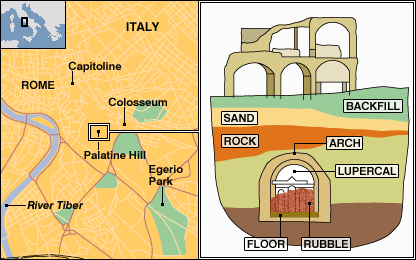
The cave was discovered in January 2007 by Irene Iacopi, the archaeologist in charge of the Palatine Hill, which meets at the Roman Forum and the Coliseum. It was found during restoration work on the palace of the Emporer Augustus, the Domus Livia, after workers found the presence of a cave. Because this sanctuary is under the lower part of the house Augustus lived in is significant, because Augustus was very interested in the myth of Romulus, and wanted himself to be seen as the man who refounded Rome.
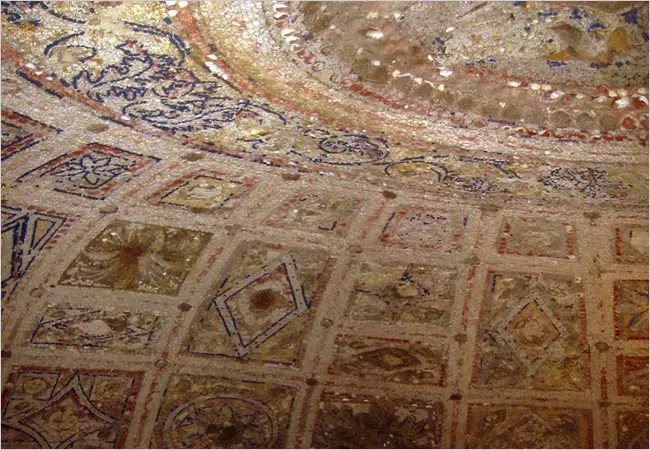
So far no one has set foot inside the cavern, and the photographs taken by a camera probe show a domed roof and walls decorated with extremely well-preserved colored mosaics and seashells. At its center is a painted white eagle, a symbol of the Roman empire, and it measures about 23 feet high and 21 feet in diameter.
The Lupercalia festival was itself a somewhat violent and sexually charged affair that was carried out in two separate locations, firstly in the cave itself and secondly on the Palatine Hill, and was held annually on the 15th February when young nobles called Luperci, taking their name from the wolf (lupa), ran from the Lupercal around the Palatine in what is believed to have been a fertility ritual. Naked, except for the skins of goats that had been sacrificed that day, they would strike women they met on the hands with strips of sacrificial goatskin to promote fertility. These strips of the freshly sacrificed goats were referred to as thongs or februa. This is likely to be where the name for our month of February found its origins.
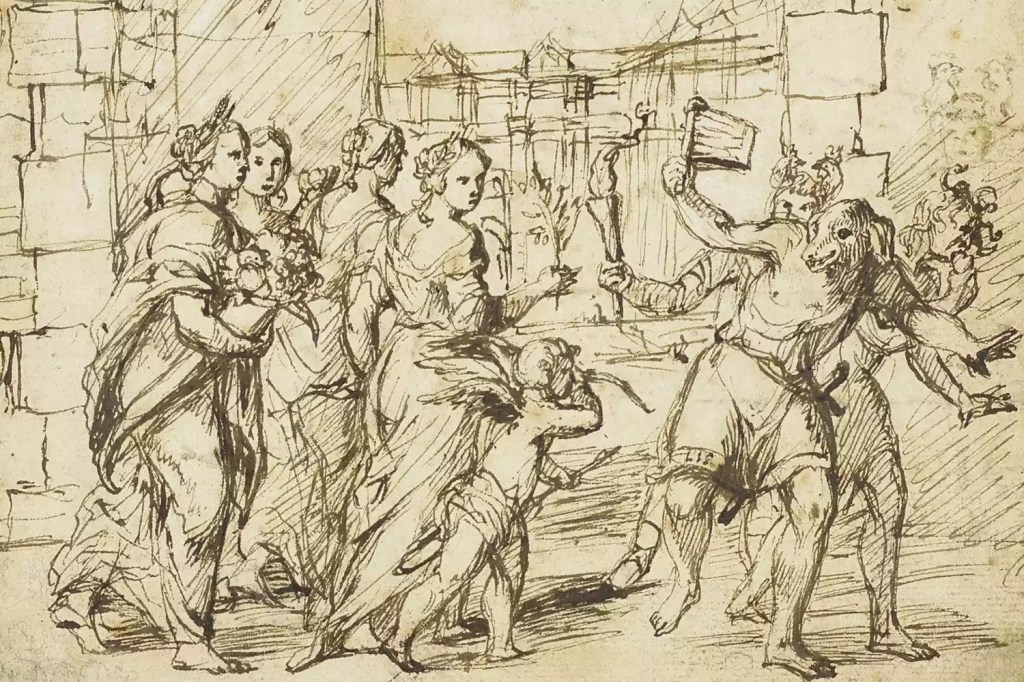
Valerio Massimo, an Italian historian and archaeologist tells us; “In fact, the sacred festival of the Lupercals began thanks to the work of Romulus and Remus, when, rejoicing at the permission of their ancestor Numitor, king of Alba Longa, to build a city in the place where they were born, under the Palatine hill, already made sacred by the Arcade Evander, made a sacrifice at the exhortation of their teacher Faustulus and, after killing goats [and a dog], they let themselves go, made merry by the banquet and the wine drunk in abundance. Then, divided into two groups, girded with the skins of the immolated victims, they went to tease those they met for fun. The memory of this playful chase around is repeated every year since then”.
The festival has a slightly darker, historical connection because it is where ” to quote Cicero (Philippic I3): that day on which, sodden with wine, smothered with perfumes and naked (Antony) dared to urge the groaning people of Rome into slavery by offering [three times] Caesar the diadem [crown] that symbolized the kingship” (J. A. North, 2008).
Experts said because the the cave was at the base of a hill between the Temple of Apollo and the Church of St. Anastasia, any further excavation could cause major collapse. So unfortunately for now, it remains buried 50 feet under the ruins of Augustus’ palace.
References: Caesar at the Lupercalia,” by J. A. North; The Journal of Roman Studies, Vol. 98 (2008), pp. 144-160.
For a youtube video on the discovery of the cave click here
For an article on how the bronze statue of the she wolf was made click here
Here you can download the first six volumes of Livy’s great work Ab Urbe Condita


Leave a Reply