
If you must break the law, do it to seize power: in all other cases observe it. Gaius Iulius Caesar 100BC – 44BC
The Roman Senate was one of the most incredible and enduring institutions of antiquity. According to the Roman historian Livy (59 BC – 17 AD), it was created not long after the founding of the city of Rome by Romulus, its first king, and consisted of 100 men. It went on to survive the expulsion of the Roman Kings, the collapse of the Republic in the civil war of 49 BC, the division into western and eastern parts of the empire in 286 AD, and even the fall of the Western Roman Empire in 476 AD. Over the centuries, of the many who joined the senetorial class two thousand years ago, there are still many names that have come down through the ages to us, Cincinnatus, Sulla, Cataline, Cicero, Cato the Younger, Ahenobarbus, Crassus, Mark Antony, Brutus, and of course, Julius Caesar.
The Senate was the seat of government, and the major political body throughout the much of the history of Ancient Rome. It consisted of elite, and mainly old and wealthy men from powerful families, many of whom had a long lineage going back to Romes earliest days. Indeed the word ‘senate’ in Latin means old man (senex).
The incredibly complex and sometimes fraught political structure of the Republic was initially designed with the idea of preventing one-man rule. The Romans detested kingship, thereby introducing checks on power designed to stop abuse of the system from overly ambitious individuals. These checks included no general being allowed to let his troops cross regional boundaries and enter the city of Rome, an absolute control over public monies held in the treasury, and having a vote on whether to allow a military campaign.
In the early ages of Rome, the senate was there to advise the king. After in-fighting, corruption, rape and murder, a group of Roman noblemen, led by Lucius Junius Brutus, with the support of the aristocracy and the ordinary people, expelled the king, and his family, and formed the Republic. During the following years the senate became stronger, run as it was by the wealthy, usually for the wealthy. It controlled the spending of the state money, which made it extremely powerful, and its rulings were usually obeyed. This was until one Gaius Julius Caesar, in an act of blatant disregard for the established system, plunged the country into a civil war, an undertaking that had huge consequences that lasted for centuries. As the war dragged on, the Republic morphed into an Empire, with the senate’s power base effectively disappearing and after Caesars murder, and a further 15 years of civil war and bloodshed, the real power was held by his great nephew Octavian, who went on to become Augustus, the first Emperor of Rome.
Originally in Rome’s early days, only men from the patrician class could become senators, and were only appointed such, after having served as a magistrate. They practiced the skills of rhetoric and oratory to put across their case (much like politicans today!), and some of them, like Cicero became very well known, because of their skill in addressing the senate and the public. As with any institution though, it seems the wealthy, and therefore influential held the real authority. So the Republic was never a truly democratic seat of government, but an oligarchy, where the richest held most of the power. But throughout it’s existence the senate popularised the image of being for the people, summarised in its emblematic phrase SPQR, The Senate and the People of Rome.
With the growth of the Republic, the senate oversaw the administration of the provinces, and it decided which magistrate should govern which province. After much debate, men from the lower class, the plebeians, also gained admittance. But allowing ordinary men to sit in the Senate was only really a ploy, a way of keeping the lower classes quiet, content, or so they thought, that their voices were being heard. The real power was still held by the wealthy elite. As the Empire grew, Augustus cut the numbers of senators back down to six hundred and toughened up the rules on who was allowed to be admitted, passing a law that required potential senators to have at least one million sesterces of private wealth, effectively ruling out any plebeians from gaining authority in the senate.
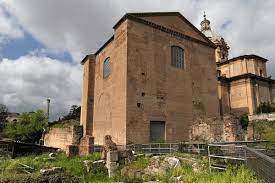
The actual building that survives today is not the original from Cicero’s time and at just 25 meters long by almost 18 meters wide is reasonably small, and quite basic inside. There are three broad steps that fitted five rows of seats capable of holding 300 senators, and during meetings many others stood, and often crowds thronged outside of the building watching the proceedings, as the buildings doors were left open because senate meetings were supposed to be public affairs. It’s exterior was originally lined with marble, but this has fallen, or perhaps has been torn off, and now the underlaying brickwork is visible. This is the third building that was built on the site of the previous senate houses, after fire and earthquake destroyed those.
During most of the Roman Republic there were between three and five hundred senators. They increased in number to around six hundred as time progressed, and then to nearly nine hundred in the Republics final years under Julius Caesar, a move designed to dilute the old fashoined Roman elite of the senate, and fill the seats with people who were loyal to him. Many of these new faces came from other parts of Italy, some even came from Romes latest acquisition, Gaul.
Senators were supposedly to be of good moral character. They had to be wealthy, in order to keep the status quo, and because they were not paid as Senators. They were expected to spend their money on the Roman state, and were not allowed to be bankers, foreign traders, or to have committed a crime, and they could not leave Italy unless they received special permission to do so. In times of crisis or a war that could engulf Rome, the senate could appoint a temporary dictator to rule for a limited time until the crisis was over. This was seen as undemocratic in nature and it sat uncomfortably with many leading Romans. Other than Caesars self proclamation of Dictator for Life in 44 BC, a move that cost him his life just a month later, the most famous example is that of Cincinnatus, a farmer and Senator, who was granted the title in 458 BC, in order to lead an army to the rescue of beseiged Roman troops, a feat he managed in just sixteen days, before giving up his power and returning to farm his land. This was how the Republic was supposed to function; no standing army, its citizens trained as soldiers and an army raised as needed. A general would be appointed to be dictator while the Senate stepped back from power. The dictator would see the Republic through the crisis and then step down when the crisis was over. Simple. What went wrong was that the unbridled ambition of extremely powerful and wealthy men, could not be controlled.
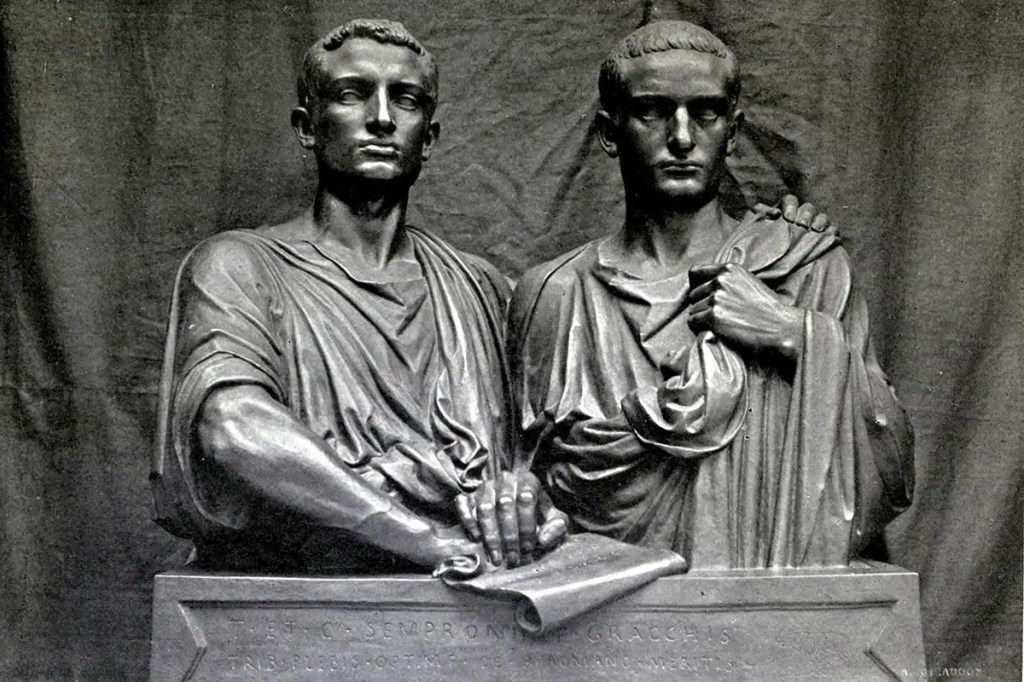
Many times violence broke out within the senate house, on one rowdy occasion Marcus Calpurnius Bibulus was drenched in a bucket of human filth, and on another the respected Cato the Younger, after opposing Caesar, was forcibly removed and temporarily imprisoned. But these events pale into insignifigance compared to the killing in 133 and 121 BC respectively, of the Gracchi brothers, Tiberius and Gaius, both Tribunes of the plebians, by violent mobs whipped up by other wealthy land owning senators, because they had attempted to pass laws that supported land redistribution, giving land and rights to poor rural farmers.
One senator who made the senate house his own was Marcus Tullius Cicero, a novus homo, a ‘new man’, one without a distinguished lineage that guaranteed him a head start in politics, but a self trained barrister who went on to ‘save’ the Republic when Lucius Sergius Catalina attempted to have several senators killed, including Cicero himself, and seize control of the state. Cicero had an incredible career in politics, which saw more than it’s fair share of turbulence and some tragedy as well, and some of his writings and speeches he gave in the senate have come down the ages to us, thanks in some small way to his secretary Tiro, a freedman, who was responsible for copying out all Cicero’s speeches in his own form of shorthand which is still used today (Robert Harris‘s Dictator is a very good fictional read about the great orator, written from Tiro’s pespective).
The weakened senate rumbled on until around 300 AD, when the emperor Diocletian imposed a number of constitutional reforms. One such reform, asserted the right of the emperor to take power without the consent of the senate, which deprived the senate of its status as the pinnacle of supreme power in the Empire. These reforms finished whatever illusion anybody had of the senate having independent legislative, judicial, or electoral powers. It still existed in name right through until the 12th Century in Constantinople, when it elected Nicolas Canabus as Emporer in 1204, but this was its final act.
In our modern world, many countries that once had empires, Great Britain, France, based their seats of power loosely on the senate of Rome, but the closest would be the United States of America. Many have drawn parallels between the senate of Rome and the one in Washington DC, as both were created to bring together the good and the great people in public life, the politicans, the financial experts, the military, and diplomats who can best represent their country.
For a superb history of the Roman Senate in paintings you can click on the following link: eclecticlight.co
For a short look at the Senate from Good Old History click here
 everythinglatin.co.uk
Leave a comment