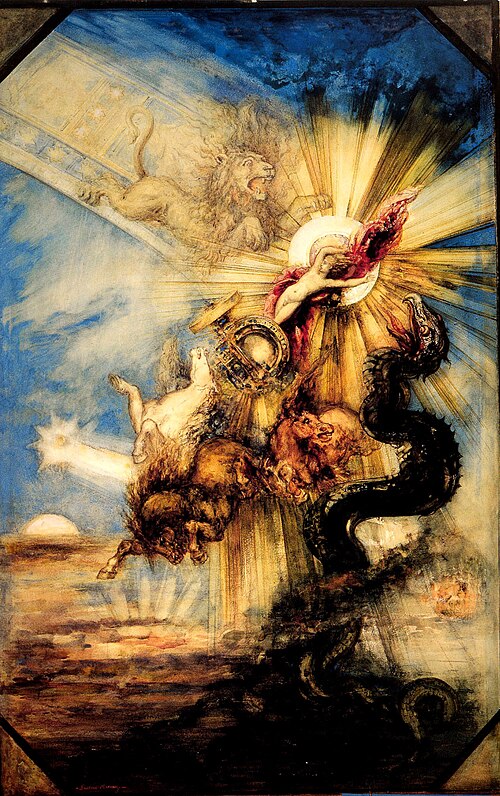
Phaethon Gustave Moreau, 1878, Musée du Louvre, Paris
Praise for Tales from Ovid:
‘A breathtaking book…To compare his versions with the Latin is to be awestruck again and again by the range and ingenuity of his poetic intelligence…He rescues the old gods and goddesses from the classical dictionaries and gives them back their terror. There should be a copy of his book in every school’. John Carey Sunday Times
Taken from Tales from Ovid, 24 Passages from the Metamorphoses, published by Faber and Faber Ltd 1997. Copyright Ted Hughes, 1930 -1998
When Phaethon bragged about his father, Phoebus
The sun god
His friends mocked him.
‘Your mother must be crazy
Or you’re crazy to believe her.
How could the sun be anybody’s father?’
In a rage of humiliation
Phaethon came to his mother, Clymene.
‘They’re all laughing at me
And I can’t answer. What can I say? It’s horrible.
I have to stand like a dumb fool and be laughed at.
‘If it’s true, Mother,’ he cried, ‘if the sun,
The high god Phoebus, if he is my father,
Give me proof.
Give me evidence that I belong to heaven.’
Then he embraced her. ‘I beg you,
On my life, on your husband Merops’ life,
And on the marriage hopes of my sisters
Only give me proof that the sun is my father.’
Either moved by her child’s distress,
Or piqued to defend her honour against the old rumour,
Clymene responded. She stretched her arms to the sun:
‘By the dazzling ball itself
Who is watching us now, and is listening
To everything I say, I swear
You are his child. You are the son
Of that great star which lights up the whole world.
If I lie, then I pray
To go blind, this moment,
And never again to see the light of day.
But if you want so much to meet your father
It is not impossible
He rises from that land beyond our borders.
If you must have the truth about yourself
Go and ask him for it.’
Phaethon rushed out, his head ablaze
With the idea of heaven.
He crossed his own land, Ethiopia,
Then India, that trembled in the sun’s nearness,
And came to his father’s dawn palace.
Fittingly magnificent
Columns underpropped a mass
Of gold strata so bright
The eyes flinched from it.
The whole roof a reflector
Of polished ivory.
The silver doors like sheet flame –
And worked into that flame
Vulcan, the god of fire,
Had set, in relief, a portrait of the creation.
There were the seas. Triton
Cruising in foam, through the swell,
Making his lonely music.
And Proteus, amoebic,
Flitting from form to form,
A submarine, shape-shifting shadow.
And Aegeon, half reclining.
His arms across two whales.
Dorcas was there with her two daughters –
Swimming, riding fishes,
Or sitting on rocks and combing their hair.
Each one quite different
Yet all looking like sisters.
And there, on earth, were the cities, the people,
The woods, the beasts, the rivers, the nymphs
And the spirits of wild places.
Surrounding the whole thing, the Zodiac –
On the right door six signs, and six on the left.
Phaethon climbed the steep approach
And entered the house of his father
Who had brought him so much shame.
He went straight into the royal presence –
But had to stand back: the huge light was so fierce
He could not go near it.
For there was the god – Phoebus, the sun,
Robed in purple
And sitting on a throne of emeralds
That blazed,
Splitting and refracting his flames.
To right and left of him
His annual retinue stood arrayed –
The seasons, the generations, and the hours.
Spring crowned with a flower garland. Summer,
Naked but for a coronet of ripe corn.
Autumn, purple from treading the wine-press.
And Winter, shivering in rags,
His white hair and his beard
Jagged with icicles.
The boy stared dumbfounded,
Dazed by the marvel of it all.
Then the great god
Turned on him the gaze that misses nothing
And spoke:
‘Phaethon, my son!
Yes I call you my child – or rather, a man
A father might be proud of. Why are you here?
You must have come with a purpose. What is it?’
Phaethon replied:
‘O’ God, Light of Creation!
O Phoebus, my father – if I may call you father! –
If Clymene is not protecting herself
From some shame from claiming your name for me
Give me the solid proof.
Let it be known to the whole world
That I am your son. Remove all doubt.’
His father doffed his crown of blinding light
And beckoning Phaethon closer, embraced him.
‘Do not fear to call me father.
Your mother told you the truth.
To free yourself from doubt – ask me for something.
Anything, I promise you shall have it.
And though I have never seen the lake in hell
By which we gods in heaven make our oaths
Inviolable, I call on that lake now
To witness this oath of mine.’
Phoebus had barely finished speaking before Phaethon
Asked for the chariot of the sun
And one whole day driving the winged horses.
His father recoiled. He almost
Cursed his own oath. His head shook
As if it were trying to break its promise.
‘Your foolish words’ he said
‘Show me the tragic folly of mine.
If promises could be broken
I would break this. I would deny you nothing
Except this. Be persuaded
The danger of what you ask is infinite –
To yourself, to the whole creation.
The forces, the materials, the laws
Of all Creation are balanced
On the course of that chariot and those horses.
A boy could not hope to control them.
You are my son, but mortal. No mortal
Could hope to manage those reins.
Not even the gods are allowed to touch them.
Only see how foolish you are.
The most conceited of the gods
Knows better
Than to dream he could survive
One day riding the burning axle-tree.
Yes, even Jupiter
High god of all heaven, whose hand
Cradles the thunderbolt –
He keeps his fingers off those reins.
And who competes with him?
Or first stretch is almost vertical.
Fresh as they are, first thing,
It is all the horses can do to get up it.
Then on to mid-heaven. Terrifying
To look down through nothing
At earth and sea, so tiny.
My heart nearly struggles out of my body
As the chariot sways.
Then the plunge towards evening –
There you need strength on the reins. Tethys,
Who waits to receive me
Into her waters, is always afraid
I shall topple –
And come tumbling
Head over heels in a tangled mass.
Remember, too,
That the whole sky is revolving
With its constellations, it planets.
I have to force my course against that –
Not to be swept backwards as all else is.
What would you do,
Your feet braced in the chariot, the reins in your hands,
When you have to counter the pull
Of the whirling Poles? When the momentum
Of the whole reeling cosmos hauls you off sideways?
Maybe you expect
To come across delectable cities of the gods,
Groves and temples beautifully appointed,
Much as on earth. It is not like that.
Instead, benighted gulches, with monsters.
Even if you were able to stick to the route
You have to pass
The horns of the Great Bull, the nasty arrows
Of the Thracian Archer, the gaping jaw
Of the infuriated Lion,
And the Scorpion’s lifted spike, its pincers
That grab for you from one side while the crab
Rushes at you with its double crushers
From the other.
And how could you cope with the horses?
Even for me
It is not easy, once they are fired up
With the terrible burners
That they stoke in their deep chests
And that belch flames from their mouths and nostrils.
Once their blood is up
They will hardly obey me, and they know me.
Think again. Do not ask me
For what will destroy you.
You ask me for solid proof that you are my son:
My fears for your life are proof, solid enough.
Look at me. If only your eyes
Could see through to my heart and see it
Sick with a father’s distress.
Choose anything else in Creation – it is yours.
But this one thing you have chosen –
I dare not grant it. Choose again, Phaethon.
You have asked me not for an honour, as you suppose,
But for a punishment. O my son,
This is no honour, this is a punishment.
You throw your arms around my neck and persist.
You have no notion of what you are asking for.
But I have sworn by Styx and you shall have
Whatever you desire. Only, my son,
Ask again, for something different, wiser.’
Phaethon seemed not to have heard.
He wanted nothing but to drive
The chariot and the horses of the sun.
His father could find no other means to delay him.
He led him out to the chariot.
Vulcan had made it. The axle-tree was gold,
And the chariot-pole gold. The wheel-rims were gold.
The wheel-spokes silver. The harness, collar, and traces,
Crusted with chrysolites and other jewels
Blazed in the beams of the sun-god.
And as Phaethon stood there, light-headed with confidence,
Giddy with admiration
Of the miraculous workmanship and detail,
Dawn opened her purple doors behind him,
Letting the roses spill from her chambers.
The stars decamped – their vanishing detachments
Supervised by the morning star
Who followed them last.
When the sun-god saw that, and the reddening sky
And the waning moon seeming to thaw
He called the Hours to yoke the horses.
The light-footed goddesses brought them
Swinging in stream from the high stables,
Blowing soft flames, fat with ambrosia.
Yoked to the chariot, they champed at the jangling bits.
But now as Phoebus annointed Phaethon
With a medicinal blocker
To protect him from the burning
And fixed the crown of ray’s on the boy’s head
He saw the tragedy to come
And sighed:
‘At least, if you can,
Stick to these instructions, my son.
First: use the whip not at all, or lightly.
But rein the team hard. It is not easy.
Their whole inclination is to be gone.
Second: avoid careering
Over the whole five zones of heaven.
Keep to the broad highway that curves
Within the three zones, temperate and topic.
Avoid the poles, and their killing blizzards.
Keep to that highway, follow the wheel ruts.
Share your heat fairly
Between heaven and earth, not to low
and not crashing in among the stars. Too high
You will set heaven aflame – and, too low, earth.
The middle way is best, and safest.
And do not veer to far to the right
Where your wheels might crush the Serpent, nor to the left
Where they might be shattered against the Altar.
Take a bearing between them.
Now fortune go with you. And I pray
She will take care of yourself better
Than you have taken care of yourself.
We have talked too long. Night has gone down
Behind the world westward. No more delays.
Our great light is looked for.
Grasp the reins. Or better, with a changed mind,
While your feet are still on the earth,
Before you have hurled your idiot emulation
Among the terrors of space,
Grasp my advice.
Leave my chariot to me.
Let me give the world the light it expects,
A light for you to smile at in safety.’
But Phaethon, too drunk with his youth to listen,
Ignored the grieving god
And leapt aboard, and catching the reins
From his father’s hands, joyfully thanked him.
Pyrois, Eous, Aethon, Phlegon –
The four winged horses stormed to be off.
Their whinnyings quaked the air-waves,
A writhing crackle of interference
Throughout heaven. And their pawing hooves
Racketed at the barred gate.
Then Tethys (who knew nothing
Of the part about to be played by her grandson)
Lifted by the bars – and all space
Lay open to the racers.
They burst upwards, they hurled themselves
Ahead of themselves,
Winged hooves churning cloud.
They outstripped those dawn winds from the east –
But from the first moment
They felt something wrong with the chariot.
The load was too light.
More like a light pinnacle
Without ballast or cargo,
Without the deep-keeled weight to hold a course
Bucking and flipping
At every wave,
Sliding away sidelong at every gust.
The chariot
Bounced and was whisked about as if it were empty.
When the horses felt this
They panicked.
They swerved off the highway
And plunged into trackless heaven.
Their driver, rigid with fear,
Gripped the chariot rail. It was true,
He had neither the strength nor the skill
To manage those reins.
And even if he could have controlled
The wild heads of the horses
He did not know the route.
For the first time
The stars of the Plough smoked.
And though the Arctic Ocean
Was forbidden to them they strained
To quench themselves in it.
And the Serpent
That hibernated close to the Pole Star
Harmless, and inert in the cold, woke
Scorched, lashing, furious to cool itself.
Even slow Bootes puffed and scrambled
To get away from the heat,
Dragging his plough like an anchor.
And now Phaethon looked down
From the zenith –
And saw the earth
So far below, so terrifyingly tiny,
His whole body
Seemed suddenly bloodless.
His knees wobbled, his eyes
Dazzled and darkened.
He wished he had never seen his father’s horses.
He wished he had never learned
Who is father was. He wished his father
Had broken his promise.
He wanted only to be known
As the son of Merops.
Meanwhile the chariot bounded aong
Like a ship under a gale
When seas have smashed the rudder
And the ropes have gone
And the helmsman
Crouches and clings in the scuppers,
And prays,
Hiding his eyes with his arm.
What could he do?
Much of the sky was behind him,
But always more ahead.
He looked East, trying to measure
What he had covered.
He looked West – where his Fate lay waiting.
Either way, nothing could help him.
His wrists were looped in the reins he no longer
Had the strength to cling to.
Even the horse’s names had gone out of his head.
And now he saw the monsters
Littered among the constellations.
The Scorpion loomed
Suspending his tail
Over the wide embrace of his claws,
Sprawling across two signs of the Zodiac.
When Phaethon saw that, when he saw
The ponderous talon of the sting, bulbed with poison,
He dropped the reins.
They fell in a tangle over the horses.
Then the horse’s took off, blindly.
Uncontrolled, they let their madness
Fling them this way and that
All over the sky.
They dashed in among the sky
Switching the chariot along
Like a whip-tail.
They swept low – till the clouds boiled in their wake
And the moon was astonished
To see her brother’s chariot below her.
Earth began to burn, the summits first.
Baked, the cracks gaped. All fields, all thickets,
All crops were instantly fuel –
The land blazed briefly.
In the one flare noble cities
Were rendered
To black stumps of burnt stone.
Whole nations, in all their variety,
Were clouds of hot ashes, blowing in the wind.
Forest-covered mountains were bonfires.
Athos burned.
Cilician Taurus and Tmulos,
Oeta and Ida, formerly blessed for its springs,
Helicon, home of the muses, all burned.
And Haemus, that Orpheus would make famous.
The twin peaks of Parnassus, and Cynthus and Eryx,
Were pillars of fire. Etna convulsed
In multiple eruptions.
The snows of Rhodope
Boiled off, and the ridges glowed.
Othrys, Mimas, Dindmya, Mycale
And Cithaeron, dancing place of the Bassarids,
Were ablaze.
Scythia’s freezing winds could not protect it.
Ossa, Pindus, Olympus bigger than either,
The Alps that look across Europe
And the Apennines, their clouds gone,
Burned like fleeces.
Now Phaethon saw the whole world
Mapped with fire. He looked through flames
And he breathed flames.
Flame in and flame out, like a fire eater.
As the chariot sparked white-hot
He cowered from the showering cinders.
His eyes streamed in the fire-smoke.
And in the boiling darkness
He no longer knew where he was
Or where he was going.
He hung on as he could and left everything
To the horses.
That day, they say,
The Ethiopians were burnt black.
That day,
Lybia, in a flash of steam,
Became a shimmering desert,
Where the nymphs of the springs and the lakes
Wandered like wraiths, wailing for lost water.
Boeotia wept for the fountain of Dirce,
Argos for Amymone, Ephyre for Pyrene.
Strong rivers fared no better.
The shallows of Tanais fried. Old Peneus,
Mysian Caecus and the headlong Ismenus –
Their shallows and riffles bubbled as if over pebbles
That were red hot.
And Trojan Xanthus, who would be burned again.
Yellow Lycormas poured a reeking soup.
Looped Meander steamed like a scalded serpent.
Melas in Thrace, Eurotas in Sparta,
Euphrates in Babylon,
Orontes, Thermodon, Ganges, Phasis and Hister
Seemed to smoulder in their beds.
Alpheus dived through fire. Sperchius
Crept between banks that broke into flame.
The gold in Tagus melted.
The swinging swans of Cayster
Cried in dismay as the river boiled,
Scalding and stripping their plumage.
The terrified Nile
Escaped into Africa, and hid his head
Among smouldering mountains, leaving the seven
Delta channels
To blow into dunes.
Ismarus’ bed was a gully of burning dust.
The Rhine, the Rhone, the Po and the Tiber
Which had been promised an Empire
Were bubbling pits of quag in scabby trenches.
The earth cracked open. And the unnatural light
Beamed down into hell
Scaring the king and queen of that kingdom
With their own terrific shadows.
The seas shrank, baring deserts.
Submarine mountains emerged as islands,
Multiplying the Cyclades.
Fish hugged the bottom of their deepest holes.
Seals bobbed belly up, lifeless.
And the dolphins stayed far down.
Three times
Neptune reared his angry head and shoulders
Above the bubbling surface
And each time plunged again
To escape the searing flames of the air.
Then the Goddess of Earth
Alarmed by the water scrowding into her bowels
Pushed up through the embers
And lifted her head and neck into the furnace.
She spread her hand
To shield her face from the sun.
The terror
That shook her body shook the whole earth.
She crouched lower and cried
With her holy voice:
‘You God of the gods,
If my annihilation
Has been decided, why drag it out?
Where are your thunderbolts
To finish the whole thing quickly?
If I am to end in fire
Let it be your fire, O God,
That would redeem it a little.
I can hardly speak.’
She choked in a squall of ashes.
‘See my hair singed to the roots,
My eyes cauterised by your glare.
Are these my rewards
For my fertility, my limitless bounty,
My tireless production?
Is this my compensation
For undergoing the ploughshare,
The pick and the mattock,
My flesh gouged and attacked and ground to a tilth
Year in year out? Is this how you pay me
For foddering fat beasts,
For plumping the milky grain that suckles man,
For concocting the essences and rich herbs
That smoke on your altars?
Even if I have somehow deserved all this
How are the seas guilty, or your brother?
Why should the oceans, that are his portion,
Cringe and shrink from the sky?
But if you are deaf to us
What about your own heaven? Look at it.
Both poles are glowing. Once they go
Your whole realm flies off it’s axle,
Your palace is rubbish in space.
And look at Atlas. He is in trouble.
His shoulders are fabulous, but who can carry
The incineration of a Universe?’
Then heat overcame her. Little by little
She drew in her smoking head,
Like a tortoise, and sank into herself –
Into the caves, close to the land of ghosts.
The Almighty, aroused,
Called on the gods,
Including Phoebus who had lent the chariot –
He asked them to witness
That heaven and earth could be saved only
By what he now must do.
He soared to the top of heaven,
Into the cockpit of thunder.
From here he would pour the clouds
And roll the thunders and hurl bolts.
But now he was cloudless –
There was not a drop of rain in all heaven.
With a splitting crack of thunder he lifted a bolt,
Poised it by his ear,
Then drove the barbed flash point-blank into Phaethon.
The explosion
Snuffed the ball of flame
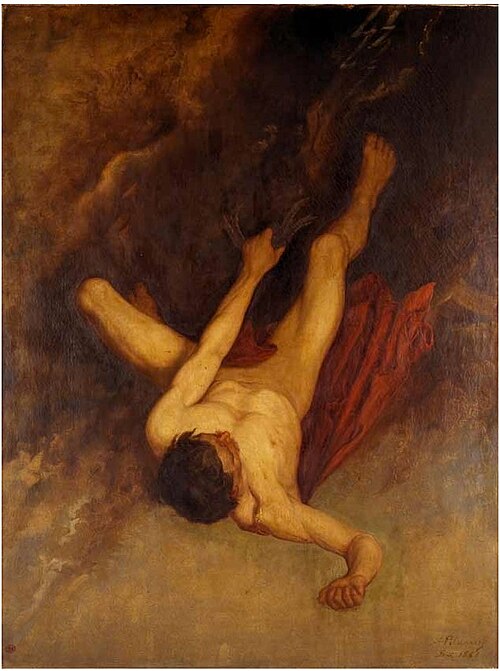
As it blew the chariot to fragments. Phaethon
Went spinning out of his life.
The crazed horses scattered.
They tore free, with scraps of the yoke,
Trailing their broken reins.
The wreckage fell through space,
Shattered wheels gyrating far apart,
Shards of the car, the stripped axle,
Bits of harness – all in slow motion
Sprinkled through emptiness.
Phaethon, hair ablaze,
A fiery speck, lengthening a vapour trail,
Plunged towards the earth
Like a star.
Falling and burning out on a clear night.
In a remote land
Far from his home
The hot current
Of the broad Eridanus
Quenched his ember –
And washed him ashore.
The Italian nymphs
Buried his remains, that were glowing again
And flickering little flames
Of the three forked fire from God.
Over his grave, on a rock they wrote this:
Here lies Phoebus’ boy who died
In the sun’s chariot.
His strength too human, and too hot
His courage and his pride.
His father mourned, hidden,
Eclipsed with sorrow.
They say no sun showed on that day.
But the fires of the burning earth
Were so far useful, to give some light.
And now Clymene’s outcry
Equalled the catastrophe.
Mad with grief, she searched the whole earth
To find the boy’s limbs, or his bones.
She came to the grave. With her breasts naked
She embraced the engraved rock.
The daughters of the sun grieved as keenly,
Beating their breasts,
Throwing themselves down on their brother’s tomb,
Calling incessantly
For the one who would never hear them.
Days, weeks, months, they mourned.
Their lamentations were obsessive,
As if they could never exhaust them
They wore out four full moons with their wailings
Until at last Phaethusa –
As she flung herself to the ground –
Cried out that her feet were fixed of a sudden.
And Lampetie, as she stepped to help her,
Found her own feet rooted, immovable.
A third, tearing her hair,
Brought away handfuls of leaves.
One screamed that a tree bole
Had imprisoned her calves and thighs.
Another was whimpering with horror
To find her arms crooking into stiff branches.
And as they all struggled in vain
To escape or understand, tree bark,
Rough and furrowed, crept on upwards
Over their bodies, throats, faces –
Till it left only their lips, human enough
To call for their mother.
And what could she do
But stagger to and fro
In growing terror –
Torn this way and that,
Kissing the mouths she could still find?
And when she tried to free her daughters
Ripping at the bark, and snapping the branches –
A liquid, like blood,
Came welling out of the wounds,
And the mouths screamed:
‘O mother, do not hurt us.
Though we are trees
We are your daughters –
Oh now we must leave you.’
So their last words were silenced
By the sealing bark.
But then, through that bark,
There oozed lymph like tears, that in the sun’s light
Solidified as amber.
These dropped from the boughs
Into the hurrying river
Which carried them off
To adorn, some day far in the future,
Roman brides.


Leave a Reply