Battle of Carrhae – June 9, 53 BC
The Battle of Carrhae (modern-day Harran in Turkey) in 53 BC was the opening fight in a series of Roman-Persian wars that lasted for almost 600 years. Rome viewed Persia not as a group of scattered nomadic tribes, but as an empire with its own wealth, army, and government. The conflict was fought over the control of border regions like Armenia and Mesopotamia (modern-day Iraq).
Simply put, the conflict began after the civil war in 57 BC, when the Parthian king Phraates III was assassinated by his two sons, Orodes II and Mithridates IV. The brothers immediately turned on each other, and the defeated Mithridates fled to Syria where he asked the Roman governor Aulus Gabinius for military assistance. This gave the ever watchful senators and egotistical military leaders in the Roman Republic an excuse to meddle in Persian affairs.
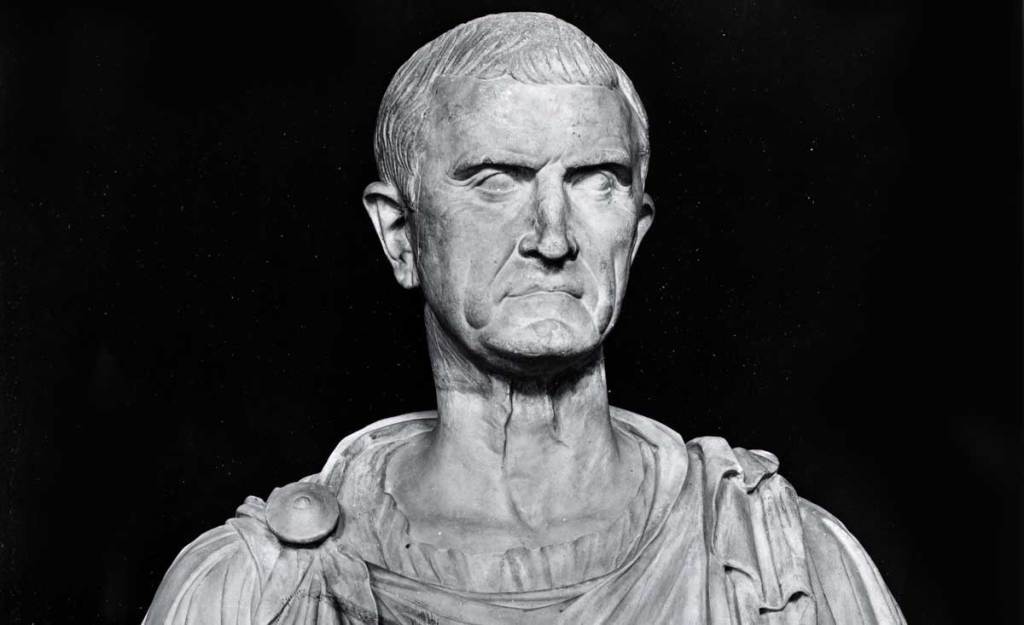
One of these men was the Roman Triumvir Marcus Licinius Crassus, a lifelong ally of Julius Caesar, who was driven by a desire for both military glory and the accumulation of as much wealth as possible. Often called ‘the richest man in Rome’ (Pliny the Elder estimated Crassus’ wealth at around 200 million sesterces, about $200 million in today’s money) he made his money through property speculation and the proscriptions after the civil war between Marius and Sulla. Appointed as the new governor of Roman Syria, Crassus used his new province to launch an unprovoked, and unauthorised, military campaign against the Persian Empire, which aimed at subjugating their territory that included parts of present-day Iran, Turkey, and Syria.
Plutarch tells us that Caesar wrote to Crassus from Gaul, endorsing his plan to invade Parthia, obviously thinking, like Crassus, the campaign would be an easy one. Caesar had enjoyed huge success in Gaul, and the Roman legions had, on occasion decisively beaten the numerically superior armies of Pontus and Armenia.
Cicero objected to the invasion, and called it a war nulla causa (with no justification) on the grounds that Parthia had a treaty with Rome. Despite protests and dire omens, Crassus left Rome on November 14, 55 BC. His son Publius joined him in Syria the following winter bringing with him a thousand Celtic cavalry from Gaul.
When Crassus arrived in Syria he started to use his immense wealth to raise and train an army. According to Plutarch, he assembled a force of seven legions, a total of 35,000 infantry, along with around 4,000 light infantry, and 4,000 cavalry which included the 1,000-strong Gallic cavalry that Publius had brought with him. With the support of another 6,000 cavalry from Artavasdes, the Armenian king, Crassus marched on Parthia.
Orodes, now the Persian king after executing his brother, sent an envoy to discuss terms of peace. Crassus ignored him, instead seeking the benefits of an easy victory on Rome’s terms, but did not hide his plans or conceal his preparations during the time the envoy was with him, allowing the Parthians to gain valuable intelligence.
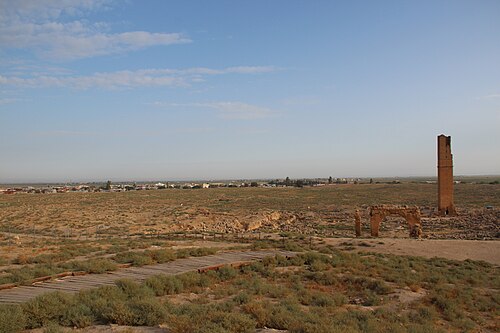
Crassus met his enemy near the town of Carrhae on the morning of 9 June, when the forward troops found the scouts that had been sent ahead had been slain and a large force of cavalry was quickly approaching. After learning of the size of the force opposing them, around 10,000, Crassus’s men panicked.
A general named Cassius recommended that the army be deployed with infantry forming the centre and cavalry on the wings, but Crassus ordered his men to form a hollow square, each side formed by twelve cohorts. This would protect his forces from being outflanked but reducing his mobility. Crassus’s generals advised him to halt and to attack the following morning to give his men a chance to rest and take on water from a nearby stream. Publius however was eager to fight, and managed to convince his father to attack immediately.
The choice of ground chosen by Crassus upon which to fight was a major mistake; he had, so we are told, been led to select that ground by the Parthians, as there was no cover, no easy access to water and no escape route either.
”There came to the camp an Arab chief named Ariamnes, a cunning and wily fellow, who, of all the evil chances which combined to lead them on to destruction, was the chief and most fatal, he [Ariamnes] was now suborned by the king’s generals and sent to Crassus to entice him…from the river and hills into the wide open plain, where he might be surrounded.” Plutarch. Crass. 21.1
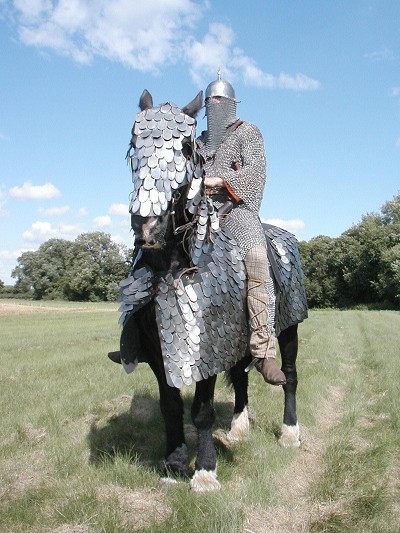
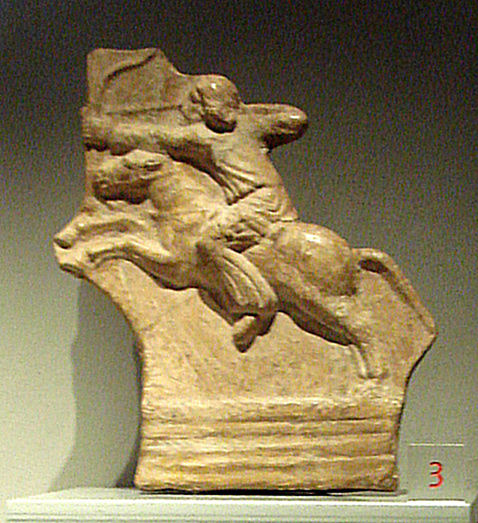
The Parthians started to intimidate the Romans. First, they beat their hollow drums, unsettling the Roman troops with the loud noise. The cataphracts were then ordered to cover their horse’s armour in cloth and advance. As they closed with the Romans, they removed the cloths, revealing the armour, the sight further intimidating the Romans.
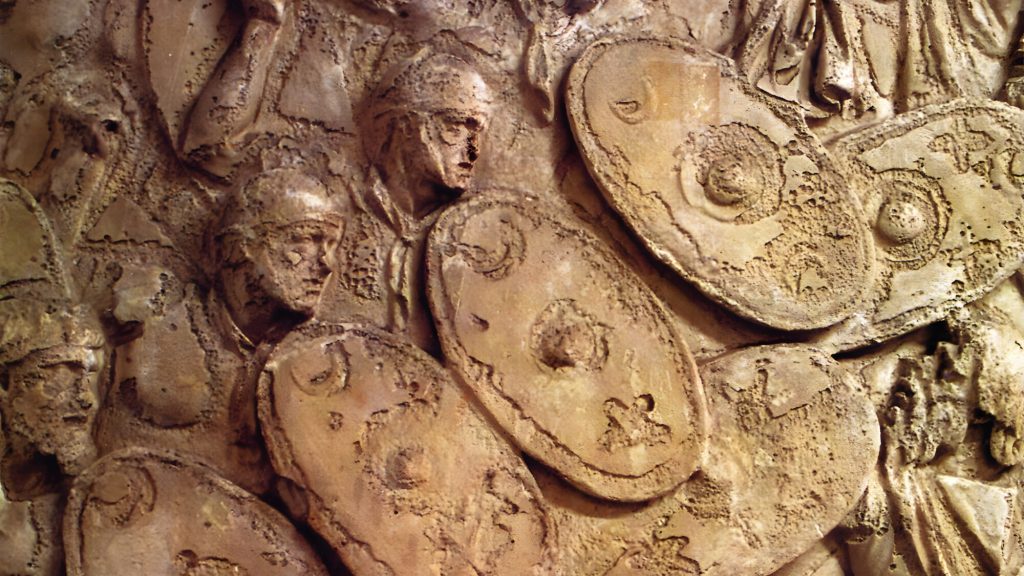
The Parthian horse archers then surrounded the Roman square, staying beyond the range of the Roman pila javelins, engaging the legionnaries, who were protected by their large shields (scuta) and armour, but they could not cover the entire body. Historians of the time described the arrows penetrating the Roman shields, nailing the shields to the limbs of the infantry and nailing their feet to the ground.
The Romans advanced towards the Parthians again and again, in an attempt to engage them in close-quarters fighting, but the Parthian cataphracts exploited the weakness in the Roman lack of mobility and repeatedly charged their line, which inflicted heavy casualties.
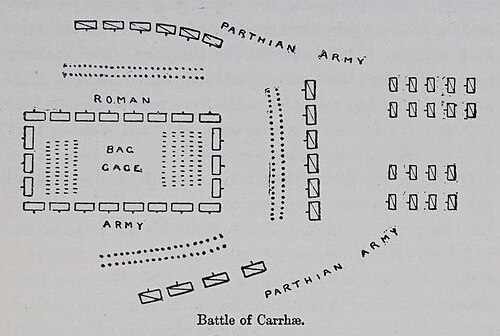
Crassus hoped that his men could hold out until the Parthians ran out of arrows, but the Parthians had over a thousand camels to resupply his archers. When he realised this, Crassus sent his son Publius, with 1,300 Gallic cavalry, 500 archers and eight cohorts of legionnaries to drive off them off. The archers pretended to retreat and drew off Publius’ force, while inflicting heavy casualties on them, and cutting off their retreat. The Gauls fought bravely, but they had to retreat, and Publius and his officers committed suicide rather than be captured, leaving just 500 of the Gauls to be taken alive.
Crassus ordered a general advance, but was confronted with the sight of his son’s head on a spear. The cataphracts then mounted a series of charges that completely shattered the Romans, and did not cease until nightfall. Crassus, now seeing the inevitability of defeat, ordered a ragged retreat to the nearby town of Carrhae leaving his wounded behind, who were killed by the Parthians the next morning. Four Roman cohorts got lost in the dark and were surrounded on a hill; only 20 survived.
The Parthians sent an envoy to the Romans to seek a peace conference, and with Crassus being reluctant, the Roman troops threatened to mutiny. At the meeting, a Parthian pulled at Crassus’s reins, sparking violence in which Crassus and his generals were killed. The story goes his head was then cut off and molten gold poured down its throat to mock his notorious greed. Plutarch reports that the severed head was then used as a prop in a play performed at a banquet before the king.
The remaining Romans attempted to flee, but most were captured or killed. Plutarch says that Roman casualties amounted to about 20,000 killed and 10,000 captured, making the battle one of the worst defeats in Roman history. Parthian casualties were few. The Parthian Army went on to defeat the Armenian king Artavasdes, and capture his country.
Gaius Cassius Longinus, a commander under Crassus, led approximately 10,000 surviving soldiers back to Syria, continuing to govern the province for two more years, successfully defending it from further Parthian attacks. Cassius also managed to resist the Parthian siege of Antioch, and when the Parthian army retreated home he ambushed them at Antigonea, leading to the death of the Parthian second-in-command Osaces. Receiving praise from Cicero for his victory, he went on to play a key role in the conspiracy to assassinate Julius Caesar.
The 10,000 Roman prisoners of war were deported to Alexandria Margiana (Merv) near the Persian Empire’s northeastern border in 53 BC, where they settled, marrying local women.
Rome was humiliated by this defeat, which was made even worse by the fact that the Persians had captured the aquilae (legionary battle standards), and was considered a serious humiliation and an bad omen for the Romans. The standards were eventually brought home after diplomacy by Augustus 33 years later, but conflict between Rome and Parthia continued to rage for more than another 500 years, seeing a series of catatrophic defeats and failures that ultimately helped weaken and hasten the downfall of both empires, at the hands of the new Arab Muslim armies .


Leave a Reply