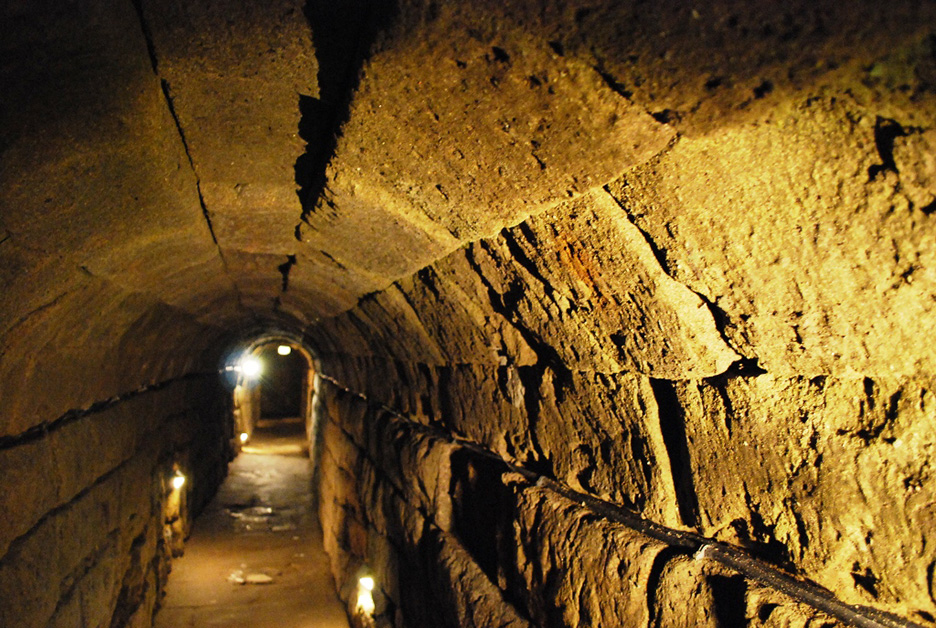
Built in Rome two thousand years ago, this underground sewer, a vaulted tunnel called Cloaca Maxima (meaning “the greatest drain”) was constructed from massive blocks of volcanic rock and limestone, and, along with concrete, aqueducts, ampitheatres and an amazing network of almost straight roads linking distant provinces to the capital, it is another testament to the longevity of Roman engineering skills. It’s name is drawn from the Roman goddess Cloacina.
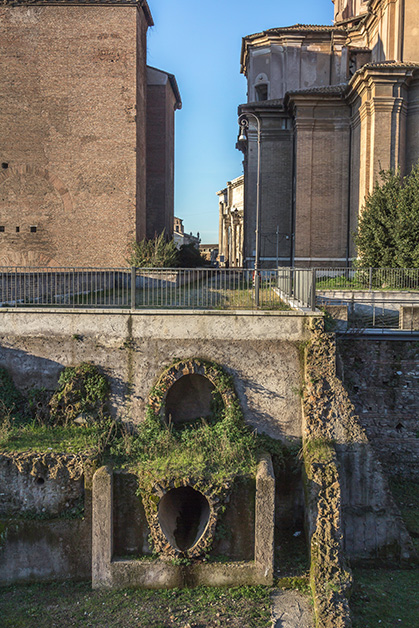
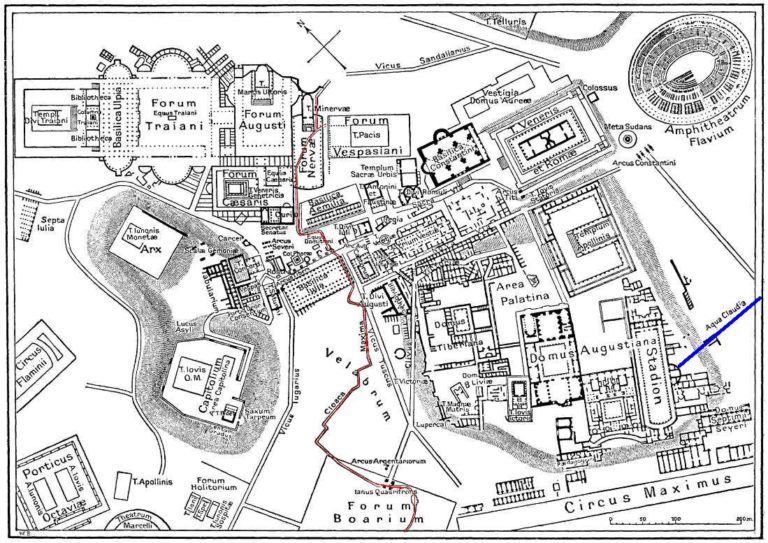
The sewer started as open drainage somewhere in the 6th century BC, probably instigated by the Etruscans, which followed the route of an existing stream, and was used to drain the marshy area the forum was eventually built upon. This helped reduce the mosquitos in the area, thereby limiting the spread of malaria. The stream was subsequently lined with stone and enclosed in the 3rd century BC, and later completed with a stone barrelled cover. It’s job then, after the marshland was gone, was to drain off surface water in the forum and transport it out to the River Tiber. With an increase in Rome’s population the canal was enlarged, and as the understanding for sanitation and hygiene grew, the canal became the underground sewer system we know today.
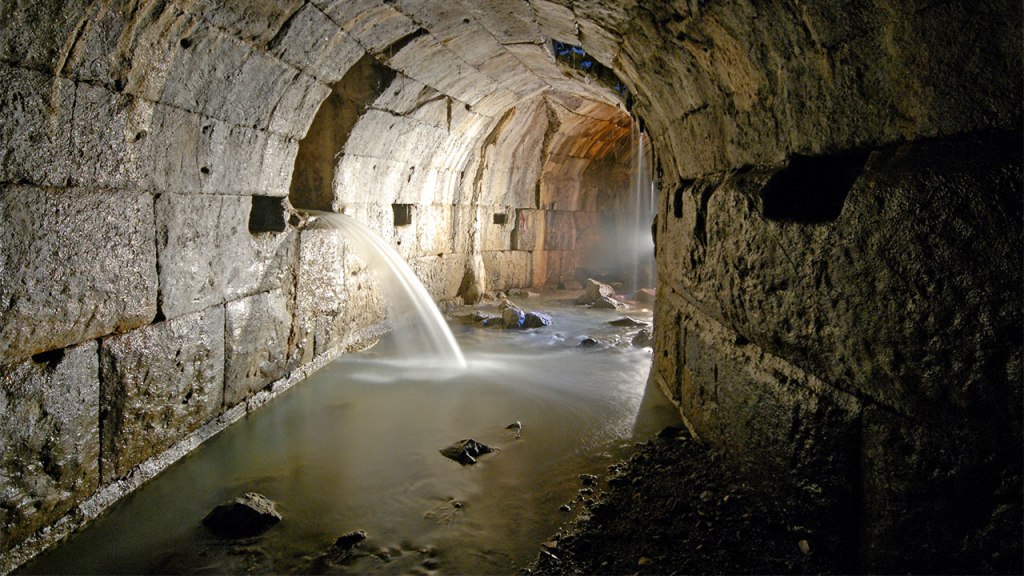
The aqueducts that supplied water to Rome were channelled into this system, after having supplied not only the public baths, but also public fountains, imperial palaces and eventually, the private houses of the wealthy elite. The constant running water helped to remove waste and keep the sewer clear of obstructions.
As Empire grew, the sewer system was copied in overseas territories, and it was especially successful as we’ve seen with the copious amounts of water supplied by the aqueducts in arid regions. The sewer systems and aqueducts in Gaul and the one in Eboracum—the modern-day English city of York, were good examples of this engineering skill.
Marcus Agrippa, a Roman General and close friend of the Emperor Augustus was an aedile in 33 BC, and carried out extensive repairs and cleaning of Rome’s existing sewer system, including the Cloaca Maxima. In his role as aedile (similar to a minister of public works), he improved Rome’s sanitation and infrastructure by repairing streets, cleaning sewers, and building new aqueducts that helped maintain a clean water supply to the city, and so improve living standards.
In his Natural History, first published in 7 AD, Pliny the Elder says of this great sewerage system:
“…an engineering marvel…In the streets above, massive blocks of stone are dragged along, and yet the tunnels do not cave. They are pounded by falling buildings…The ground is shaken by earth tremors; but in spite of all, for 700 years from the time of Tarquinius Priscus (the fifth King of Rome 616 -578), the channels have remained well-nigh impregnable…[they are] large enough to allow the passage of a wagon loaded with hay.”
Strabo, the Greek author (c. 60 BC to 24 AD), had great admiration for the ingenuity of the Romans, and wrote in his Geographica (his encyclopedia of geographical knowledge, consisting of 17 books), ”The sewers…and the quantity of water brought into the city [through them] by aqueducts is so great that rivers…flow through the city and the sewers; almost every house has water tanks, and service pipes, and plentiful streams of water…In short, the ancient Romans gave little thought to the beauty of Rome because they were occupied with other, greater and more necessary matters.”
Slowly but surely, homes were connected to the sewers, and more sewers were laid throughout the city, serving public and many private latrines, these public facilities serving as dumping grounds for the waste from homes not directly connected to a sewer. In truth poorer residents used pots that they were supposed to empty into the sewer, or visited public latrines, although many dumped their waste into the street, culminating in a law being passed to protect passers by from assualt. Public latrines date back to the early republic, and they became places to socialise. Long bench-like seats with keyhole-shaped openings cut in rows offered little privacy, but that didn’t seem to bother many Romans. Some of these latrines were free, for others small charges were made.
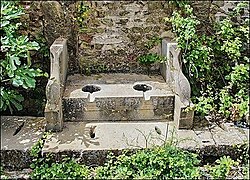
In the latrines, Romans wiped themselves after defecating with a sea sponge on a stick called a tersorium. This might be shared by all of those using the latrine, or people would bring their own sponge. This could be the root of the old saying ‘don’t get the wrong end of the stick!’
To clean the sponge, they washed it in a bucket with water and salt or vinegar. This subsequently became a breeding ground for bacteria, helping to spread disease. It is believed the Romans used sea sponges on a stick and dipped in vinegar after defecation, but it is not known for sure.
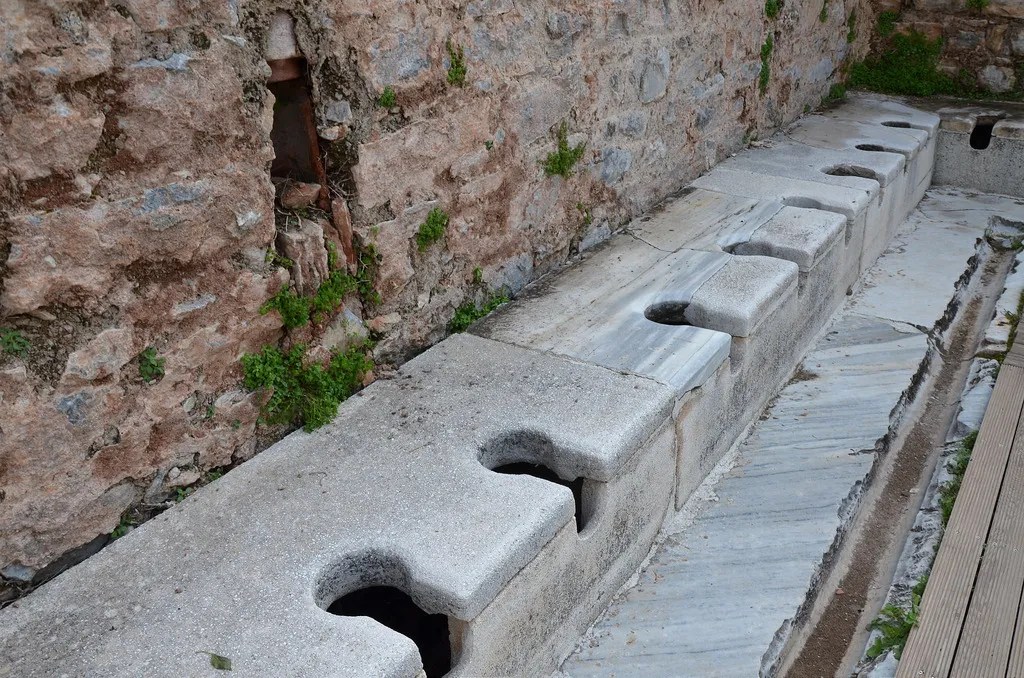
The great sewer wasn’t without it’s drawbacks however, compelling reasons that may have deterred private homeowners from having a drain fitted to remove waste water were flooding, foul odours and of course, vermin. The Tiber flooded with regularity and the Cloaca Maxima became backfilled with water, clogging the drains with the wastes it had dumped into the river.
Supposedly, the site where Julius Caesar was assassinated, the Hall of Curia in the Theatre of Pompey, was turned into a public latrine because of the dishonour it had witnessed. A small sewer ran beneath it, carrying waste away to the Cloaca Maxima, and then out into the Tiber.
Lewis Mumford, the American historian and sociologist, in his The City in History (1961), writes of his admiration at the social value of Rome’s sewer system, “With its record of continuous service for more than twenty-five hundred years, that [sewer] structure proves that in the planning of cities low first costs do not necessarily denote economy… on these terms, the Cloaca Maxima has turned out to be one of the cheapest pieces of engineering on record.” The Cloaca Maxima is an undoubted ancient engineering accomplishment and a genuine demonstration of political leadership.
 everythinglatin.co.uk
Leave a comment