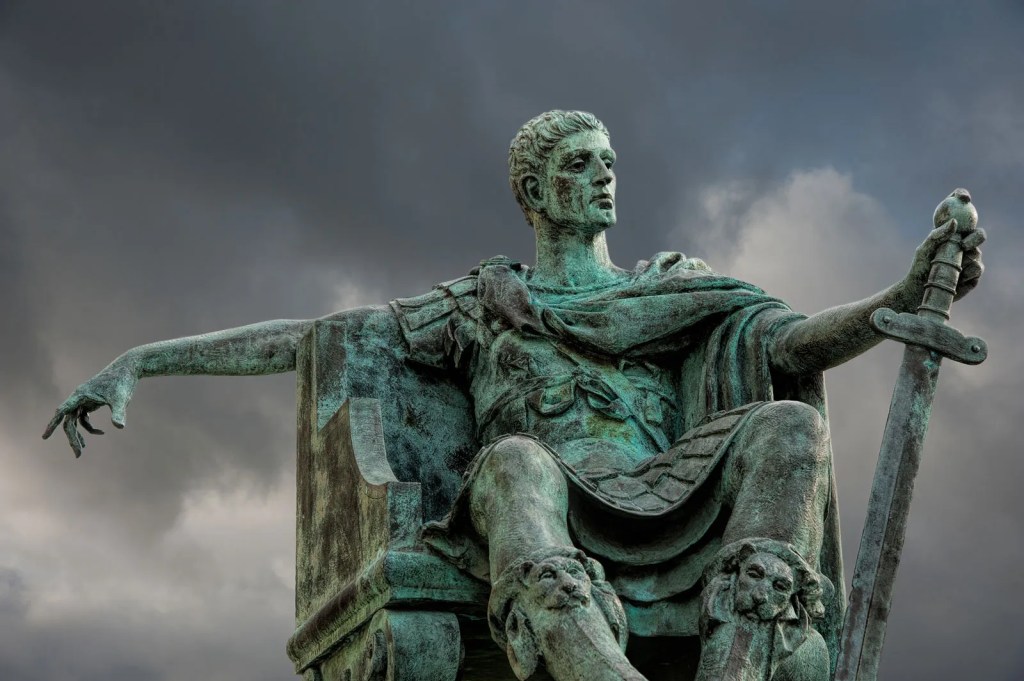
Constantine the Great – York
Thinking is the great enemy of perfection. The habit of profound reflection, I am compelled to say, is the most pernicious of all the habits formed by civilized man – Constantine the Great
In comparison to the third century, Constantine’s reign (306 -337 AD) was a period of radical change rather than continuity for the Roman Empire, a change that saw the alignment of a contemporary state religion with the foundation of ‘New Rome’, and this change was a reaction to the civil wars fuelled by both a rapacious army and the ambition of self-serving men, who posed a real threat to the existence of Empire.
That an ‘overarching’ period commonly termed ‘crisis’ gripped the third century is beyond doubt; but the crisis manifested mainly in the lesser, western half of the Empire; rebellions in Britannia, increasing Germanic tribal incursions, epidemics depleting both the military and agricultural sectors, the subsequent decay of villages and small towns that were dependant on a rural economy, decreasing amounts of silver mined leading to a debased currency, coupled with military expenditure swallowing around three-quarters of total tax revenue, all led to exponential pressures on the government in Rome, and an austerity that impacted severely on traditional provincial life.
However, ultimately it was the domineering Praetorian Guard, declaring egotistical military leaders as Emperor, sidelining Rome and the Senate, which was a defining feature of the breakdown in the systems of orderly Imperial succession, that eventually forced Constantine to make dramatic change.
By the third century, although the Roman army was still manned by Roman citizens (after the Emperor Caracalla’s edict in 212 AD giving Roman citizenship to all free-born men anywhere in the Empire), it’s recruitment now came increasingly from outside Italy, weakening its traditional loyalty to Rome, with soldiers inhabiting a world of their own, their larger camps resembling walled cities. Quite simply, the political power of Rome was diminishing, and now it was the legions who demanded the regimes allegiance.
There were several instances of military indiscipline; in Aragoë and Takina serious complaints were made, and in Skaptopara, Thrace in 238 AD, the villagers petitioned the Emperor, Gordian III about marauding troops stealing food and demanding free lodgings. The petition shows infrastructure was functioning, as villagers lobbied their Emperor through it, but the provincial governor Dio Cassius (165-235 AD), sometimes seen as an unreliable source due to his aristocratic class, frequently commented on a lack of discipline within the ranks, his complaints eventually leading to his dismissal. This ‘decreasing power of cultured, unmilitary high-status aristocrats, who wanted to co-operate with emperors, shows both the extent of leverage over the Emperor to remove a provincial governor the Praetorian Guard had, and the extent of their collusion in the breakdown of Imperial control.
The inscription on the petition declares loyalty to Rome ‘Wanting for nothing, [the villagers] fulfilled their taxes and other duties’ yet ‘we [may] leave our family farms because of the violence’ and ‘…we shall flee our homes and the treasury will incur a great loss’.
Complaints about predatory soldiers had occurred before, under Hadrian, himself a professional soldier and conscientious administrator of the military, an Egyptian praefectus reports ‘…many soldiers…requisition boats and animals and persons improperly, in some cases seizing them by force…the result of which…persons are subjected to insults and abuses and the army is reproached for greed and injustice…’.
A soldiers misconduct was his commanders responsibility, and very often his fault. Tacitus writes that Valens led his army through Gaul and Switzerland plundering villages, humiliating dignitaries, destroying communities, and becoming very wealthy in the process. This indiscipline was quintessential in the overall, negative changes affecting provincial society.
During the Third Century, civic patronage and commemoration of the dead dropped sharply, and city walls were constructed from dismantled mausolea and uprooted tombstones showing the loss of traditional values…and family continuity, and it was universal citizenship that probably removed the desire for formerly subservient peoples to affirm their status through inscription and dedication, so this observation is not perhaps indicative of societal collapse, rather simply a pragmatic re-use of materials; but that there was some kind of foundering of Imperial control cannot be in doubt.
It is against this chaotic backdrop that Constantine, supposedly after receiving a vision from God at the Battle of Milvian Bridge, defeats Maxentius, and later Licinius to become Emperor in 324 AD. He was not by modern standards a pleasant man, neither saint nor tyrant’, but a soldier-emperor determined to rule his Empire.

Constantine is best known through the works of Eusebius (265-339 AD), a chronicler of early Christianity, and someone who saw ‘…the Roman Empire…as the necessary background for the coming of Christ and…of Christianity’ (Oxford Classical Dictionary).
From the outset, Eusebius’ writings are pro-Constantine and pro-Christianity, writing of Constantine’s ‘…battles in war, …valiant deeds and victories…[and a] life which is dear to God’, before continuing ‘’…everything had been brought under the Emperor by the power of the Saviour God…’. That Eusebius was dedicated to realising a Christian Roman society with Constantine as Emperor is clear, but quite how genuine Constantine’s belief in Christianity was, we do not know. Eusebius presented himself as the Emperor’s confidant, but it is known he wrote several versions of his Ecclesiastical History (his chronological account of the development of Early Christianity) before ever meeting him, thus, the significance of Eusebius as the preserver of privileged imperial recollections is not truly known, with another scholar saying Eusebius’ work should be analysed as literature rather than a source.
No sudden catastrophe engulfed the Roman Empire, rather Constantine saw the problem, and understood the degree of change that would remedy it. His aim was to preserve the Empire, and by emerging victorious from civil war he chose to use his belief in God to justify his conquests, as he believed anyone resisting the Emperor and Roman rule would be going against the will of God, because he as Emperor had allied Christianity to Imperial power.
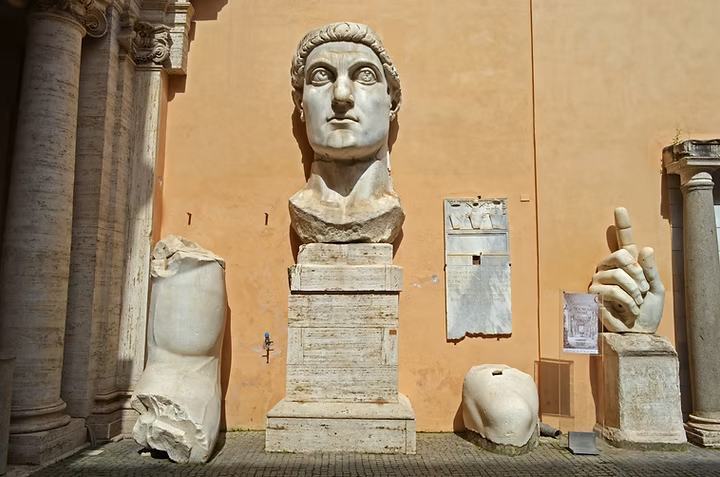
The Emperor was however careful in how he promoted Christianity, highlighting Roman culture in both monuments and statues. In some representations he wears military garb, and despite the religious transformations in his Empire, he is undeniably shown as a soldier-Emperor, and Hadrian, is shown in uniform, headdress and serious facial expression. Eusebius records the Arch of Constantine in Rome as having ‘… large lettering and inscriptions the sign of the saviour…as the salvific sign of the authority of Rome…’ (Eusebius, Life of Constantine), but, ambiguously, the Arch mostly features traditional Roman motif’s, gods such as a winged Victory, Apollo and Hercules, and containing ‘spolia’, that is re-used pieces from monuments built by Trajan and Hadrian, thereby connecting Constantine’s reign to the greatness of previous Emperors. Constantine here was trying to appeal to all in society, the necessary pragmatism of holding Empire together.

In building his Arch, Constantine was acting like previous Emperors, building monuments in Rome to preserve the memory of historical events, and revamping existing buildings, but this time for Christian worship. Eusebius quotes a letter sent by Constantine to bishops in Rome about the maintenance of church buildings ‘…church buildings have… become dilapidated through neglect…ask for the necessary supplies from the governors…[who are] directed to cooperate whole heartedly with…your holiness…’ (Eusebius, Life of Constantine). This was a huge move by the Emperor, by ordering government to pay for church maintenance effectively aligned the church with Imperial administration. That Constantine did these things was not necessarily divinely inspired, but more a Roman trait, as the writer Woolf puts it ‘Romans ruled well because they owed it to their nature to do so, not in respect of the rights of others’; stability, through good management was the Emperor’s priority.
Constantine’s benevolence didn’t stop there, as gifts he made to the Basilica of Saint Peter, and in particular, the adornment of the vaulted roof show,‘…gleaming with polished gold…over the body of the blessed Peter…a cross of purest gold, weighing 150lbs…’ (Liber Pontificalis, Silvester). All this wealth was placed over the body of an apostle, Constantine is now allowing the dead to be buried within the city walls, another fundamental shift away from traditional Roman practice, previously only carried out when the Emperor Trajan’s ashes were interred in the base of his column in Rome.
Having stamped his authority on Rome, Constantine now invested courage and foresight in the creation of a new capital city in the east, one bearing his name. Eusebius records the honouring of ‘the tombs of [Christian] martyrs, and consecrating the city to…God’ and ‘…[seeing] fit to purge it of all idol-worship…altars foul with bloody slaughter, sacrifice offered as holocaust in fire, feasts of demons, [and]…customs of the superstitious’ (Eusebius, Life of Constantine). Archaeological evidence tells a different story, which again questions Eusebius’ conviction of Constantine’s conversion to Christianity, with huge marble heads of mythical gorgons, the guardians against mis-fortune, being found in Constantinople’s forum, the completion by Constantine of the city’s hippodrome, complete with statues commemorating Augustus’ victory at Actium and an Imperial palace, and the extant Çemberlitaş, a 36-meter red-porphyry column originally topped by a bronze statue of Constantine himself, mirroring that of Trajan’s in Rome.
Accordingly the Greek historian Zosimus (460 -520 AD), writing a century later, denounced the Emperors rejection of traditional Roman religion for Christianity, and taking a view contrary to that of Eusebius, writes of Constantinople itself as being ‘…considerably enlarged…to make it a residence worthy of an emperor…yield[ing] himself to voluptuousness… expand[ing] the public treasury in unnecessary and unprofitable buildings… likewise [making] great change in the ancient magistracy’.
Here, the pagan Zosimus is attacking Constantine’s adoption of Christianity as disingenuous, noting wasteful practices and indulgence, but perhaps we are again seeing Constantine’s pragmatism, building a new ‘Christian’ capital while still staying loyal to traditional Roman culture, surely a survival mechanism, avoiding an outright break by distancing himself, and the Roman apparatus from those who sought conflict. Transformations were probably underway that represented a cross-fertilisation of Roman and Christian elements, so Zosimus’ resistance was a natural reaction to such huge transformational cultural changes. Zosimus does however acknowledge Constantine’s benefaction in distributing a present of corn to the people, the traditional Roman annona, or corn dole, in itself something that could have been described of Constantine as ‘Christian’ by Eusebius.

Constantine’s final act, a significant one after his baptism, was his choice of burial place. His mauseoleum, high up on a city hill and dedicated to the twelve apostles, was possibly cross-shaped, when traditionally, imperial tombs were circular. Eusebius records ‘’He…gave instructions for services to be held there, setting up a central altar, [and] erected twelve repositories…in honour and memory…of the apostles, and put his own coffin in the middle…’ (Eusebius, Life of Constantine). Constantine’s burial in Constantinople helped reinforce the dramatic change of direction, and fortune, of the Roman Empire.
The evidence found shows that Constantine’s huge gamble and great power shift, the abandonment of Rome and the fractious, non-profitable war-torn west, pulled the rug from beneath an uncontrollable military, and reinvigorated the Empire in the relative calm of the east, using a brand-new state-religion, with himself in true Roman Imperial fashion, at the centre of it. His ability in creating a ‘new Rome’ in the east, Nova Roma Constantinopolitana, and conversion to Christianity was, in reality a survival mechanism, a reaction to the upheavals of the previous century and a means to preserve the Empire, albeit a preservation that demanded a huge shift in what it really meant to be Roman.
Sources:
Silvester, Bishop of Rome, Liber Pontificalis
Eusebius, Life of Constantine
Woolf, An Empire’s Story, 2022
Oxford Classical Dictionary, Third Edition, 2012
 everythinglatin.co.uk
Leave a comment