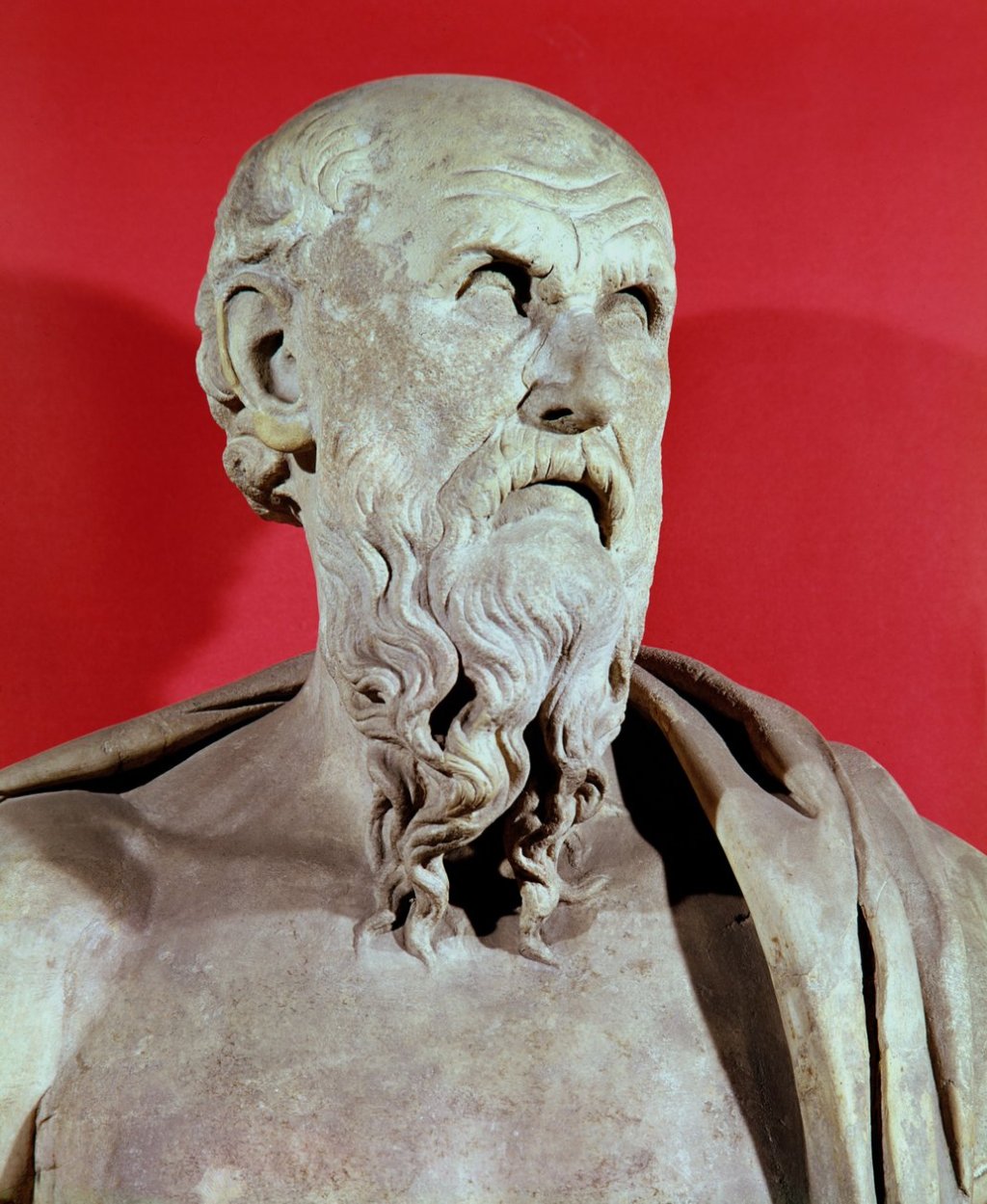
Marble bust of Hesiod
The Five Ages of Man is a creation story written by a Greek shepherd named Hesiod, who lived somewhere between 776 BC and 650 BC, who along with Homer was one of the epic writers of Greek poetry. It is likely that Hesiod ‘borrowed’ some of his poem from an unidentified older legend, possibly of Mesopotamian or Egyptian origin.
According to Greek legend, Hesiod was a farmer from the Boeotian region of Greece who encountered the Nine Muses one day when he was tending his sheep. The Nine Muses were the daughters of Zeus and Mnemosyne (Memory), divine beings who inspired creators of all kinds, including poets, writers, speakers, and artists. The Muses were always invoked at the beginning of an epic poem, and were instrumental in the telling of Greek myth.
The Muses inspired Hesiod to write the 800-line epic poem which he called Works and Days, which tells three myths: the story of Prometheus’ giving of fire to mankind, the tale of Pandora and the jar that contained all the woes of the Earth, and the five, very different ages of man. This poem is a creation story that traces the lineage of man through five successive “ages” or “races” that tell humankind’s story. They are the Golden Age, the Silver Age, the Bronze Age, the Age of Heroes, and the present, as it was to Hesiod, Iron Age.
The Golden Age
The first age of man was the Golden Age, and was a mythical time that saw the people of the Golden Age formed by the Titan Cronus, the father of Zeus. Man lived like the gods, he never knew sorrow or toil; when he died, it was as if he fell asleep. Springtime always endured, and there was no winter. They lived in happiness and enjoyed an abundance of food and resources that were provided to them by Gaia (Earth). When men died, they became daimones, beings that act as an intermediary between man and the gods;
‘The Stoics say, then, that there are also some demons who have sympathy for men, who watch over human affairs, and also that there are heroes, that is, the surviving souls of the virtuous’ – Diogenes Laertius
After Zeus had castrated his father Cronus, and had overthrown him to become king of all the gods, he defeated the Titans in the epic war known as the Titanomachia after 10 years of fierce fighting, and the Golden Age came to an end.
The Silver Age
During Hesiod’s Silver Age in the Five Ages of Man, the Olympian god Zeus was in charge, and he made this generation of man vastly inferior to the gods in appearance and wisdom. He divided the year into the four seasons. Man had to work the land, he had to plant grain and build shelter, but man’s children could play for 100 years before having to grow up. But the people didn’t want to pay homage to the gods, so Zeus destroyed them. When they died, they became “blessed spirits of the underworld.”
Bronze Age
Hesiod’s Third Age in the Five Ages of Man was bronze, and during this time the earth was stricken with war. Zeus created men from ash trees—a hardwood used in spears. The men of the Bronze Age were terrible, strong, and warlike. Their houses and tools were made of bronze; they did not eat bread, living mainly on meat. This generation of man was destroyed by the great flood in the days of Prometheus’ son Deucalion.
The myth of this flood is told in the story of how Deucalion and his wife Pyrrha build a boat and therefore survive the flood that destroys mankind. When the waters eventually subside, the couple repopulate the earth by throwing stones down on the ground, as instructed by the goddess Themis, which are turned into people.
When the men of the bronze age died, they went to the Underworld. In Greek, and older myths, bronze was connected to weapons, war, and warfare, and the armour these men wore was made of bronze.
The Age of Heroes
For the fourth age in the Five Ages of Man, Hesiod dropped the metallurgical metaphor and called it the Age of Heroes. The Age of Heroes was a historical period to Hesiod that referred to the Mycenaean age and stories by Hesiod’s fellow poet, Homer. The people of this time were honourable, and many of their heroes, like Hercules, Ajax and Achilles, respected the gods (some of them were actually semi-divine) and followed their laws. The Age of Heroes was a better time, when man understood justice, and the men called Hemitheoi were demigods, strong, brave, and heroic. Many were destroyed by the great wars of Greek legend, such as the Trojan War. After death, some went to the Underworld; others to the Islands of the Blessed Ones, and their names have gone down in history.
The Iron Age
The fifth age in the Five Ages of Man was the Iron Age, Hesiod’s name for his own time, and in it, all modern men were created by Zeus as evil and selfish, burdened with weariness and sorrow. All manner of evils came into being during this age. Death and disease plagued the inhabitants and they were always surrounded by desolate places and destruction. Piety and other virtues disappeared and most of the gods who were left on Earth abandoned it. Hesiod predicted that Zeus would destroy this race someday. Iron is the hardest metal and the most troublesome to work, forged in fire and hammered.
Hesiod’s Message
‘Hesiods message is a tale of degeneration, following the lives of men as they fall from a state of primitive innocence to malign evil, with a single exception for the Age of Heroes, which is probably illustrated to highlight what man could be capable of, if he chose. Works and Days is a poem about morality, Hesiod being concerned with almost all the moral issues of his world: Law, justice and injustice, religion, peace and war, as well as matters of family and community, issues that have tortured generations and are still torturing us today’
Panayiotis P. Mavrommatis
Massachusetts Institute of Technology
You can read Gregory Nagy’s translation of Works and Days here

 everythinglatin.co.uk
Leave a comment