
In Roman culture, there was a belief in life after death and that the soul lived on after the person had died. The Romans believed that after death, the soul became a shade (umbra) which took on the likeness (simulacrum) of the person who had just died. There were distinct similarities with Greek history, in Homer’s Illiad Odysseus travels to the underworld to meet several ‘shades’ including that of Achilles and his own mother. In Virgil’s Aeneid, the hero Aeneas travels there to meet his father who shows him a succession of future Roman leaders. The Romans thought, as did the Greeks, there was three distinct realms: the Elysian Fields, if they died a brave warrior in battle; the Plains of Asphodel if they died having lived a good life; and Tartarus, or Hell, where an evil doer would be sent, and would remain, until they were forgiven their sins.
Those who received a proper burial entered the Elysian fields, but those whose bodies not buried respectfully, or insepultum, were denied access. These souls were doomed to wander aimlessly as Pliny’s ghost story tells us, when he writes of a Greek philosopher, called Athenodorus who arrives in Athens looking for lodgings, and hears of a house that is available for rent at a very cheap price, mainly because the landlord couldn’t convince anyone to rent it because of the ghost that haunted it. Unconcerned, Athenodorus rents the house and that night hears the rattling of chains and discovers the ghost of a man in his room motioning for him to follow. Athenodorus follows the ghost to a spot in the courtyard where the spirit suddenly disappears, so the next day Athenodorus excavates the area that the ghost showed him, and the remains of a man bound in chains are discovered. Athenodorus then ensures the body is buried with proper funerary rites, and from then on the house is free from the hauntings. The Romans considered the lack of being given a proper burial was the main reason a soul came back to haunt an area, as it could not rest in peace until their body was buried with respect.
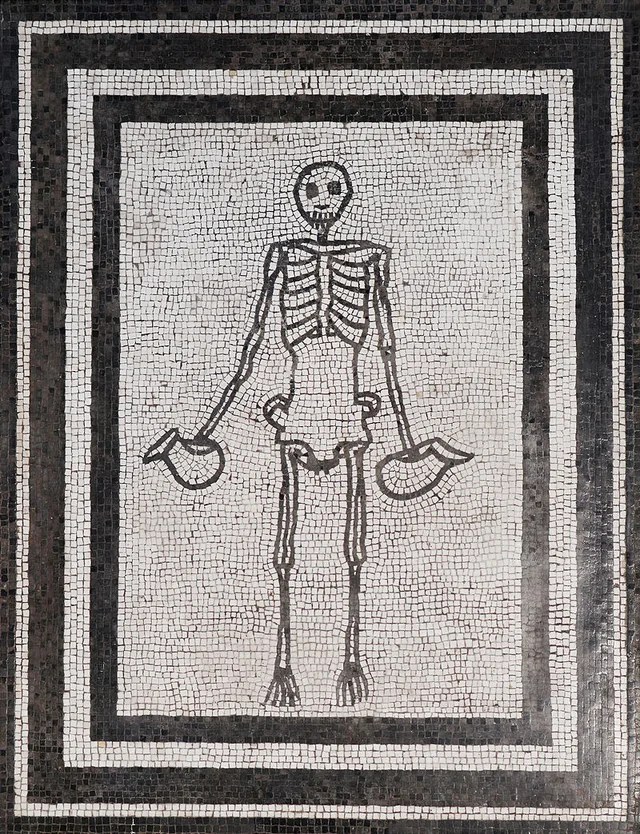
The Romans had a strong belief in how the dead should be treated, that was honourably and with respect. They worshipped the dead at their festivals, the Lemuria and Feralia – and within the home in the atrium (hallway), where the household gods, called Penates and wax imagines (see A Walk with the Dead) of the family ancestors were kept. This respect continued right through the culture of Ancient Rome, the Latin term pietas which means a ‘sense of duty’.
Alas, for some there was no respect shown, the Emperor Elagabalus was slaughtered by his own soldiers as he hid in the toilets. His corpse was dragged through the streets of Rome, and thrown into the River Tiber, washing up in Rome’s sewer, the Cloaca Maxima. A most inglorious death for one of Rome’s most hated emperors, he was subjected to what we call damnatio memoriae, the damnation of memory—a practice whereby dead, disgraced Roman emperors had their statues pulled down, coins defaced, and inscriptions erased. This happened to several figures in Roman history including Marc Antony, Nero, Caligula, and Elagabalus.
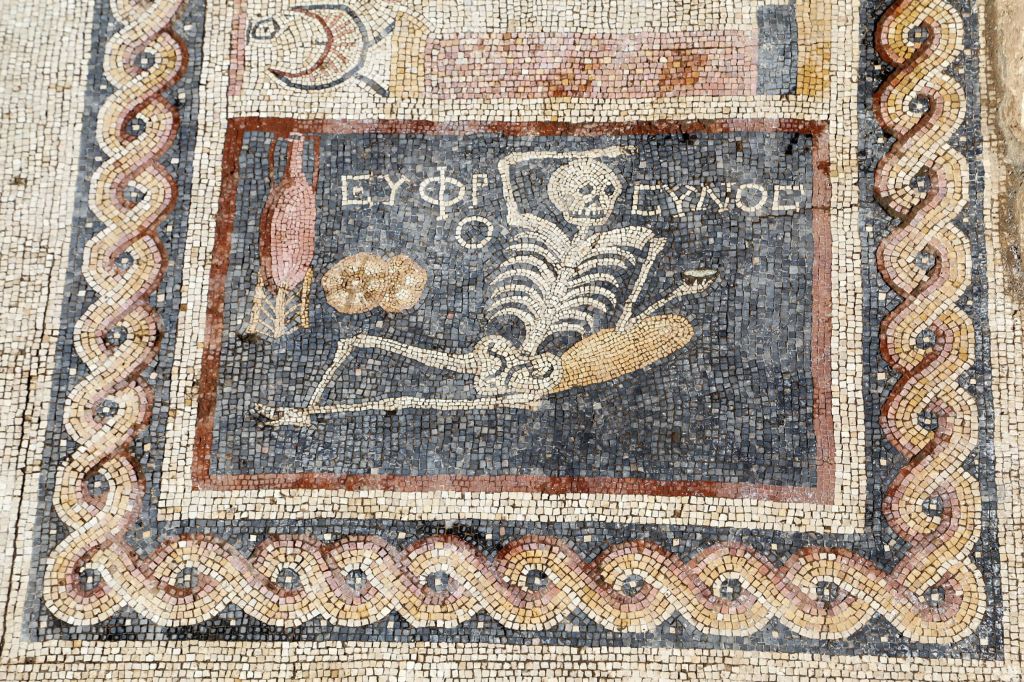
A third century B.C. Roman mosaic discovered in 2012 in Antakya Turkey, which depicts a skeleton lying down with a jorum in his hand, a wine pitcher and bread on the side along with an inscription that translates as ‘be cheerful, enjoy your life’
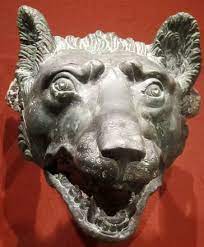
Just for a bit of fun, there is a story from ancient Rome below that tells of a man whose friend suddenly became a werewolf, which was written by the courtier Petronius who lived around the time of Nero and is thought to have written the extant Satryiacs. The Wolf was seen as a powerful animal to the Romans and was often seen as a symbol of strength and power, most probably due to the fable of Romulus and Remus being suckled by one.
When I was still a slave, we lived in Brundisium. There I began to love Melissa, a very beautiful woman who lived in a villa in the country. Perhaps my master had set out for Capua. Given the opportunity, therefore I decided to visit Melissa, but I did not want to go alone. Therefore, I persuaded a friend to come to the fifth milestone with me. However, he was formerly a soldier, as strong as hell.
We set out at night. The moon was shining just like at midday. We came among some tombs. My man began to go towards the tombstones. I sat singing and counting the tombstones. Then, when I looked back at my friend, he had stripped off all his clothes and placed them near the road. My breath was in my nose. I was standing just like the dead. Suddenly he became a wolf. Do not think I am joking.
After he had become a wolf, he began to howl and fled into the woods. At first, I did not know where I was. Then I approached the tombstones in order that I pick up his clothes. However, they were made of stone. For a short time, I stood terrified. However, I drew my sword and struck out at the shadows in the whole road until I arrived at the villa of my friend. I entered half dead like a ghost.
Melissa wondered why I was walking so late,
‘If you had come earlier’ she said ‘you would have been able to help us. For a wolf entered the villa and he killed all the animals like a butcher. A slave however wounded him in the neck with a lance’.
Upon hearing this I was so disturbed I was not able to close my eyes, but fled homeward at dawn. After I came to that place where the clothes were made into stone, I found nothing except blood. But when I came home, my soldier was lying in bed like an ox and a doctor was attending to his neck. I understood him to be a werewolf and afterwards I was not able to taste bread with him, not if you had killed me.
 everythinglatin.co.uk
Leave a comment