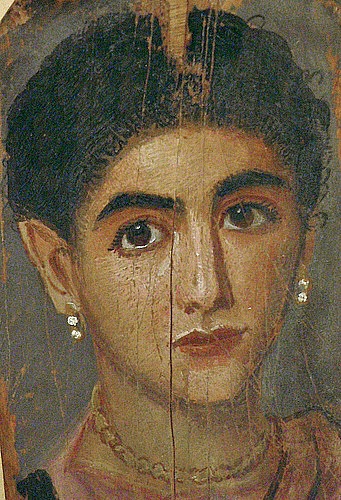
A Fayum mummy portrait, a painted portrait on wooden board attached to the body of an usually upper class person before burial in Roman Egypt.
Immortal Aphrodite, on your intricately brocaded throne,
child of Zeus, weaver of wiles, this I pray:
Dear Lady, don’t crush my heart
with pains and sorrows.
But come here, if ever before,
when you heard my far-off cry,
you listened. And you came,
leaving your father’s house,
yoking your chariot of gold.
Then beautiful swift sparrows led you over the black earth
from the sky through the middle air,
whirling their wings into a blur.
Rapidly they came. And you, O Blessed Goddess,
a smile on your immortal face,
asked what had happened this time,
why did I call again,
and what did I especially desire
for myself in my frenzied heart:
“Who this time am I to persuade
to your love? Sappho, who is doing you wrong?
For even if she flees, soon she shall pursue.
And if she refuses gifts, soon she shall give them.
If she doesn’t love you, soon she shall love
even if she’s unwilling.”
Come to me now once again and release me
from grueling anxiety.
All that my heart longs for,
fulfill. And be yourself my ally in love’s battle.
Some say an army of horsemen,
some of footsoldiers, some of ships,
is the fairest thing on the black earth,
but I say it is what one loves.
It’s very easy to make this clear
to everyone, for Helen,
by far surpassing mortals in beauty,
left the best of all husbands
and sailed to Troy,
mindful of neither her child
nor her dear parents, but
with one glimpse she was seduced by
Aphrodite. For easily bent…
and nimbly…[missing text]…
has reminded me now
of Anactoria who is not here;
I would much prefer to see the lovely
way she walks and the radiant glance of her face
than the war-chariots of the Lydians or
their footsoldiers in arms.
Translated by Julia Dubnoff

 everythinglatin.co.uk
Leave a reply to Caleb Cheruiyot Cancel reply