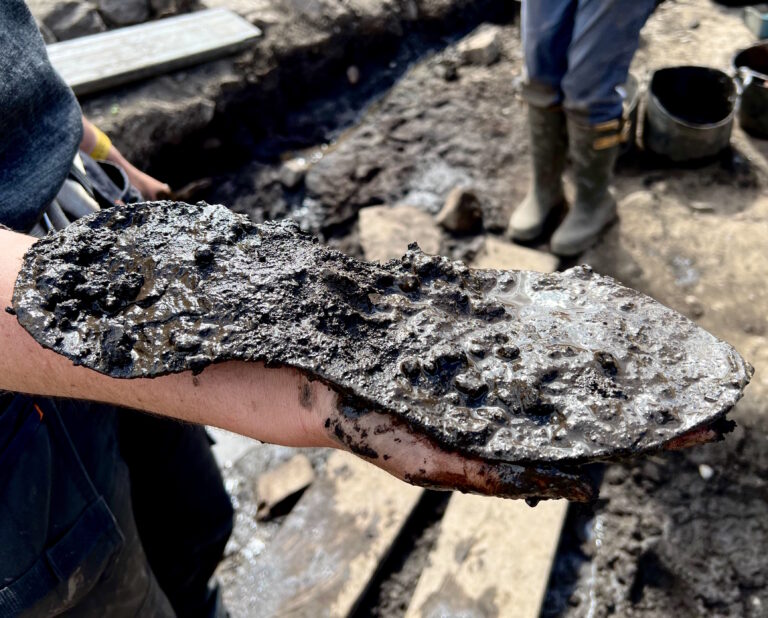
Evidence has emerged of Northumberland’s very own Bigfoot during a dig at a Roman fort near Hadrian’s Wall. Excavations by teams of volunteers are investigating defensive ditches at the little-explored Magna fort, which is also the site of the Vindolanda Trust’s Roman Army Museum.
And the latest find has seen one occupant of the fort walk into the history books as one of his shoes was discovered in a ditch. The trust, which runs the Vindolanda and Magna sites, has around 5,000 shoes that have survived in the anaerobic underground conditions, where waterlogging excludes oxygen meaning that organic material like leather is preserved. To the astonishment of archaeologists and volunteers, the Magna shoe measures 32cm long, which is the equivalent of UK men’s size 12-14 in modern footwear.

“It immediately drew impressed gasps from volunteers and staff alike,” said Magna senior archaeologist Rachel Frame. “The sheer size of the shoe and guesses about who could have worn it dominated the conversation. We were baffled and astounded by the sheer size of the shoe.”
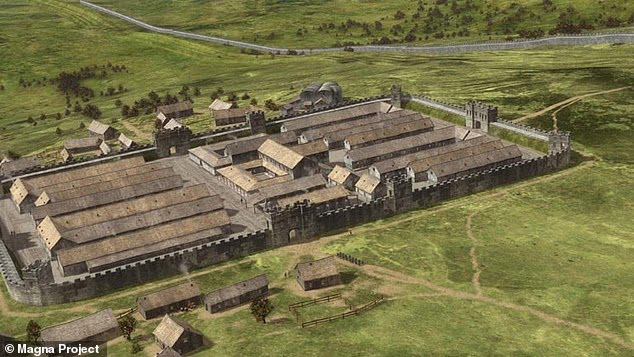
Magna was home to two of the most exotic Roman regiments to have served in Roman Britain – the Syrian archers and the Dalmatian Mountain soldiers. The dig is the third in a five-year project at the 52-acre Magna fort, which is threatened by climate change and is part of an operation, backed by the National Heritage Lottery Fund, which is monitoring the underground conditions and the impact of changing weather such as May’s record breaking dry spring.

Rachel said: “These finds are just a few more examples of the artefacts and information at risk from our changing climate so we are very grateful to still have the chance to find such personal connections to the past. This month-long dry spell is contributing to the underground changes affecting the preservation of organic material remains at Magna and Vindolanda.
“At Magna, the lack of rain has caused the groundwater level to drop considerably. When the groundwater level drops changes occur in the soil environment. These changes can impact upon basic soil chemistry and microorganisms living in it.
“The changing environmental conditions can in turn impact on the archaeological artefacts and reduce the preservation of organic material remains such as wood, leather and textiles.”
The trust is working with Newcastle, Teesside and Edinburgh universities in the study of how water and oxygen are behaving underground as part of the impact caused by changing weather patterns.
Magna archaeologist Franki Gillis said: “ The knowledge we are gaining from our environmental monitoring is critical to understanding the impact of climate change. So although nice, this abnormally lovely warm spring may be harmful to the continual preservation of our organic finds at Magna and Vindolanda.
“We have our weather station and probe array to monitor these changes in the soil environment as they occur. Our continuous monitoring can help us develop future mitigation plans so we can salvage as much archaeology as possible.”
Magna—also known as Carvoran—was at the edge of the Whin Sill on Hadrian’s Wall, part of a series of Roman forts in Britain. Experts believe this site could have been a fort since 85 A.D., before the start of the wall’s construction in 122 A.D.
“It’s always exciting to find anything that hasn’t been touched for 2,000 years but a shoe is such a personal item,” a volunteer on the project said, “It really puts you in touch with the people who used to live at the fort. Getting wet and muddy and digging in the wet is just a bonus.”
Preliminary boring at Magna has shown that archaeological preservation extends to six metres below ground – a huge potential bank of knowledge on life during the Roman occupation and beyond. On November 15, a one-day climate conference will be held at the Roman Army Museum at Magna. The event will explore the theme of climate change and its impact on archaeology – from the specific conditions at Magna fort to the wider frontier landscape of Hadrian’s Wall and beyond.
This article was written by Tony Henderson who writes about the environment, architecture, nature & heritage. He is a multi-award winning journalist with more than 30 years experience. It was published in the Chronicle Live on the 9th June 2025
 everythinglatin.co.uk
Leave a comment