By Joobin Bekhrad posted 20th June 2018 on BBC Travel blog
This post isn’t really about the Roman Empire, although their seemingly never-ending conflict with the Parthian Empire, and long association with the ancient cities of Philadelphia (modern-day Amman in Jordan), Palmyra and Damascus (both in modern-day Syria), amongst others, would have definately brought them into contact with this practice of supplying clean, fresh water to a desert location. Considering their own engineering skills, especially in the building of aquaducts, the Qanat is a construction they would have truly admired. I hope you enjoy reading Joobin Bekhrad’s article.
Dating back around 3,000 years, the qanat is an ingenious and sustainable solution to Iran’s dearth of easily accessible water.
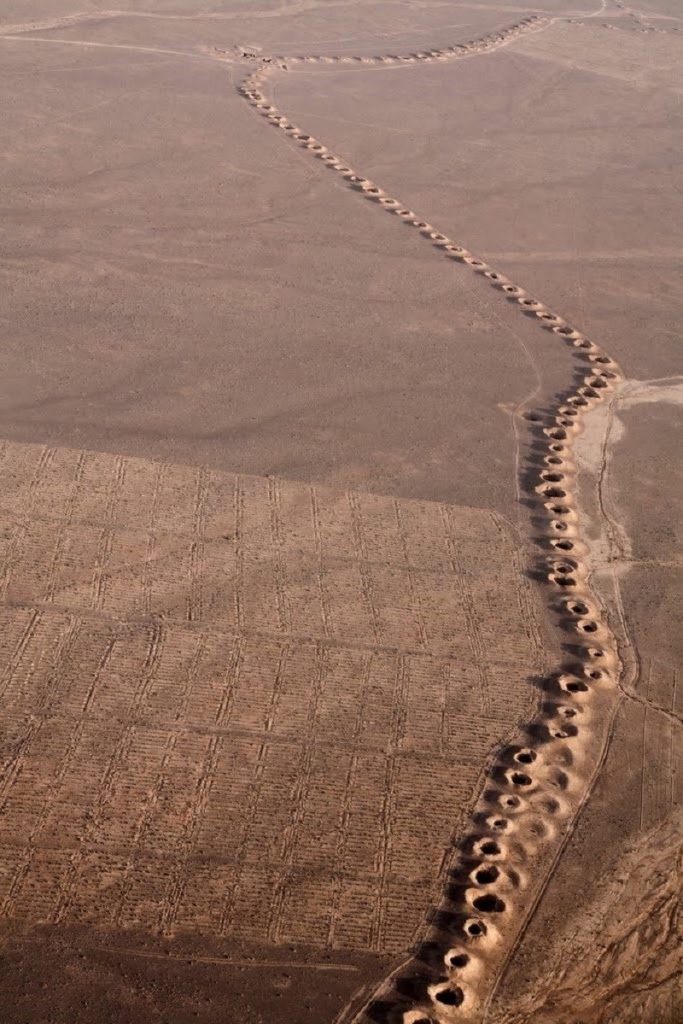
Simply put, a qanat is an underground channel that carries fresh water from an elevated source in the mountains to an opening at a lower altitude for the purposes of irrigation – a perfect solution in a region with an abundance of mountains. Once a possible source of fresh water is identified, indicated by the presence of an alluvial fan (a triangle-shaped sedimentary deposit at the base of a mountain), a shaft that looks from above like an anthill is bored underground until the water source is reached.
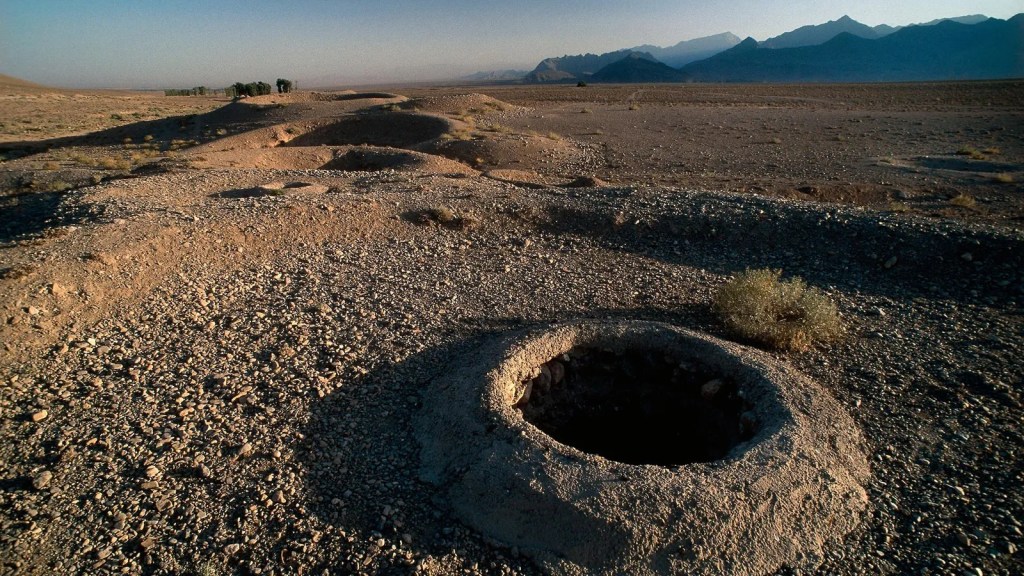
While in some cases not much digging is required, other shafts can extend up to 300m below ground. Numerous other anthill-like shafts are then bored at regular intervals to extract soil as well as provide ventilation for the workers excavating the earth below. To make things even more difficult, the slope of the qanat must be precisely calculated: too steep an incline, and the water’s downward force will erode the qanat; too flat, and the water won’t flow.

The complex system was well worth the effort, however. These underground aqueducts have allowed Iranians for millennia to access and transport water in some of its most arid regions. One of the most impressive examples is in the Fars province of south-west Iran. Here, the city of Persepolis was built by the Achaemenid Persians (550-330BC) in a hot and dusty plain surrounded by the Zagros Mountains. The location was not exactly endowed with nature’s bounty. Yet, by way of the qanat, Persepolis became the epicentre of an empire that stretched from Greece to India, and was regarded by many as the most luxurious city in the world, famed for its opulent palaces and exquisite gardens.

The qanat system was so effective that it soon spread to other corners of the world, first through the ancient Persians’ conquests, and later by way of the Muslim Arabs, who adopted the system from the Persians and carried it with them as far as Andalusia, Sicily and North Africa. According to William B Hemsley in The Qanat: An Ancient Water Supply, so highly did the ancient Egyptians value the qanat system that the Persian emperor Darius the Great “was later honoured with the title of Pharaoh” in return for introducing it to them.
Not only does the qanat provide necessary drinking water, it also helps lower indoor temperatures. In Yazd in central Iran, where summers can be stiflingly hot, the qanat is as indispensable as it is ingenious. Used in combination with a badgir (an Iranian wind-catcher), the water in the qanat cools warm incoming air, which enters it through a shaft, before being released into a basement and expelled through the openings at the top of the badgir. In houses in Yazd, for instance, this ancient method of air conditioning is still widely used, and is an inseparable aspect of engineering and architecture.
Similarly, the qanat made it possible to store large quantities of ice year round in desert climates. Constructed in conical shapes made of an admixture of heat-resistant materials, and also making use of Iranian wind-catching technology, the yakhchal (literally ‘ice pit’) is an ancient Iranian form of refrigeration dating to around 400BC. In the winter months, water would be sourced from a qanat and left to freeze in the yakhchal’s basement enclosure before being cut into blocks and stored for year-round use. Air entering through the qanat shafts and cooled by the underground water would further assist in reducing temperatures.

Although technological innovations have reduced the reliance of Iranians on the qanat, the aqueducts are still prominent and widespread throughout the country. With tens of thousands of qanats in Iran today boasting a total distance comparable to that between the Earth and the moon, the ingenuity of the ancient Persians has more than stood the test of time. In accordance with the ancient Iranian/Zoroastrian reverence for nature and the elements, it is incomparable as a sustainable and environmentally friendly method of not only fresh water extraction, but air conditioning and refrigeration. As well, in rural contexts, it allows for the equitable distribution of water, and through the necessity of its ongoing maintenance brings about social collaboration.
Despite Cyrus the Great’s world renown as a wise, just and compassionate leader, one can’t help but wonder what the empire he founded – the basis of modern-day Iran, barring politics – would have been without the aid of the qanat. What would the Persian army and people have done without access to fresh water? What would Persepolis – and the innumerable cities in the vast dominion of the Empire – have looked like without fresh water?


 everythinglatin.co.uk
Leave a comment