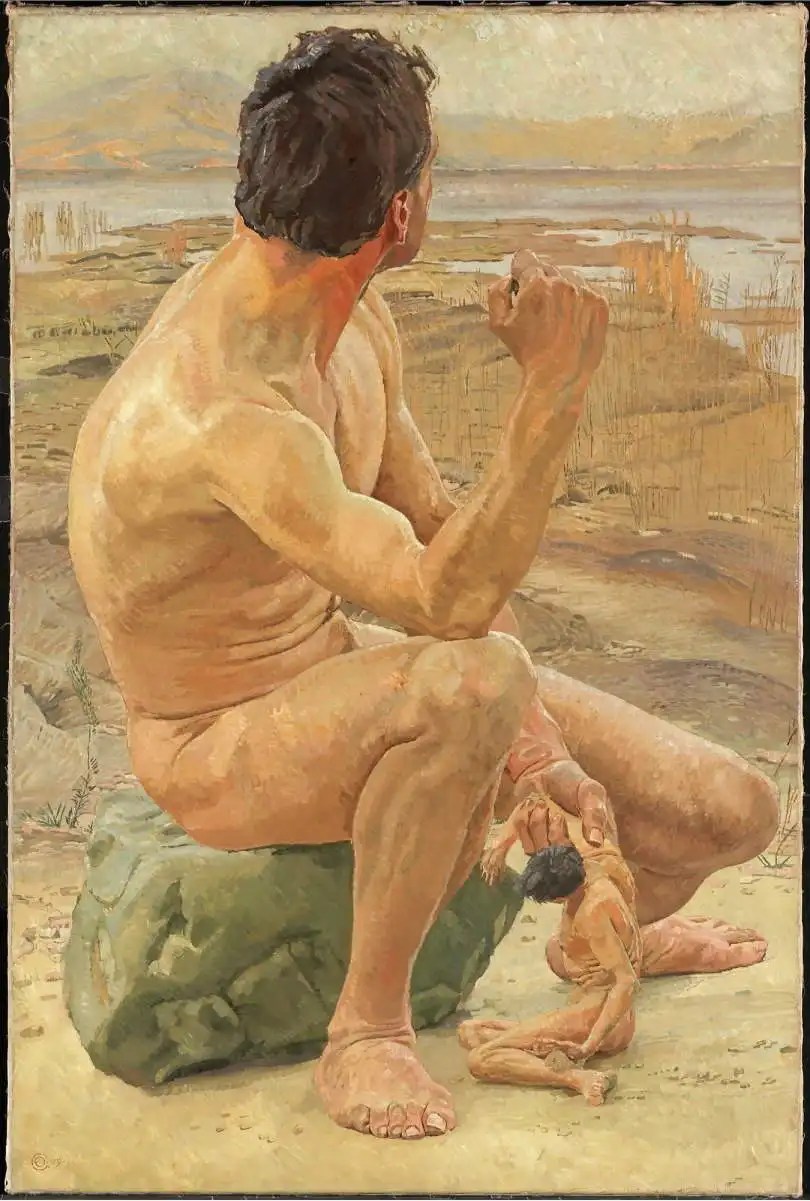
Prometheus, possibly meaning “forethought” is a god of fire and his adaptability in the face of brutality has become legendary. He is known across the world for defying the Zeus by stealing fire from him and giving it to humanity in the form of technology and civilization. His story inspired the famous Greek play Prometheus Bound.
In the time before humans were created, there were the Gods and the Titans. The Gods were great beings with immense powers, and Zeus was their leader. The Titans were powerful giants, who were older than the Gods. Both were greedy to rule over the heavens, and ultimately a great war broke out that was fought to decide which group of supreme beings would have control over the universe. The war was vicious, it lasted for ten years and ended in victory for the Olympian gods.
There were two Titans, twins, called Prometheus and Epimetheus. The name ‘Prometheus’ means ‘foresight’ and he was the wiser of the two brothers, and they both turned against their fellow Titans and joined with Zeus and the Olympian Gods, fighting many battles with great bravery, proving themselves true warriors, earning Zeus’ praise when they achieved victory.
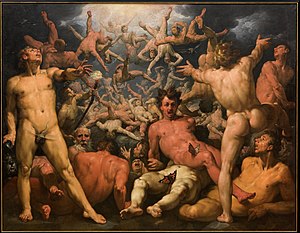
The two brothers saw the defeated Titan army sent to the fiery pits of Tartarus in the Underworld as punishment, and their brother Atlas, who led the Titan rebellion, doomed to hold the earth in the sky for all eternity as punishment. The brothers made the choice not to live on Mount Olympus, but rather they preferred to make their home on Earth.
On his travels Prometheus paid a visit to Athena, the goddess of wisdom who taught him many things about astronomy, mathematics, architecture, navigation, metalworking and writing. Zeus tasked the brothers with creating the animals of the Earth and giving these creatures the traits of the gods. Epimetheus accepted this challenge readily, bestowing the gift of flight to the birds, and the ability to the fish to swim and live in the oceans.
Prometheus however, took a handful of mud and began to sculpt. First he made a strong torso, then hands, feet and eyes. He made these figurines in the image of the Gods themselves. Athena loved these slightly strange, clay creatures and so breathed life into them – between them Prometheus and Athena had created the first humans to walk the Earth.
When Zeus saw the humans that the two had created, he was not impressed, and laughing, said “ Look at these simple creatures!, they may look like gods, but will always be nothing but mortal. They will pay us Gods our due tribute and forever worship us!”
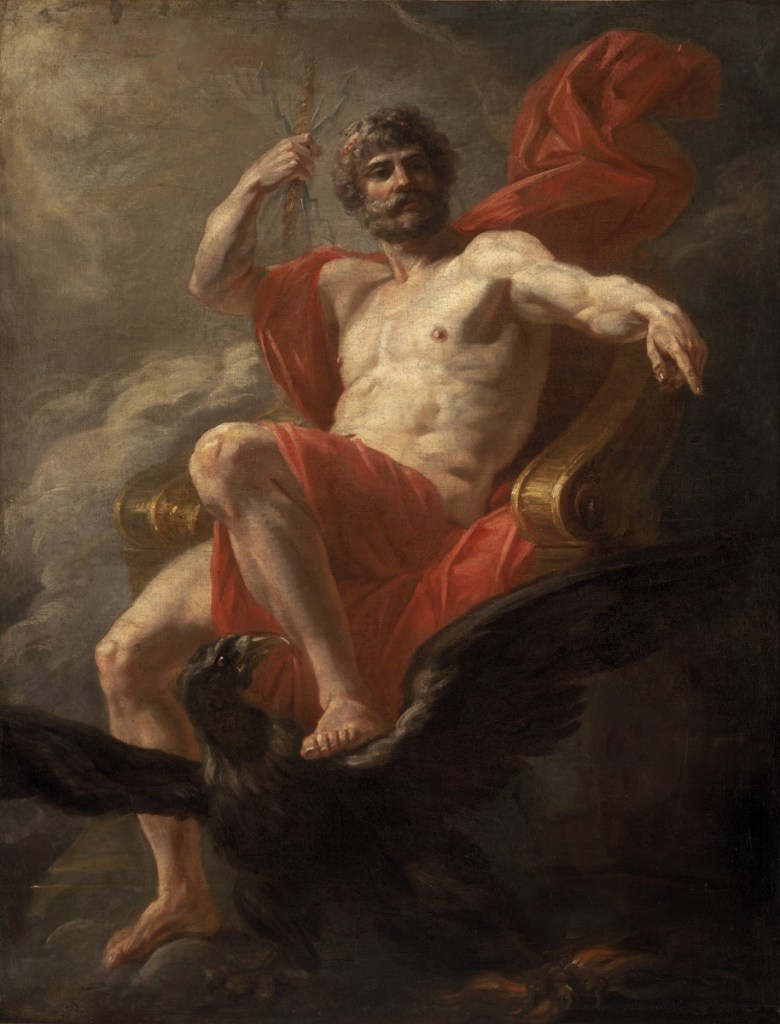
Prometheus was downcast, as he thought his creations were more important than that, and that they could have a greater purpose on Earth, other than just being simple-minded creatures, fit for nothing other than paying the Gods tribute. He swore he would find a way to help these small creatures he had created make something of their lives.
Zeus wanted the humans to worship the gods, and that they should know how to offer tributes and sacrifices properly. He wanted them to give the Gods the best tribute they could of what was available to them. Prometheus said that he would show the humans how to sacrifice a bull, and how to split the meat into two parts, one part (the best) for paying tibute to the gods, the lesser part to feed themselves with. Zeus agreed, he would choose what he wanted and show the humans how to worship him.
Prometheus made two heaps out of the slaughtered bull. On pile held all the healthy meat and the skin that could be worn to keep warm, but he disguised this by putting it beneath the remains of the bull’s intestines. The other pile was the bones and the gristle of the animal covered with a thin layer of fatty meat. He showed this to the humans so they understood his game, and then called Zeus to come and collect his tribute.
Zeus looked in disgust at the stomach and offal and quickly chose the part with the fatty flesh and took it back to Mount Olympus. However, when Zeus uncovered the worthless bones under the layer of meat, he knew he had been tricked, and by Prometheus the Titan.
The Olympian god knew Prometheus cared for his human creations dearly, so in order to punish the Titan for his trickery, Zeus declared, “No human may use fire on Earth, neither to cook with nor to keep warm. You will be blinded by the dark of night and you will never forget how powerful the Gods are, and how it is by our power you have any food or warmth at all. Perhaps then you will remember to always worship us properly and not challenge us with these tricks again!”
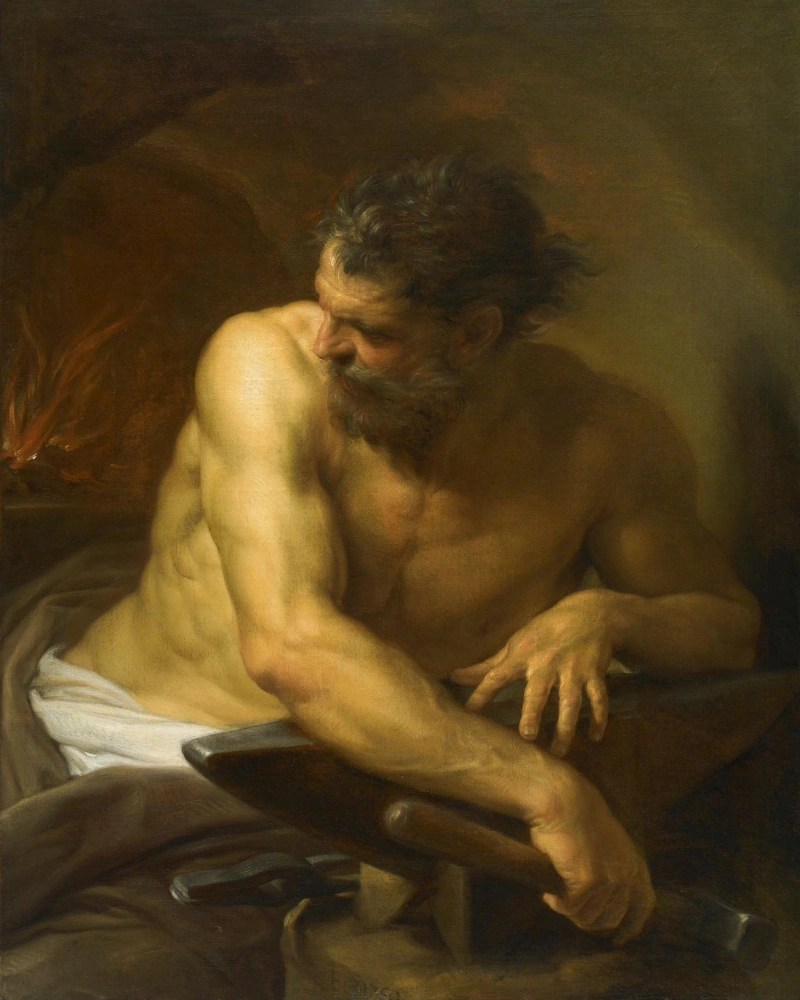
The humans shivered in fear and in the cold, and without fire they would stay weak, and vulnerable. Prometheus was outraged, and decided he could not stand by as his humans struggled to survive. Secretly that night, he climbed the steep rocks of Mount Olympus to the very top where lay the workshop of Hephaestus, God of Blacksmithing and Fire. Hephaestus’ workshop was a great forge containing a huge fire, an anvil and the weapons of the gods. In a corner he saw the arrows of Artemis, Goddess of the Hunt, and on a bench there lay a pile of Zeus’ own thunderbolts, ready to smite the earth.
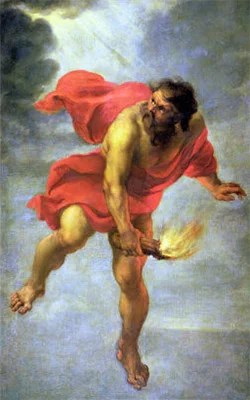
Prometheus crept forwards to the gigantic anvil and hearth, and took a spark of Hephaestus’ fire and stored it within a hollow stalk of fennel. He hurried back to Earth, and started to teach mankind how to use fire to improve their lives.
…the humans had not received any of the traits of the gods, and so, Prometheus brought them these gifts instead. Along with the gift of fire, he taught them mathematics and architecture to build safe and strong towns. They learnt astronomy and navigation and soon they could sail the sea. He taught them to write and to forge metal and create things that would last for centuries. Fire meant that the humans could care for themselves, but it also meant that they could forge weapons, and then they waged wars. They chopped trees to build their homes, they travelled the seas and soon spread all over the world.
Some human beings became kings and some were enslaved by their own kind. Prometheus’ fire was responsible for the rise of civilisations and empires as humans learned to embrace their power. Some became so powerful that they even questioned the authority of Zeus and the gods on Mount Olympus. Some even thought of themselves as gods.
Zeus was outraged at this, not only had Prometheus stolen from the gods, but he had destroyed, perhaps forever, the subservience of human beings to the gods. Zeus’ vengeance was swift and cruel. He captured Prometheus and bound him to a cliff on Mount Caucasus in unbreakable chains, uttering these terrible words:
“if thou wilt not obey my words, …first, this rocky chasm shall the Father split with earthquake, thunder and his burning bolt, and he shall hide thy form, and thou shalt hang bolt upright, dandled in the rock’s rude arms. Nor till thou hast completed thy long term shalt thou come back into the light; and then the hound of Zeus, the tawny eagle, shall violently fall upon thy flesh and rend it as if ’twere rags; and every day and all day long shall thine unbidden guest sit at thy table, feasting on thy liver till he hath gnawn it black. Look for no term to such an agony till there stand forth among the Gods one who shall take upon him thy sufferings and consent to enter hell far from the light of Sun, yea, the deep pit and mirk of Tartarus, for thee.”
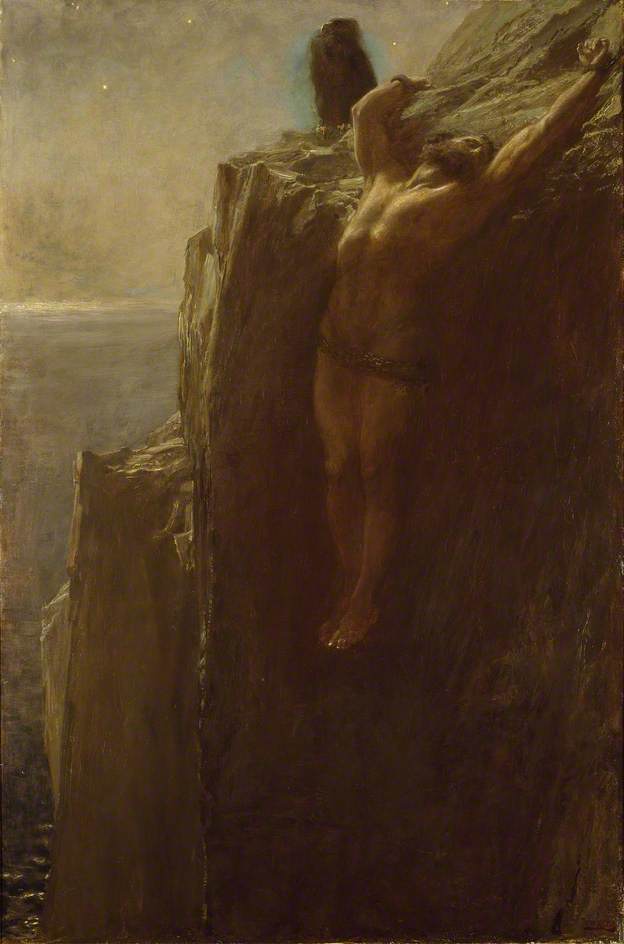
He then called forth a huge and vicious vulture to rip out the Titan’s liver every day. Every night, Prometheus’ body healed itself, and then the vulture would return to attack him again in the morning. Through all his torture, Prometheus was defiant, and never once regretted his rebellion against Zeus. The God said to be free a immortal must agree to die on Prometheus’ behalf, and somebody must kill the eagle and break the unbreakable chains that bound him. These conditions seemed impossible, but eventually Chiron the Centaur agreed to die for him (as to lose his immortality, as he was in perpetual agony from the poison of the Hydra, slain by Hercules). So, Heracles, a son of Zeus by Alcmena, who was travelling through Greece fulfilling his Twelve Labours, stumbled upon Prometheus chained to the cliff, and decided to free the Titan.
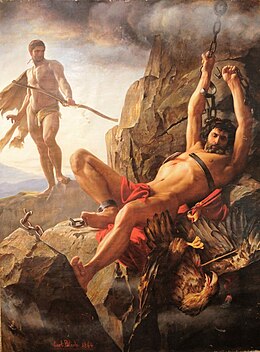
He killed the eagle with an arrow and using his superhuman strength, broke Prometheus free of his chains. Proud of his son’s awesome physical ability, and admiring the Centaurs sacrifice, Zeus finally relented and allowed Prometheus his freedom.
Sources: Marian Vermeulen, BA History and Philosophy &
Daniel Soulard, BASc Classical Civilizations The Collector


 everythinglatin.co.uk
Leave a comment