As reported by Historic England and others in April 2021:
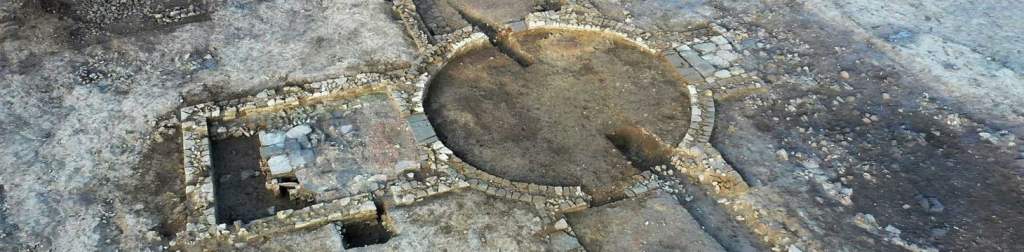
Rare Roman remains were discovered in recently at the site of a new housing development in Scarborough, North Yorkshire.
The potential for discovering Roman ruins had been identified at the site in Eastfield, so archaeologists employed by the developer Keepmoat carried out excavations as part of the agreed planning conditions with advice from Historic England.
During the course of these excavations, it became clear that the Roman archaeological remains were far more significant than anticipated.
The excavations revealed a large complex of buildings including a circular central room with a number of rooms leading off it, as well as a bathhouse. Archaeology experts believe they are likely to represent a high-status luxury Roman villa or religious sanctuary, or perhaps a combination of both.
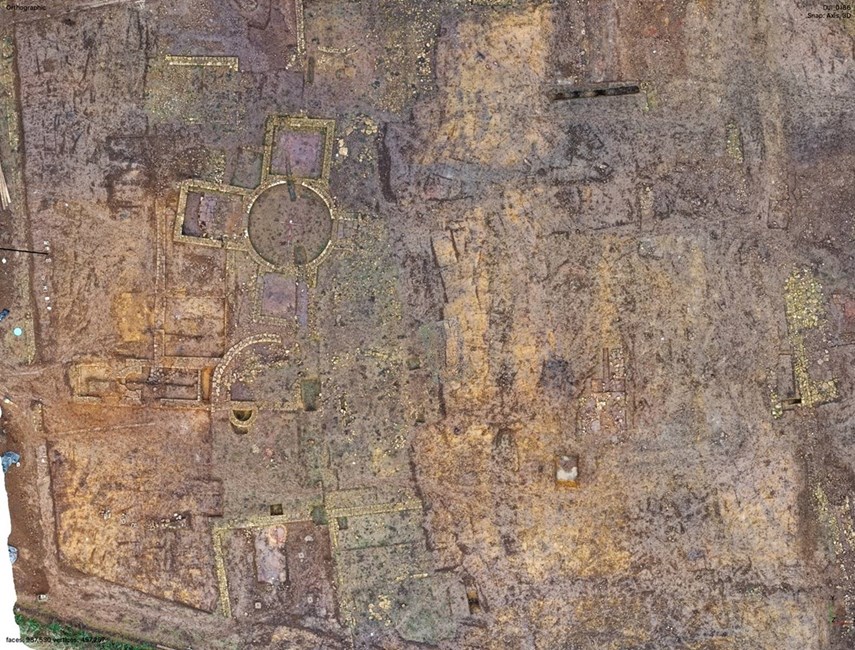
This type of building layout has never been seen before in Britain and could even be the first of its kind to be discovered within the whole former Roman Empire.
Working in partnership with Historic England, North Yorkshire County Council and Scarborough Council, Keepmoat has modified its design for the housing development to protect the remains for future generations. In the original application, houses would have been built over the site, but the public open space within the development has now been relocated to cover and conserve the core of the Roman structural remains.
Historic England will grant aid the additional archaeological work, which will include the analysis and publication of discoveries made at the site.
”These archaeological remains are a fantastic find and are far more than we ever dreamed of discovering at this site. They are already giving us a better knowledge and understanding of Roman Britain. We are grateful to Keepmoat Homes for their sensitive and professional approach to helping ensure the future conservation of this important historical site.”
Keith Emerick, Inspector of Ancient Monuments
Historic England
Theo Farrant reported the following, published on 18/11/2024
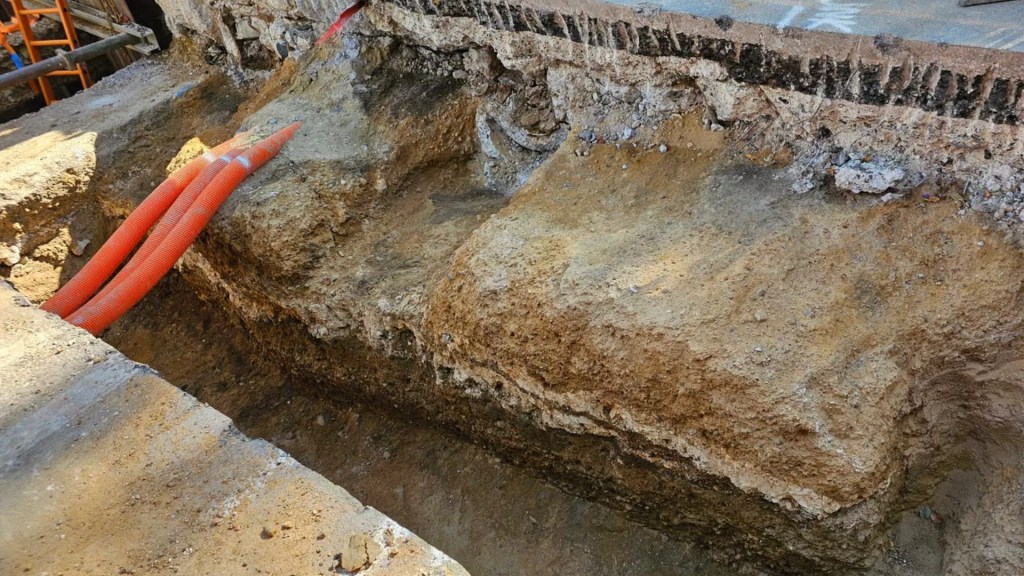
Just a few weeks ago, a very well-preserved section of Watling Street, one of Britain’s most significant and famous Roman roads, has been discovered in south-east London, in what archaeologists have described as a “remarkable” find.
The ancient route, built shortly after the Roman invasion of Britain in AD 43, is originally said to have stretched 276 miles, linking the Roman port of Dover with Londinium (the capital of Roman Britain) and extending up into the West Midlands. It played an important role in connecting Roman Britain, even hosting imperial visitors such as Emperor Hadrian in AD 122, when he initiated construction of the 73-mile-long -wall that would bear his name.
Watling Street has featured countless times throughout popular culture, from Geoffrey Chaucer’s story of a group of medieval pilgrims travelling from London to Canterbury in “Canterbury Tales”, to James Bond, who drives along the road in Ian Fleming’s novel “Moonraker”.
Despite its fame, the exact course of Watling Street through London has long been a mystery to archaeologists and historians, with much of its route hidden by centuries of urban development. This latest discovery beneath Old Kent Road, ahead of work to expand Southwark’s low-carbon heat network, offers crucial evidence of its path through the capital.
The uncovered stretch lies south of the junction with Ilderton Road and measures approximately 19ft (5.8m) wide and nearly 5ft (1.4m) high.
“The intact section of Roman Watling Street directly under the current Old Kent Road has redrawn the Roman road map for Southwark and informs on Roman construction techniques generally. It is a key finding for archaeological research for London,” explains Gillian King, the director of archaeology at RPS Consulting.
To commemorate the discovery, Southwark Council plans to place a commemorative sign near the site on the Old Kent Road railway bridge.
 everythinglatin.co.uk
Leave a comment