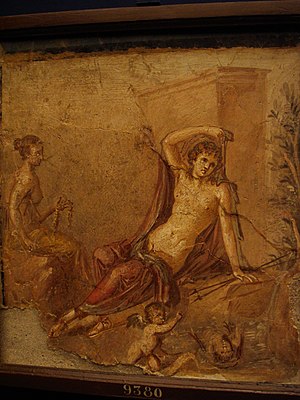
Narcissus and Echo (45–79 AD), wall painting from Pompeii
Praise for Tales from Ovid:
‘A breathtaking book…To compare his versions with the Latin is to be awestruck again and again by the range and ingenuity of his poetic intelligence…He rescues the old gods and goddesses from the classical dictionaries and gives them back their terror. There should be a copy of his book in every school’. John Carey Sunday Times
Taken from Tales from Ovid, 24 Passages from the Metamorphoses, published by Faber and Faber Ltd 1997. Copyright Ted Hughes, 1930 -1998
When the prophetic vision awoke
Behind the blind eyes of Tiresias
And stared into the future,
The first to test how deeply he saw
And how lucidly
Was Liriope, a swarthy nymph of the fountain.
She was swept off her feet by the river Cephisus
Who rolled her into the bed of a dark pool,
Then cast her up on the shingle pregnant.
The boy she bore, even in his cradle,
Had a beauty that broke hearts.
She named this child Narcissus. Gossips
Came to Tiresias: ‘Can her boy live long
With such perfect beauty?’ The seer replied:
‘Yes, unless he learns to know himself.’
All regarded these words as a riddle –
Till time solved them with a strange madness.
A stranger death completed the explanation.
In his sixteenth year Narcissus,
Still a slender boy but already a man,
Infatuated many. His beauty had flowered,
But something glassy about it, a pride,
Kept all his admirers at a distance.
None dared be familiar, let alone touch him.
A day came, out on the mountain
Narcissus was driving and netting and killing the deer
When Echo saw him.
Echo who cannot be silent
When another speaks. Echo who cannot
Speak at all
Unless another has spoken.
Echo, who always answers back.
In those days, this nymph was more than a voice.
She had a pretty body.
But her prattle was the same –
Never anything more
Than the last word or two, the tail end
Of what she heard uttered by others,
Which she repeated over and over.
Juno had stricken her
With this odd affliction.
When Juno, following a tip off,
Would be stalking Jupiter, to catch him
In some dell, with a nymph,
Echo made it her duty
To engage the goddess in an unending
Rigmarole of chatter. Till the nymph
Had pleased the god enough
To be let go.
Echo did this so often,
And so artfully, Juno
In a rage turned on her: ‘Your tongue
Has led me in such circles,
Henceforth
It will have to trail
Helplessly after others, uttering
Only the last words, helplessly,
Of what you last heard!’
The moment Echo saw Narcissus
She was in love. She followed him
Like a starving wolf.
Following a stag too strong to be tackled.
And like a cat in winter at a fire
She could not edge close enough
To what singed her, and would burn her.
She almost burst
With longing to call out to him and somehow
Let him know what she felt.
But she had to wait
For some other to speak
So she could snatch their last words
With whatever sense they might lend her.
It so happened, Narcissus
Had strayed apart
From his companions.
He hallooed them: ‘Where are you?
I’m here.’ And Echo
Caught at the syllables as if they were precious:
‘I’m here’ she cried, ‘I’m here’ and ‘I’m here’ and
‘I’m here.’
Narcissus looked around wildly.
‘I’ll stay here’ he shouted.
‘You come to me’ and ‘Come to me,’
Shouted Echo. ‘Come to me,
To me, to me, to me.’
Narcissus stood baffled,
Whether to stay or go. He began to run,
Calling as he ran: ‘Stay there’. But Echo
Cried back, weeping to utter it, ‘Stay there,
Stay there, stay there, stay there.’
Narcissus stopped and listened. Then, more quietly,
‘Let’s meet halfway. Come.’ And Echo
Eagerly repeated it: ‘Come’.
But when she emerged from the undergrowth
Her expression pleading,
Her arms raised to embrace him,
Narcissus turned and ran.
‘No,’ he cried ‘no, I would sooner be dead
Than let you touch me.’ Echo collapsed in sobs,
As her voice lurched among the mountains:
‘Touch me, touch me, touch me, touch me.’
Echo moped under the leaves.
Humiliated, she hid
In the deep woods. From that day
Like a hurt lynx, for her
Any cave was a good home.
But love was fixed in her body
Like a barbed arrow. There it festered
With his rejection. Sleeplessly
She brooded over the pain,
Wasting away as she suffered,
The petal of her beauty
Fading and shrivelling, falling from her –
Leaving her voice and bones.
Her bones, they say, turned
Into stone, sinking into the humus.
Her voice roamed off by itself,
Unseen in the foest, unseen
On the empty mountainside –
Though all could hear it
Living the only life left to Echo.
Narcissus had rebuffed her adoration
As he had the passionate attentions
of many another a nymph of the wilderness
And many another man.
One of these, mocked and rejected,
Lifted his hands to heaven:
‘Let Narcissus love and suffer
As he has made us suffer.
Let him, like us, love and know it is hopeless.
And let him, like Echo, perish of anguish.’
Nemesis, the corrector,
Heard this prayer and granted it.
There was a pool of perfect water.
No shepherd had ever driven sheep
To trample the margins. No cattle
Had slobbered their muzzles in it
And befouled it. No wild beast
Had ever dashed through it.
No bird had ever paddled there preening and bathing.
Only surrounding grasses drank its moisture
And though the arching trees kept it cool
No twigs rotted in it, and no leaves.
Weary with hunting and the hot sun
Narcissus found this pool.
Gratefully he stretched out full length,
To cup his hands in the clear cold
And to drink.
But, as he drank
A strange new thirst, a craving, unfamiliar,
Entered his body with the water,
And entered his eyes
With the reflection in the limpid mirror.
He could not believe the beauty
Of those eyes that gazed into his own.
As the taste of water flooded him
So did love. So he lay, mistaking
That picture of himself on the meniscus
For the stranger who could make him happy.
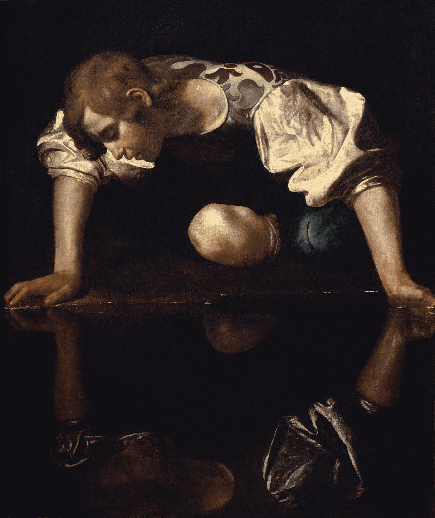
He lay, like a fallen garden statue,
Gaze fixed on his image in the water,
Comparing it to Bacchus or Apollo,
Falling deeper and deeper in love
With what so many had loved so hopelessly.
Not recognising himself
He wanted only himself. He had chosen
From all the faces he had ever seen
Only his own. He was himself
The torturer who now began his torture.
He plunged his arms deep to embrace
One who vanished in agitated water.
Again and again he kissed
The lips that seemed to be rising to kiss his
But dissolved, as he touched them,
Into a soft splash and a shiver of ripples.
How could he clasp and caress his own reflection?
And still he could not comprehend
What the deception was, what the delusion.
He simply became more excited by it.
Poor misguided boy! Why clutch so vainly
At such a brittle figment? What you hope
To lay hold of has no existence.
Look away and what you love is nowhere.
This is your own shadow.
It comes with you. While you stay it stays.
So it will go
When you go – if ever you can go.
He could not go.
He wanted neither to eat nor to sleep.
Only to lie there – eyes insatiably
Gazing into the eyes that were no eyes.
This is how his own eyes destroyed him.
He sat up, and lifting his arms
Called to the forest: ‘You trees
Was there ever a love
As cruel as mine is to me?
You aged voyeurs, you eavesdroppers,
Among all the lovers who have hidden
Under yoyr listening leaves
Was there ever a love
As futureless as mine?
What I love is untouchable.
We are kept apart
Neither by seas nor mountains
Nor the locked up gates of cities.
Nothing at all comes between us –
Only the skin of water.
He wants my love as I want his.
As I lean to kiss him
He lifts up his face to kiss me –
Why can’t I reach him? Why can’t he reach me?
In that very touch of the kiss
We vanish from each other – he vanishes
Into the skin of water.
‘Who are you? Come out. Come up
Onto the land. I never saw such beauty
To compare with yours. Oh why do you always
Dodge away at the last moment
And leave me with my arms full of nothing
But water and the memory of an image.
It cannot be my ugliness
Or my age that repels you,
If all the nymphs are so crazy about me.
Your face is full of love
As your eyes look into my eyes
I see it, and my hope shakes me.
I stretch my arms to you, you stretch yours to me
As eagerly to me. You laugh when I laugh.
I have watched your tears through my tears.
When I tell you my love I see your lips
Seeming to tell me yours – though I cannot hear it.
‘You are me. Now I see that.
I see through my own reflection.
But it is too late.
I am in love with myself.
I torture myself. What am I doing –
Loving or being loved?
What can my courtship gain?
What I want, I am.
But being all that I long for –
That is my destitution.
Why can’t I get apart from my body?
This is a new kind of lover’s prayer.
To wish himself apart from the one he loves.
‘This impotent grief
Is taking my strength
And my life.
My beauty is in full bloom –
But I am a cut flower.
Let death come quickly –
Carry me off
Where this pain
Can never follow.
The one I loved should be let live –
He should live on after me, blameless.
But when I go – both go.’
Then Narcissus wept into the pool.
His tears shattered that still shrine
And his image blurred.
He cried after it: ‘Don’t leave me.
If I cannot touch you at least let me see you.
Let me nourish my starving, luckless love –
If only by looking.’
Then he ripped off his shirt,
And beat his bare chest with white fists.
The skin flushed under the blows.
When Narcissus saw this
In the image returned to perfection
Where the pool had calmed –
It was too much for him.
Like wax near the flame,
Or like hoar-frost
Where the first ray of the morning sun
Creeps across it,
He melted – consumed
By his love.
Like Echo’s, the petal of his beauty
Faded, shrivelled, fell –
He disappeared from his own eyes.
Till nothing remained of the body
That had driven Echo to distraction.
Echo was watching all this misery.
Remembering how it happened before
To her, when he ran from her,
Her anger blazed
But her pity smothered it.
And when he moaned, ‘Alas, ‘ she wept,
And groaned. ‘Alas.’ His last words,
As he gazed into the dark pool,
‘Farewell, you incomparable boy,
I have loved you in vain.’
Returned from her lips with sorrow doubled:
‘I have loved you in vain’
And after his last ‘Farewell’
Came her last ‘Farewell.’
He pillowed his head on the grass.
So finally death
Closed the eyes that had loved themselves too much.
When he entered the Land of the Dead
Narcissus could not resist it –
He ran straight to the banks of the Styx
And gazed down at the smear of his shadow
Trembling on the fearful current.
His sisters, the nymphs of the fountains,
Cropped their hair and mourned him
In a lamenting song – and far off,
Wandering heartbroken among the hills
Echo sang the refrain.
When men came with timber
To build a pyre, and with crackling torches
For the solemnity
That would reduce Narcissus
To a handful of dust in an urn –
No corpse could be found.
But there, in the pressed grass where he had perished,
A tall flower stood unbroken –
Bowed, a ruff of white petals
Round a dainty bugle centre
Yellow as egg yolk.

Yes, it was this quiet woodland flower
Trumpeted the fame of Tiresias
Throughout Achaia.


 everythinglatin.co.uk
Leave a reply to Mark Cancel reply