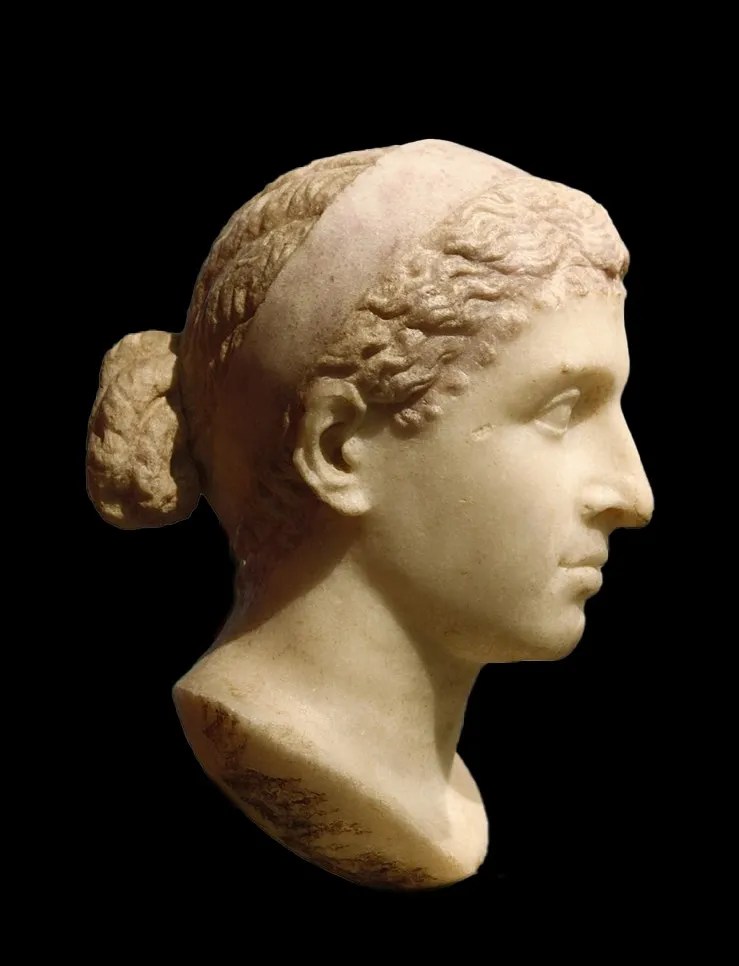
Bust of Cleopatra VII in the Altes Museum, Berlin
Her full name was Kleopatra VII Thea Philopator, the title Kleopatra, is Greek for ‘Glory of her Father’, and she was the seventh female in the royal dynasty of Egypt to be called a Kleopatra. Although she was born in Egypt, she could trace her family back to Macedonian Greece and a soldier named Ptolemy I Soter, one of Alexander the Great’s generals. Soter ruled Egypt after Alexander’s death in 323 BC, and he launched a dynasty of Greek-speaking rulers that lasted for nearly three hundred years. In keeping with the tradition of his name, almost every male child born into the royal house after his death was called Ptolemy.
Like many royal houses, members of the Ptolemaic dynasty quite often married into their own family in order to ‘preserve’ their bloodline. Several of Cleopatra’s ancestors tied the knot with either a cousin, brother or sister, and it’s possible her own mother and father, Ptolemy XII were also sister and brother.
Cleopatra’s elder sister Bernice was executed by their father, Ptolemy XII after she tried to depose him and seize the throne. The Royal intrigue rumbled on with Cleopatra, at different times marrying her teenage brothers, both of them serving as her co-regent.
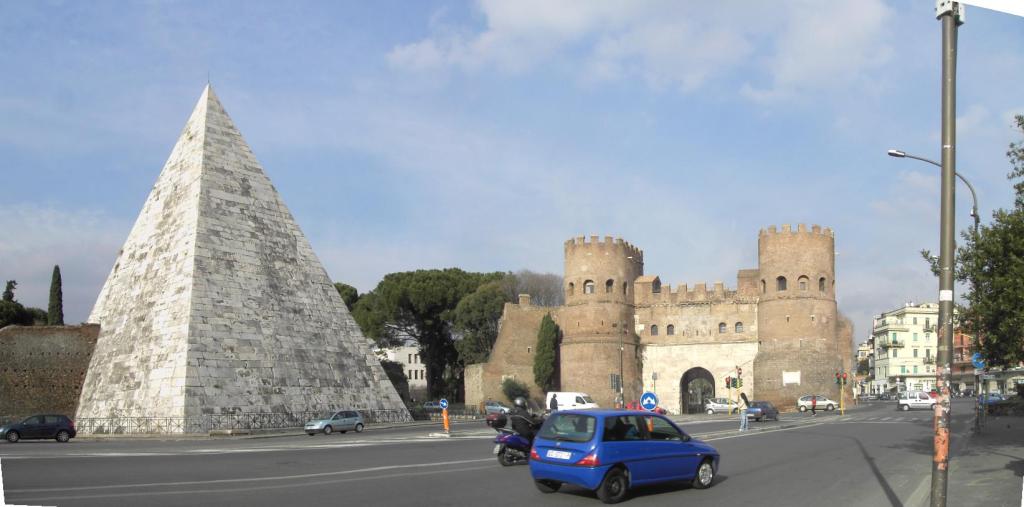
The Romans had a fascination with the culture of anything even remotely Egyptian, they even built a pyramid, The Pyramid of Cestius, in Rome in 18 BC in the style of the Nubian pyramids as a tomb for Gaius Cestius, a member of the Epulones religion.
But in truth, they were more interested in the Egyptian grain they could export back to their own country. Rome had always suffered food shortages, and access to grain was the reason why they had fought Carthage in the Mediterranean 200 years previously; in order to gain control of the North African controlled island of Sicily, which grew a large amount of wheat.
This was a time of shifting political allegiances and treachery, with Rome as the predominant power in the region. When they made overtures to Egypt, with the aim of buying up Egyptian grown grain at the cheapest price possible, they were just not used to dealing with authorative or overly intelligent women, and the political situation grew uneasy. The poet Horace said she was not humble as a woman should be, and called her ‘fatale monstrum‘ – a fatal omen. Cicero never referred to her by name, and called her simply the Queen, but it was not done out of respect.
Roman propaganda painted Cleopatra as debauched, wanton, and heathen almost, but she possessed a great intellect, far greater than many she came up against, most of them men. She possessed a charm, wit and an intelligence that gave her a personal magnetism that quite simply dissolved any animosity that her rivals had for her. A gifted linguist, she was fluent it was said, in nine languages. As the only Macedonian ruler who taught herself Egyptian, she was worshipped by her many of her subjects as a living goddess, calling her the new Isis. She was the foreigner whom Romans feared most, since Hannibal over a century before her. She used her charm as a weapon not arms.
As well as languages, and was educated in mathematics, philosophy, oratory and astronomy, and Egyptian sources later described her as a ruler “who elevated the ranks of scholars and enjoyed their company.”
Coins with her portrait show her with manly features and a large, hooked nose, though some historians say that she intentionally portrayed herself as masculine as a display of strength. For his part, the ancient writer Plutarch claimed that Cleopatra’s beauty was “not altogether incomparable,” and that it was instead her mellifluous speaking voice and “irresistible charm” that made her so desirable, and the larger part of that charm was her intelligence.
However, when it came down to it, power grabs and murder plots were as much a Ptolemaic tradition as family marriage, and Cleopatra and her brothers and sisters were no different. Her first sibling-husband, Ptolemy XIII, ran her out of Egypt after she tried to take sole possession of the throne, and the pair later fought a civil war. Cleopatra regained the upper hand, and Ptolemy drowned in the Nile River after being defeated in battle. After Caesar visited the country during the civil war in Rome, the war that saw Pompey the Great, Caesar’s adversary, murdered on an Egyptian beach, she started an affair with him, hoping to give her country stability. She knew Rome was far stronger than her country was, and would one day try a land grab and claim Egypt for herself, so she wanted to preserve her dynasty. Her affair with Caesar resulted in her giving birth to a son, Ptolemy XV Caesar, known as Caesarion.
Later, Cleopatra remarried her younger brother Ptolemy XIV, but she is believed to have had him murdered in a bid to make Caesarion her co-ruler. For her role in a conspiracy to take the throne of Eygpt for herself, Arsinoe, Cleopatra’s sister, was taken as a prisoner of war to Rome where she was forced to walk in chains through the streets, drawing cries of pity from the crowd. Arsinoe was then exiled to the Temple of Artemis at Ephesus, and was executed there by orders of Mark Antony in 41 BC at Cleopatra’s behest, who had by then taken him as her lover. Arsinoe’s murder was a gross violation of temple sanctuary, and it caused a serious scandal back in Rome, and drew an unreserved apology from Cleopatra.
Cleopatra believed herself to be a living goddess, and she often used dramatics to emphasise her divine status. A famous example of her flair for the dramatic came in 48 BC, when Julius Caesar arrived in Alexandria during her feud with her brother Ptolemy XIII. She wrapped herself in sheets of bedlinen, some say she climbed into a linen sack, and was carried by her personal attendant into Caesar’s quarters. The Roman, aged 52 was so dazzled by the sight of the 21 year old queen in her royal garb, that the two quickly became lovers.
The Egyptian Queen joined Julius Caesar in Rome at the beginning of 46 BC, and her presence seems to have caused quite a stir. Caesar didn’t hide the fact she was his mistress, she even brought their child Caesarion with her, and many Romans were shocked when he erected a gilded statue of her in the temple of Venus Genetrix. But then, Caesar was used to snubbing his nose at authority and its conventional attitudes, and he seemed to be enjoying it.
Cleopatra was forced to flee Rome after Caesar was stabbed to death on the Ides of March in 44 BC, but by then she had made her mark on the city. Her exotic hairstyle and pearl jewelry became a fashion trend, and the historian Joann Fletcher, professor at the department of archaeology at the University of York has written “so many Roman women adopted the ‘Cleopatra look’ that their statuary has often been mistaken for Cleopatra herself.”
Summoned to meet Mark Antony in 41 BC, in order to explain where she sat in relation to the growing unrest between Antony and Octavian, Cleopatra is said to have arrived at the meeting on a flower-decked barge, purple sails billowing in the breeze, rowed by oars inlaid with silver. She was dressed to look like the goddess Aphrodite, and sat beneath a canopy while her flunkies fanned her and burned sweet-smelling incense. Antony, who considered himself akin to the Greek god Dionysus (Cicero attacked him for this in his Philippics), was instantly enchanted.

When civil war between Octavian and Mark Antony broke out, again trying to stabilise her country, Cleopatra allied herself with Antony, whom she saw as the stronger of the two men in Rome. She had three children with him, but their relationship created a huge propaganda coup for Octavian. He portrayed Antony as a traitor who was caught in the web of a scheming foreigner, and a woman at that, and in 32 BC, the Roman Senate, on his urging, declared war on Cleopatra and Antony. The conflict reached its climax the following year in a famous naval battle at Actium, off the shores of western Greek mainland. Cleopatra personally led several dozen Egyptian warships into battle alongside Antony’s ships, but they were soundly beaten by Octavian’s forces. The two allies were forced to break out from the Roman naval blockade and flee back to Egypt.
Cleopatra and Antony famously took their own lives in 30 BC, after Octavian’s victory at Actium, and his forces pursuit of them to Alexandria. While Antony is said to have wished himself to be buried in Egypt, and fatally stabbing himself, some mystery surrounds Cleopatra’s death. Legend has it that she died by enticing an asp to bite her arm, but the historian Plutarch admits that “what really took place is known to no one.” He says Cleopatra was also known to conceal a deadly poison in one of her hair combs, and the historian Strabo notes that she may have applied a fatal “ointment.”
It is known that Octavian visited Alexandria, where Cleopatra was hiding after learning of Antony’s suicide, and although no known records exist, he is thought to have had a private meeting with her, and gave her two days in which to kill herself, or be taken to Rome as a prisoner and executed. This was presented as an honourable way out for the Egyptian Queen, and perhaps she took it.
She died aged 39, the last Pharoah to rule over Egypt. Ironically, after Octavian’s eventual victory, as was the Roman custom, all vestiges of Mark Antony were removed from public view, his statues were smashed, coins bearing his likeness were removed from circulation, and his name was forbidden to be uttered in public, or be passed down to a new born child. Yet Caesar’s statue of Cleopatra in the temple of Venus Genetrix, in the centre of Rome remained in place for many years.
In reference to her beauty let’s finish with a quote from Gnaeus Domitius Ahenobarbus in William Shakespeare’s tragedy ‘Antony and Cleopatra’, “Age cannot wither her, nor custom stale / Her infinite variety: other women cloy / The appetites they feed, but she makes hungry / Where most she satisfies…”
The Queen of the Nile was most famously played by Elizabeth Taylor in the 1963 epic Cleopatra. The Welsh actor Richard Burton played Mark Antony, and it was on set the pair met for the first time, when he was suffering from a hangover, and Taylor said: “The first day we worked together he had a hangover and was looking so vulnerable. He was trying to drink a cup of coffee and his hand was shaking, so I held the cup to his lips..” Their passionate and sometimes volitile relationship was soon to equal even that of the characters they were portraying.

The film was plagued by production problems, script issues, and its intial budget eventually increased from a meagre $2 million to over $44 million! This apparently included the $200,000 alone that was required to pay for Taylor’s costumes. It was the most expensive movie ever made at the time of its release, and nearly bankrupted the studio despite it’s raking in a fortune at the box office. If inflation is taken into account, Cleopatra remains one of the most expensive movies in cinematic history.
Interesting fact: We know how incredibly old the ancient civilisation of Eygpt is, but to put this into perspective, in her lifetime Cleopatra was closer in time to the building of the Eiffel Tower than she was to the building of the Pyramids at Giza.
Cleopatra the Great: The Woman Behind the Legend by Dr Joann Fletcher,
ISBN 9780062106056, published by Harper Collins in 2008

 everythinglatin.co.uk
Leave a comment