
”It is much better to overcome the enemy by famine, surprise or terror than by general actions…” – Flavius Vegetius Renatus, writer
Livy, writing during the reign of Augustus after thirteen years of civil war and the possibility of moral collapse in the Roman people, highlighted the wisdom of Romes’ ancestors, for they had built an empire built upon trust, virtue, and devotion to the gods: fides, virtus, pietas. Later historians such as Cassius Dio credit many of Rome’s successes to its willingness to open its ruling class to men of obscure social origin, and foreigners, and Rome’s willingness to accept the new that had previously been untried in the ancient world. They noted the social solidarity of Roman society that helped give the city-state, its extraordinary competitivness.
But in our relatively peaceful times, a darker reason for the Romans’ success in conquest has come to the fore: their extreme use of violence and terror to subdue their enemies. This kind of warfare, along with the reprehensible practice of slavery, the “Roman custom,” as Polybius called it, can no longer be ignored, when we study their society, or to judge them, historically, as a people.
The conduct of Caesar’s conquest of Gaul was waged with a brutality that shocked some in the senate, a fact which Caesar openly admits in his Commentaries. He writes again and again how enemies, both combatants and civilians, were killed or sold into slavery. He razed town after town, destroying not only Gallic military strength and structure but also cultural heritage. For example, in the capture of the town of the Atuatuci, Caesar relates:
“As many as four thousand were killed, and the rest were pushed back into the town. The next day the gates – which no one was now defending – were broken open and our soldiers sent in. Caesar auctioned the booty acquired in the town in a single lot. The buyers reported to him that the number of heads amounted to about fifty-three thousand.”
In another example Caesar was trying to remove some German tribesmen from Gaul, and twice their leaders requested more time to think about what to do, which made Caesar believe they were not negotiating in good faith. Then their cavalry carried out an unprovoked attack upon his men during the truce, so he arrested their leaders, who had come to his camp to apologise for the incident, and immediately went on to attack them in their village, completely surprising and terrifying the occupants:
”Their fear was obvious from their screams and chaotic running around. Our
soldiers, spurred on by the betrayal of the previous day, burst into the camp where those of the enemy who could quickly seize their weapons resisted for a short time…
Meanwhile the masses of other persons—women and children, for the Germans had left home and crossed the Rhine with their entire families—began to flee in every direction. Caesar sent the cavalry to run them down. When the Germans heard shouts rising behind them and saw that their people were being slaughtered, they threw their arms away… and rushed out of the camp. When they reached the place where the Rhine and Meuse run together, they lost any remaining hope of getting away. A great number of them were killed. The rest threw themselves into the river and perished there, overcome by panic, exhaustion, and the power of the current. Every last one of our men survived, and only a few were wounded.”
Here is Caesar’s cold-blooded attack on an unsuspecting enemy with the intention of destroying men, women, and children, and his gloating about
having achieved this aim without any loss to his army.
During the siege of Uxellodunum, located above the river Dordogne near the modern-day French village of Vayrac, a series of tunnels (of which archeological evidence has been found) were dug by the Romans to divert the spring that fed the city with drinking water. Not realising the Roman plan, the Gauls believed the spring was going dry as a sign from the Gods and surrendered. Caesar chose not to slaughter the defenders as was his usual practice, but to simply cut off their hands instead.
During the seige of Alesia, the Gauls tried to appeal to Caesar’s clemency and released Alesia’s women and children into an area of no-mans land between the two opposing armies, hoping that the Romans would give them free passage, and they could survive. Caesar would not allow them past his lines and so they starved to death within meters of both the Gallic, and Roman forces.
It was not only the sword that inflicted death on the Gallic population, but systematic pillage and looting played a large part too.
Many starved to death because their harvests were either confiscated or destroyed and their farmsteads burned, or they froze to death when the legions drove them out of their settlements in winter and burned down their villages. Forests were felled because the army needed firewood and wood with which to build forts, bridges, ships, or simply to prevent people from using them as a refuge. Herds of cattle and pigs were driven from the fields and devoured. Historian Ernst Badian writes: ” The material and financial exploitation of Gaul…had a disastrous, though often underestimated, impact on the population.”
Polybius tells us in a dry, unemotional tone, about the assualt of Scipio Africanus on New Carthage (modern Cartagena in Spain) in 209 B.C:
”Finally, when the walls had been taken in this manner, those who entered through the gate occupied the hill on the east after dislodging its defenders. When Scipio thought that a sufficient number of troops had entered, he sent most of them, as is the Roman custom, against the inhabitants of the city with orders to kill all they encountered, sparing no one, and not to start pillaging until the signal was given. The Romans do this, I think, to inspire terror, so that when they take towns one may often see not only the corpses of human beings, but dogs cut in half and the dismembered limbs of other animals, and on this occasion such scenes were very many owing to the numbers of those in the place.”
In Book VI of his chronicle, Of The War Josephus records the sack of Jerusalem under Titus, and how the Roman army ran amok when realising the city was finally their’s after severe fighting and a horrendous famine;
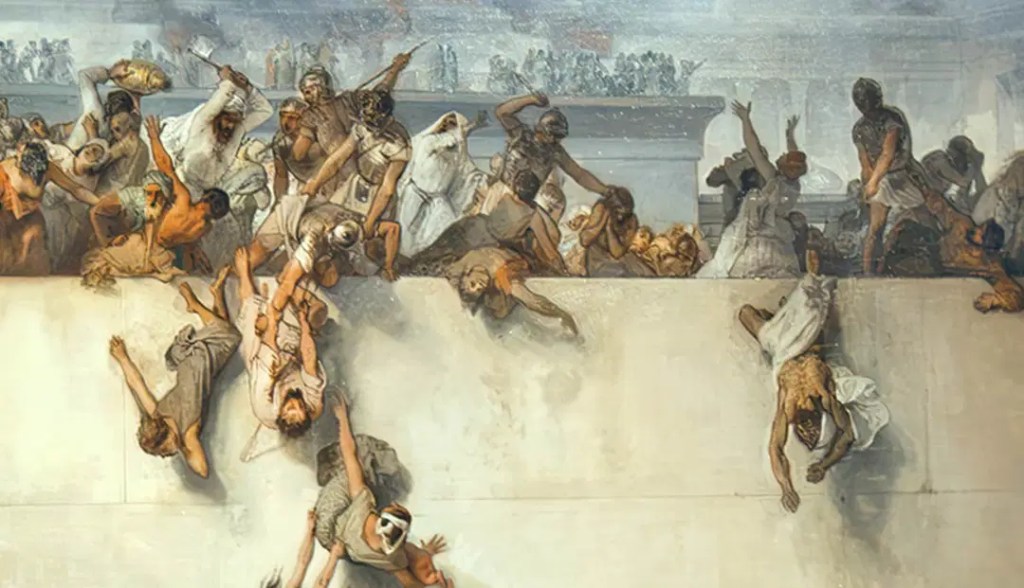
”So the Romans being now become masters of the walls, they both placed their ensigns upon the towers, and made joyful acclamations for the victory they had gained: as having found the end of this war, much lighter than its beginning. For when they had gotten upon the last wall, without any bloodshed, they could hardly believe what they found to be true; but seeing no body to oppose them, they stood in doubt what such an unusual solitude could mean. But when they went in numbers into the lanes of the city, with their swords drawn, they slew those whom they overtook without mercy; and set fire to the houses whither the Jews were fled, and burnt every soul in them: and laid waste a great many of the rest: and when they were come to the houses to plunder them, they found in them intire families of dead men; and the upper rooms full of dead corpses: that is of such as died by the famine. They then stood in an horror at this sight: and went out, without touching any thing. But although they had this commiseration for such as were destroyed in that manner, yet had they not the same for those that were still alive: but they ran every one through whom they met with; and obstructed the very lanes with their dead bodies; and made the whole city run down with blood, to such a degree indeed, that the fire of many of the houses was quenched with these mens blood. And truly so it happened, that though the slayers left off at the evening; yet did the fire greatly prevail in the night. And as all was burning, came that eighth day of the month Gorpieus… upon Jerusalem: a city that had been liable to so many miseries during this siege…”
As time passed the Romans began to understand that in the era of their early great conquests, they had preferred to be feared, but they were slowly learning the advantages to be had of making those they ruled feel contented and grateful, a mindset culminating in the Pax Romana, a roughly 200-year-long period identified as the golden age of relative peace and order, and prosperous stability.
The Romans did have laws of war that forbade certain behaviours such as the breaking of treaties, although their savagery was still sometimes unacceptable, even by the standards of the ancient world. Roman military rules said that victorious generals should treat surrendered enemies with moderation, especially women and children. This was perhaps what Virgil meant when he famously wrote:
”Roman, remember by your strength to rule
Earth’s peoples—for your arts are to be these:
To pacify, to impose the rule of law,
To spare the conquered, war down the proud.”
Aeneid VI, 851
References:
Ernst Badian, 1968, Roman Imperialism in the Late Republic, Blackwell, Oxford/Cornell University Press


 everythinglatin.co.uk
Leave a comment