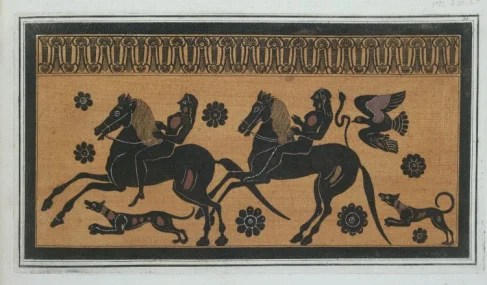
Black-figure amphora depicting the Dioscuri on horseback. Dating to circa 500 BC, held in the British Museum
In the southern sky during wintertime, near the constellations of Orion and Taurus there are two bright stars. Known in Greek mythology as the Dioscuri, (Dioscuri from the Greek Dioskouroi, meaning “Sons of Zeus”), they were twin supernatural beings who helped save shipwrecked sailors, usually by appearing as the natural phenomenon St Elmo’s Fire, and received sacrifices to grant favourable winds at sea.
The twins were named Castor and Pollux, born to Leda, the Queen of Sparta, and fathered respectively by her mortal husband, King Tyndareus, and the God Zeus (identified by the Romans with Jupiter, King of the Gods).
These two stars are part of the constellation of Gemini. The constellation is the best known of the ancient star patterns, first charted by the Greek-Egyptian astronomer Claudius Ptolemy, and named “Gemini” after the Latin word meaning “twins,” with most stargazers depicting the constellation as twin boys.
Roman Worship
The Romans being the great innovators that they were, incorporated the twins into Roman religious practice early on in the Republic’s history. At the Battle of Lake Regillus, fought in 489 BC, the Latin army, led by Tarquinius the Superbus, (Superbus means proud, arrogant, haughty) the last king of Rome, was finally defeated by the army of the new Roman Republic. It was claimed by the Romans that Castor and Pollux appeared miraculously as horsemen, just as the Romans were beginning to waver, and assured victory for the new regime, thus symbolising the gods’ favour for the Roman Republic.
According to the legend, the twins then suddenly appeared in the forum in Rome to announce the victory before the Romans’ own messengers arrived from the battlefield. This legend continued as Castor and Pollux are said to have reappeared in the Forum to announce victories at other crucial moments in Roman history – after the great battles of Pydna (168 BC), Vercellae (101 BC), and Pharsalus (48 BC).
After their first appearance, the Roman commander, Postumius, built a temple to them at the Juturna Spring where it was believed they watered their dusty, tired horses. The temple became one of the greatest in the Forum, by the time of the Late Republic, it was a meeting-place for the Senate, with a speakers’ platform and voting place outside; it was also the place that magistrates took their oath. It is also likely that the standards of the weights and measures of the Republic were kept in the temple.
“It is said that in this battle two men on horseback…just growing their first beard, appeared to Postumius, the dictator…and charged at the head of the Roman horse, striking with their spears all the Latins they encountered and driving them headlong before them. And…two youths are said to have appeared in the same manner in the Roman Forum attired in military garb, very tall and beautiful and of the same age…retaining on their countenances as having come from a battle, the look of combatants, and the horses they led being all in a sweat. And…they related how the battle had gone and that the Romans were the victors. And it is said that after they left the Forum they were not seen again by anyone, though great search was made…”
Dionysius of Halicarnassus, Roman Antiquities (V.13.1-5)
In 6 AD Tiberius, stepson and eventual successor to the sick and ageing first emperor Augustus, rebuilt the temple on a massive scale and rededicated it to Pollux and Castor. Usually they are referred to as Castor and Pollux, so by alternating the names, historians believe that perhaps Tiberius was identifying himself and his dead brother Drusus Germanicus with the twins (himself with Pollux, as the adopted son of the godlike Emperor, Augustus, and his brother with Castor), and was saying that the inheritors of Augustus’ power would be from his family, the ancient and celebrated Claudian line and not the Emperor’s relatively obscure Julian family. Politics it seemed, was closely linked with religion in ancient Rome.

Roman Forum. It was here that two tired horsemen, covered in dust,
gave news of a Roman victory at the Battle of Lake Regillus to the Senate
The twins were superb horsemen and were adopted as the presiding deities of the Roman knights (equites). The Equites were the Roman citizens who were second only to the Senators in wealth and power and provided the cavalry forces for the Roman Legions. They were an important and loyal asset to the Emperor, and provided people who could fill many of the key posts in the Roman administration.
Every 15th of July, the rebuilt temple of Pollux and Castor was the focus of a cavalry parade – called the transvectio equitum – of 5,000 Equites led by two knights impersonating the two heroes, to commemorate the victory of the Romans, led by the general Aulus Postumius Albus Regillensis at the Battle of Lake Regillus.
To The Dioscuri
Sing, O clear-voiced Muse, of Castor and
Pollux, and Polydeuces, the sons of Tyndarus,
who were begotten of Olympian Zeus. Them
did queenly Leda bring forth under the peaks of
Taygetus, after secret dalliance with dark-clouded
Cronion. Hail, ye sons of Tyndarus, who ride
upon nimble steeds !
Translated by John Edgar, B.A. (Oxon.); M.A. (Glasgow) 1890
 everythinglatin.co.uk
Leave a comment