
Perhaps no other colour in history has been so celebrated as purple, and Tyrian purple was one of the costliest, and therefore most sought after, of colours to produce in ancient times. From emporers to cardinals, senators to magistrates, royalty to priests, many coveted this mysterious colour as a way of marking them out as special, in some cases almost divine, but the workers who toiled to make this dye in the Roman Empire were often treated far worse than their finished product warranted. The stench from the decaying snails permeated their skin, and their blackened hands retained the smell of the invertebrate’s excretions so much, so that their wives were given grounds to divorce them if they couldn’t put up with the stink any longer! This thankless labour of those who created luxurious items for the elite did not go unnoticed to some however. The historian Plutarch (AD 46 – AD 119) recognized so when he said;
”In other cases, admiration of the deed is not immediately accompanied by an impulse to do it. No, quite the contrary, many times while we delight in the work, we despise the workman who works for the people, a skilled workman, handicraftsman workman, as, for instance, in the case of perfumes and dyes; we take a delight in them, but dyers and perfumers we regard as base and vulgar folk”.
During the later years of the Roman empire, these workers were subject to state control, effectively binding them to their employer for life, so highly was the dye prized, that at the height of the Roman Empire, one pound of this precious dye was priced at approximately three Troy pounds of gold – roughly $70,000 in today’s currency. The Egyptian Queen Cleopatra was so obsessed with it, that according to Buraselis, Stefanou, and Thompson in The Ptolemies, the Sea and the Nile: Studies in Waterborne Power, 2013, she allegedly dyed the sails on one of her boats, and was said to soak the sails of her ships in perfume; that way the scent would float ahead of her down the Nile. The character Enobarbus says in Shakespeare’s Antony and Cleopatra “Purple the sails, and so perfumed that / The winds were lovesick with them.” (Act II Scene II).
Tyrian purple is also mentioned in Homer’s epic The Iliad where it is written as porphyrios, whose conventional translation is purple, and in The Aeneid, where Virgil’s hero Aeneas, the founder of the Roman race, travels to the underworld and sees purple light, described as ‘clothing the Lands of the Blessed’, a kind of shroud for the dead. Aeneas also receives a robe ‘blazed with Tyrian purple’ and gold thread (4.262), a gift from Dido, the Queen of Carthage, which he uses as the burial shroud for King Evander’s son, Pallas.
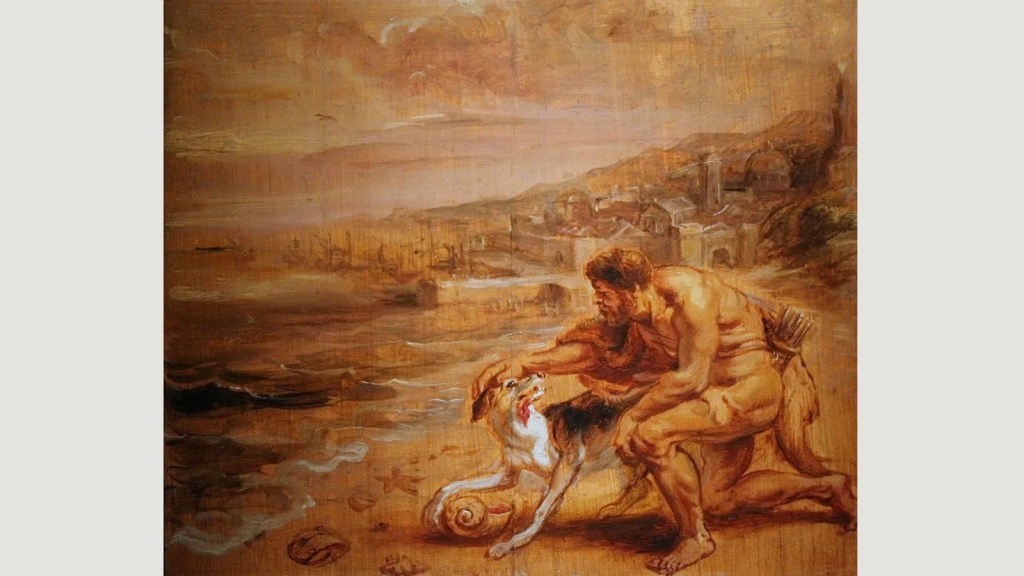
The colour was so difficult to obtain that myths started to abound to explain it’s mysterious origin. The 2nd-Century Greek Julius Pollux said in his “Onomasticon,” a 10-volume thesaurus, that the purple was accidentally disovered when the dog belonging to the demigod Heracles (who became the Roman god Hercules), who was on his way to meet a nymph named Tyrus, paused to gnaw on a snail on the shoreline. When the nymph saw the dog’s purple stained jaws, she demanded of her lover a cloak of the same colour.
The wearing of purple could also get you killed. The historian Suetonius tells us that when King Ptolemy of Mauretania visited the Emperor Caligula, wearing a splendid purple cloak, it angered the unstable Emperor so much, he had his guest killed.
Because it was so difficult to find, and make Tyrian purple dye was extremely costly. Gaius Plinius Secundus (AD 23/24 – AD 79), also called Pliny the Elder was a Roman author, naturalist, natural philosopher, naval and army commander of the early Roman Empire, and a friend to the emperor Vespasian. He wrote Naturalis Historia (Natural History), the largest single work to have survived from Roman times to the modern day. In it he discusses topics that include agriculture, anthropology, art, astronomy, botany, geography, horticulture, human physiology, mathematics, mining, precious stones, and zoology. On obtaining the precious dye he states:
” The most favourable season for taking [the shellfish] is after the rising of the Dog-star, or else before spring; for when they have once discharged their waxy secretion, their juices have no consistency: this, however, is a fact unknown in the dyers’ workshops, although it is a point of primary importance. After it is taken, the vein [i.e. hypobranchial gland] is extracted, which we have previously spoken of, to which it is requisite to add salt, a sextarius [about 20 fl. oz.] to every hundred pounds of juice. It is sufficient to leave them to steep for a period of three days, and no more, for the fresher they are, the greater virtue there is in the liquor. It is then set to boil in vessels of tin [or lead], and every hundred amphorae ought to be boiled down to five hundred pounds of dye, by the application of a moderate heat; for which purpose the vessel is placed at the end of a long funnel, which communicates with the furnace; while thus boiling, the liquor is skimmed from time to time, and with it the flesh, which necessarily adheres to the veins. About the tenth day, generally, the whole contents of the cauldron are in a liquefied state, upon which a fleece, from which the grease has been cleansed, is plunged into it by way of making trial; but until such time as the colour is found to satisfy the wishes of those preparing it, the liquor is still kept on the boil. The tint that inclines to red is looked upon as inferior to that which is of a blackish hue. The wool is left to lie in soak for five hours, and then, after carding it, it is thrown in again, until it has fully imbibed the colour ”.
The production of the dye was a hard and labourious process for those doing the manual labour needed to gather the snails, and then start extracting the snails gland that produced it. The Roman poet Martial says that Tyrian purple kept it’s distinct, fishy smell long after it had been made into a garment.
The dye was colour fast, i.e. it didn’t fade, in fact the intensity of the purple grew darker with age, and so became an item of huge importance, much prized by the Romans, who used it to colour their ceremonial robes. The sumptuousness meant that purple-dyed textiles fast became status symbols, whose use was restricted by laws which dictated what you could wear, based on your social standing. The most senior Roman magistrates wore a toga praetexta, a white toga edged in Tyrian purple. The even more luxurious toga picta, solid Tyrian purple with gold thread edging, was worn by generals celebrating a Roman triumph. For Cicero however, the desire for men to wear purple was unbecoming of them, and a symbol of unhealthy ambition. Cicero was drawing comparisons between wearing purple, luxury, and kingship. In the colour Cicero could see Roman strength – its imperium, and its inherent weaknesses, luxury and corruption.
The dye substance itself is a mucous secretion from a gland of one of several species of medium-sized sea snails that are found in the south – eastern Mediterranean Sea, and off the Atlantic coast of North Africa. These are the called the spiny dye-murex, originally known as Murex brandaris, sometimes referred to as Bolinus brandaris, and the colour produced is commonly known as Tyrian purple, named after the ancient Phoenician city of Tyre (on the southern coast of todays Lebanon), and may have been first used by the Phoenicians as early as 1570 BC. Possibly the name Phoenicia itself means ‘land of purple’, and although this is only conjecture, it may also be possible that the dye extracted from the Murex brandaris is that known as argaman in Biblical Hebrew. Recent studies suggest that through most of the Iron Age biblical era, from roughly 1150 B.C. to 600 B.C., a small shoreline town called Tel Shiqmona on modern day Israel’s Carmel coast was not a residential settlement as previously supposed, but a major purple-dyeing factory. Tel Shiqmona had long confused archaeologists, who wondered why what looked to be some kind of fort had been erected far from agricultural lands on a rocky stretch of shoreline that didn’t offer a safe harbour to ships. The eight-acre site was excavated extensively in the 1960’s, and weaving and spinning equipment, large purple-stained ceramic vats and evidence of human habitation dating to around 1500 B.C was uncovered. For the majority of the Iron Age period, Tel Shiqmona is the only site where the manufacturing of the dye can be demonstrated with absolute certainty.
It is known that the North African city of Carthage was involved in the manufacture of the dye, and that fame continued into Roman times. Rome’s great adversary Gaul, used whortleberry, also known as the bilberry or the European blueberry, a small, low-growing shrub that is commonly found on heathlands, and moors throughout Europe, to dye cloth purple, which was then made into textiles for clothing.
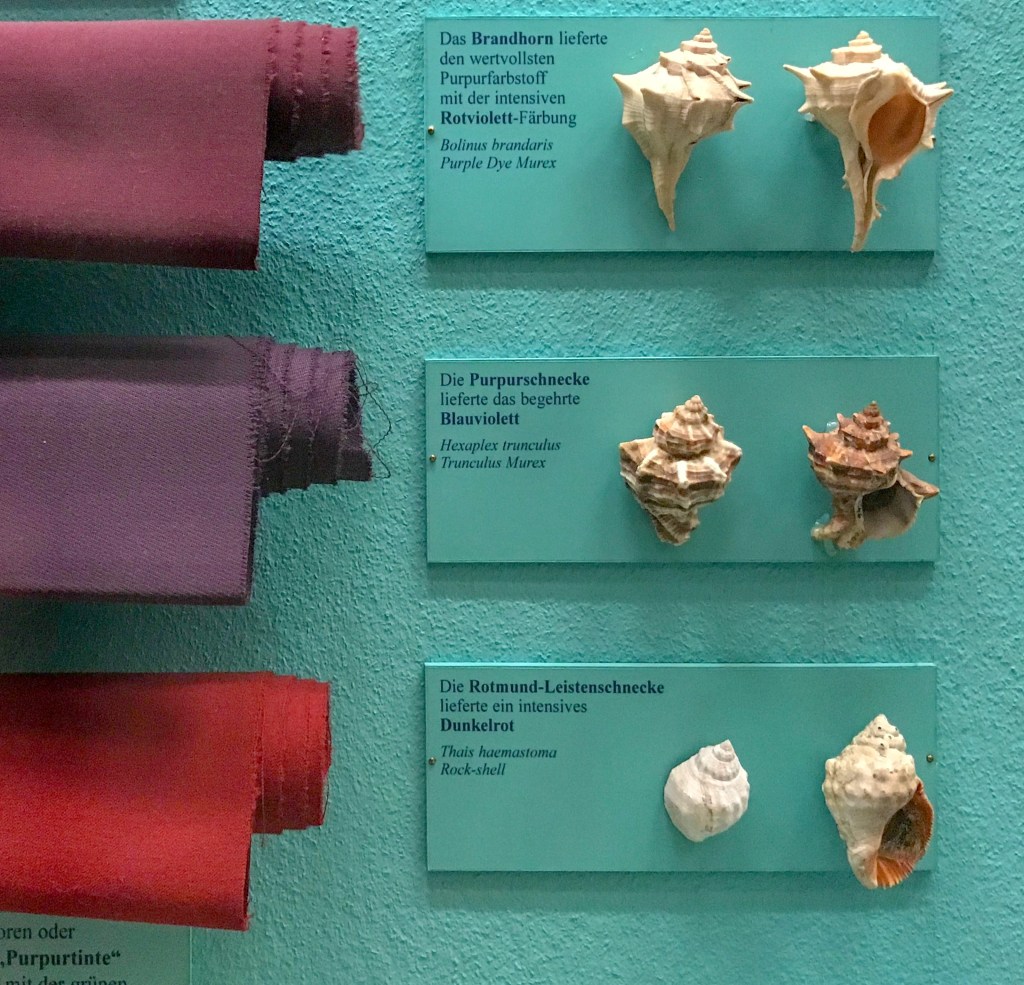
Living in relatively deep water, the snails were caught in baited traps suspended from floats. The dye was then extracted from the glands of thousands of putrefied shellfish left to bake in the sun. It could be gathered either by “milking” the snails, which was more time consuming but was a renewable resource, or by collecting and crushing the snails. Timing was an issue, as the dye begins to degrade as soon as the snail is out of the water. Therefore the port facilities to process the snails were next to where they were harvested, and it meant gathering up to twelve thousand of these sea creatures at these ports, just to produce no more than 1.4 g of dye, about enough to colour the trim of only a single toga. This can be corroborated by the mountain of discarded shells at the port of Sidon, which stands at 40 metres high, a process that drove the species almost to extinction along the coasts of the Mediterranean.
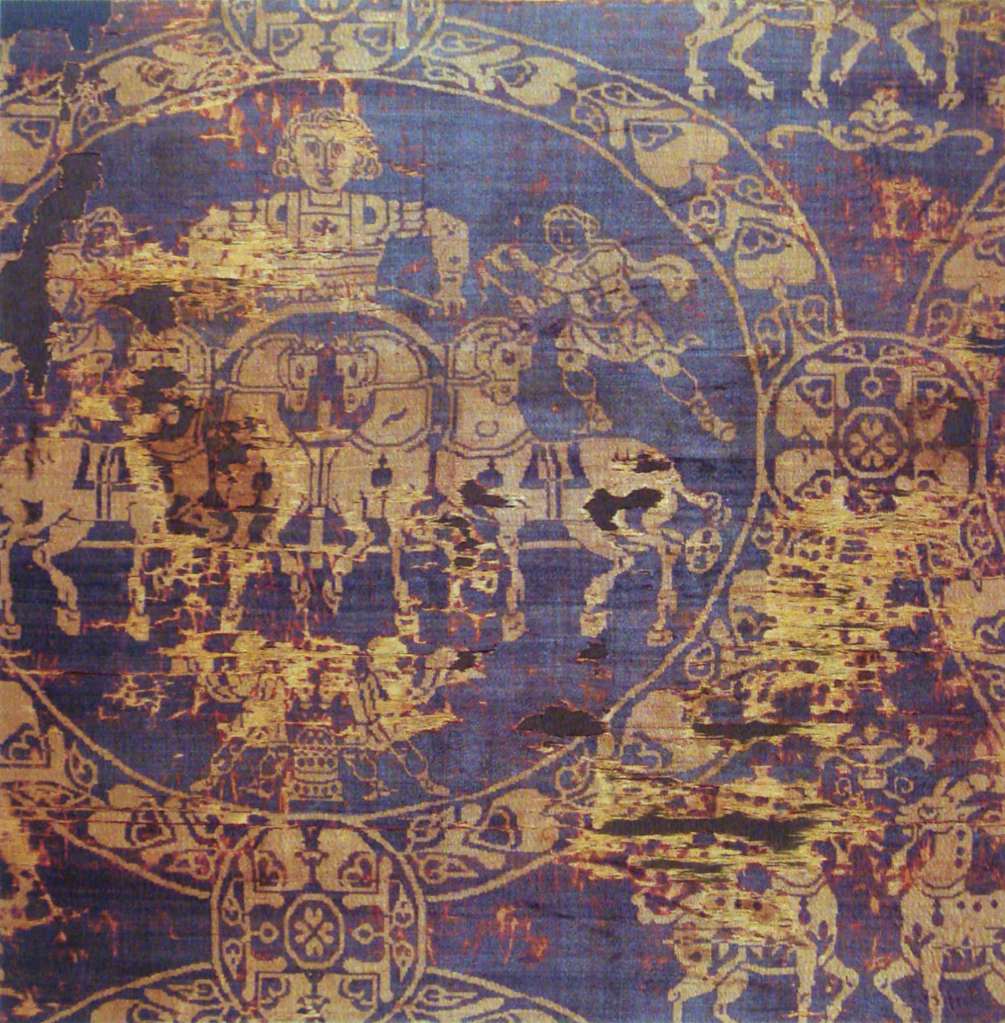
Eventually due to over fishing, the supply of shellfish gradually started to run out, so traders and their Roman customers scouted around for suitable replacements. Occasionally it was still used for grand occasions, such as when King Charlemagne died in 814 AD, and he was wrapped in a silk shroud made of gold and Tyrian purple.
We get the word indigo from the Greek indikos, which means Indian. In Latin, it becomes indicum, and became known to the Romans around the time of Augustus, 27 BC – AD 14. Incidentally the word purple comes from the Latin purpura, which has its roots in the Greek porphura. At the end of the Roman Empire in the east, Pope Paul II dictated that cardinals would have to wear a scarlet derived from kermes, a dye procured from insects. A purple dye from the lichen Roccella tinctoria, the Madder plant, was also used by some people instead as it was easier and cheaper to create.
By the Middle Ages, the Tyrian Purple dye industry had almost become non-existant and when Constantinople fell in AD 1453 it had completely disappeared. Today, purple dye is often made from cochineal insects. These insects contain carminic acid, which is a crimson shade, which turns purple when alkaline substances increase the mixture’s pH level.
As an afterword many people believe that purple stimulates the imagination, and can be related to spirituality. Therefore, purple can help people feel inspired and creative by getting them into the right mindset which can be helpful in formulating new ideas (click here for more). Purple also has a physiological effect creating a feeling of calmness, lowering the heart rate and blood pressure in some cases. Recent studies have shown that mollucs from the family Muricidae produce certain compounds that have anti-inflammatory, anti-cancer, muscle-relaxing and pain relieving properties and some of these properties have been known since antiquity (click here for more).
An interesting video about the production of Tyrian dye can be accessed here
Interesting fact:
The late British actor Sir Christopher Lee was descended from Emperor Charlemagne of the Holy Roman Empire, also related to Robert E. Lee the US Civil War Confederate general, and nearly married into the Crown of Sweden. His WW2 military service stories partly inspired his cousin, Ian Fleming to write the James Bond novels.
 everythinglatin.co.uk
Leave a comment