
In his The Life of Julius Caesar, par. 45-53 (translated by J.C. Rolfe), the ancient Roman historian Suetonius describes the appearance of Gaius Julius Caesar as follows: “They say he was tall, fair-skinned, well-built, with a full face, black and lively eyes. He was distinguished by excellent health: only towards the end of his life did he suffer sudden fainting spells and night terrors, and he had epileptic seizures twice during activities. He took overly meticulous care of his body, cutting and shaving his hair and plucking it, for which many reproached him. His baldness was unbearable to him, as it often attracted the mockery of his enemies. Therefore, he usually combed his thinning hair from the crown to the forehead; for the same reason, he gladly accepted and used the right to always wear a laurel wreath.”
These words by Suetonis are the only full description of what the man looked like, but we must bear in mind that Suetonis lived some one hundred years after Caesars death, so he wasn’t writing from personal experience.
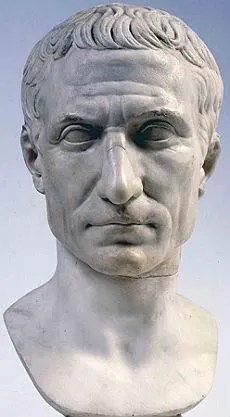
The marble bust above, discovered in the river Rhone, near Arles in southern France in 2007, is thought to have been carved during Caesars lifetime, so therefore is presumed to be a reasonable likeness. But no one’s really sure…
Many statues were made of the Dictator for Life during his lifetime, but a lot were destroyed after his murder, as the political climate changed. Some two thousand years later, we cannot be sure which, if any, are from his lifetime, or like Suetonis’s words, were later carved from memory.
Another apparent, and probably the most famous, likeness is the Cariamonti Bust. This is a copy from the time of Emperor Augustus, and was most likely taken from a bronze original. Many historians consider it a genuine likeness, as it resembles Caesar’s profile on Roman coins minted during his lifetime. It gives its audience a powerful and idealised experience, lacking the dramatically receeding hairline, and any ‘wear and tear’ age related furrows to the face, it purposely makes Caesar look more like a greek hero than an ordinary man.
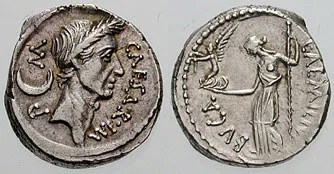
The only reliable source are the coins that were minted one year before Caesars death, which will later be used by future emperors. The profile on the coins is somewhat similar to the Cariamonti Bust, which was made sometime in the 20’s or 30s BC, but is probably a far more realistic view of what he really looked like.
The fact that we don’t really know what Caesar looked like doesn’t stop us building a fair assumption of his character, as there is a wealth of written material about his behaviour and achievements. A womaniser, he was often debt-ridden, undoubtably a brilliant but often ruthless soldier, who never showed fear to his enemies and accordingly was loved by his soldiers and the public alike, a man who was capable of great clemency (clementia), and yet stood accused of war crimes (or at least his recall to Rome due to his behaviour in Gaul was discussed in the senate), because of the murder and enslavement of hundreds of thousands in his conquest of Gaul, who ultimately became the owner of such a huge ego that it bordered on meglomania. All of this is fascinating stuff, but if we don’t know what the man looked like, it tends to be for us in todays world, with all it’s instant gratification, frustrating in the least.
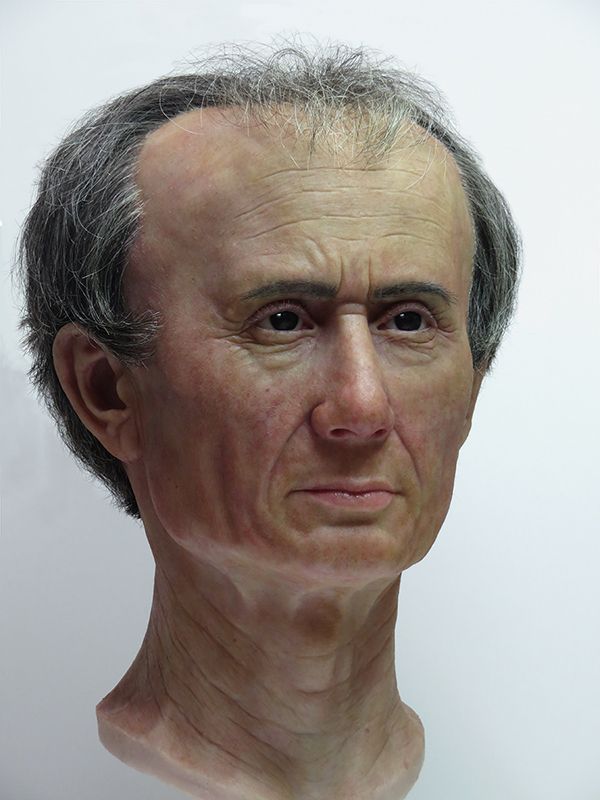
To some the world-renowned Roman leader may have been rather less heroic than we imagine, at least in terms of physique. We know Caesar was almost bald, but apparently he had a deformed skull caused by difficulties during his birth. Archaeologist and author Tom Buijtendorp recently published these findings in his book Caesar in the Low Countries. He used his conclusions about Caesar’s face, along with one of the oldest portraits of the general, in the collection of the National Museum of Antiquities in Leiden, as the basis for his reconstruction of a new, alternative face. This reconstruction is currently on show in the museum, as the ‘new’ face of Julius Caesar, at the permanent exhibition The Netherlands in Roman Times.
The bust of “Tusculum” was possibly made of Caesar during his lifetime, or right after his death, and is preserved at the archaeological Museum of Turin, and was the stone face that Buijtendorp used in his research for the real Caesar.
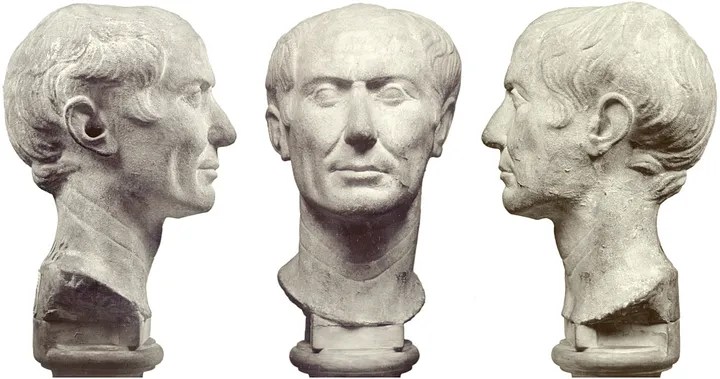
In the image you can see the enlarged skull that Buijtendorp believes is a result of problems during Caesars birth, along with the heavily wrinkled neck shown on the coins minted in AD 43, and the bust recovered from the Rhone in 2007. It certainly looks more realistic than the Cariamonti bust, which is probably one reason why it remains the most popular image we have of the great leader.
Whatever his physical looks, there is no doubt Caesar was an attractive man to many, and his libido was said to be sky-high, and he engaged in many affairs with married women, which was probably one reason many of his fellow Romans hated him so much! There were also rumours that he was bisexual, although the Romans looked the other way on those aspects of a mans personal life, provided he was discreet. In 80 BC, when he was a young man and an officer in the army of Lucius Lucullus, Caesar came to the court of Nicomedes IV – the king of Bitynia, a country located in north-west Asia Minor. Caesar was sent there by the praetor Marcus Minucius Termus to get the Bithyan fleet to help the Romans besiege the city of Mytilene on the island of Lesbos. Over time Caesar became quite close to the king who had no sons and was widely rumored to be homosexual, so inevitably the rumours began. When the King died and left his entire country to Rome, some people were amazed and immediately looked for reasons and excuses. Caesars enemies took full advantage.
The perfctly reasonable explanation given by Colleen McCullough in her series of historical novels, was that Caesar, who never knew his grandparents and lost his father as a teenager, simply saw Nicomedes and his wife as ‘surrogate grandparents’, enjoying their company, playing chess and paying attention to a lonely elderly man whose daughter had been kidnapped by the Parthians. Along with Caesar’s true features, we’ll probably never know.
In regards to the other Roman emperors, the artist Haround Binous is bringing them back to life in hyper-realistic illustrations. He works at Université de Lausanne, Switzerland, and is combining facial recognition AI, Photoshop, and historical references to revive all the Roman emperors, from Augustus to Valentinian III. You can visit his Roman Emperor Project here. For interesting background information on the project, you’ll find it here.


Leave a comment