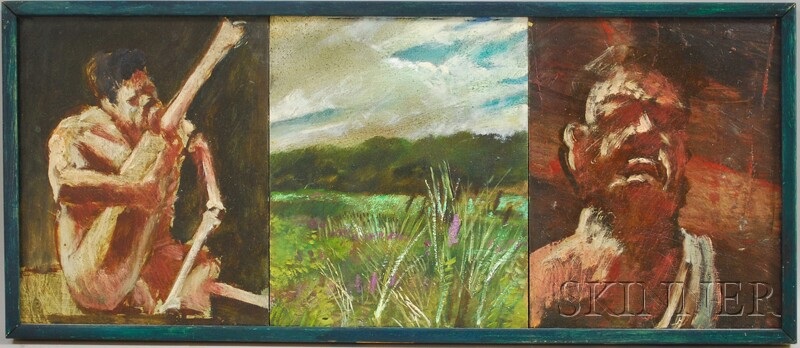
Adam Cvijanovic (American citizen, born 1959) Erysichthon, oil on Masonite
Praise for Tales from Ovid:
‘A breathtaking book…To compare his versions with the Latin is to be awestruck again and again by the range and ingenuity of his poetic intelligence…He rescues the old gods and goddesses from the classical dictionaries and gives them back their terror. There should be a copy of his book in every school’. John Carey Sunday Times
Taken from Tales from Ovid, 24 Passages from the Metamorphoses, published by Faber and Faber Ltd 1997. Copyright Ted Hughes, 1930 -1998
Erysichthon (pronounced eh-rish-chee-thon) is a fascinating figure in Greek mythology, although not very well-known. However, his story is truly impressive and sad at the same time. It is an ancient Greek tale of hubris and divine wrath, elements crucial and fundamental in Greek mythology. It touches the core of humanity’s relationship with nature. The life of Erysichthon with its twists and turns is a catastrophically tragic tale, and a moral lesson about the consequences of disrespecting nature. This fascinating Greek myth is frequently used as an allegory to remind people of the importance of environmental conservation – Nick Kampouris, November 1st, 2024 – The Greek Reporter
Some are transformed just once
And live their whole lives after in that shape.
Others have a facility
For changing themselves as they please.
Proteus, who haunts the shadowy seas
That scarf this earth, is glimpsed as a young man
Who becomes of a sudden a lion
That becomes a wild boar ripping the ground,
Yet flows forward, hidden, through grass, without sound
As a serpent, that emerges
As a towering bull under down-bent horns,
Or hides, among stones, a simple stone.
Or stands as a tree alone.
Or liquefies, and collapses, shapeless,
Into water, a pouring river. Sometimes
He is the river’s opposite––fire.
Another with a similar power
Was Erysichthon’s daughter,
The wife of Autolycus. Her father
Gave to the gods nothing but mockery.
Without a qualm he cut down every tree
In the sacred grove of Ceres––
An ancient wood that had never, before that day,
Jumped to the axe’s stroke.
Among those trees
One prodigious oak was all to itself
A tangled forest. Its boughs were bedecked with wreaths
And votive tributes––each for a prayer
Ceres had sometime granted. Dryads there
Danced a holy circle around its bole
Or joined hands to embrace it––
A circumference of twenty paces.
Erysichthon ignores all this as
He assesses the volume of its timber,
Then orders his men to fell it.
Seeing their reluctance, he roars:
“If this tree were your deity, that every clown adores,
And not merely a tree you think she favours,
Nevertheless, those twigs away there at the top
Would have to come down now, as the rest falls.”
He snatches an axe––and hauls
The weight of the broad head up and back.
But in that moment, as the blade hangs
Poised for the first downstroke, shudderings
Swarm through the whole tree, to its outermost twigs
And a groan bursts from the deep grain.
At the same time
Every bough goes grey––every leaf
Whitens, and every acorn whitens.
Then the blade bites and the blood leaps
As from the neck of a great bull when it drops
Under the axe at the altar.
Everybody stares paralysed.
Only one man protests. The Thessalian
Erysichthon turns with eyes stretched
Incredulous. “Your pious cares,” he bellows,
“Are misplaced.” And he follows
That first swing at the oak with another
At the protester’s neck, whose head
Spins through the air and bounces.
Then the oak, as he turns back to it, pronounces,
In a clear voice, these words:
“I live in this tree. I am a nymph,
Beloved by Ceres, the goddess.
“With my last breath, I curse you. As this oak
Falls on the earth, your punishment
Will come down on you with all its weight.
That is my consolation. And your fate.”
Erysichthon ignored her. He just kept going,
Undercutting the huge trunk, till ropes
Brought the whole mass down, jolting the earth,
Devastating the underbrush around it.
All the nymphs of the sacred grove mourned it.
Dressed in black, they came to Ceres,
Crying for the criminal to be punished,
Bewailing the desecration. The goddess listened.
Then the summer farms, the orchards, the vineyards,
The whole flushed, ripening harvest, shivered
As she pondered how to make his death
A parable of her anger.
If his cruelty, greed, arrogance
Had left him a single drop of human feeling
What the goddess did now
Would have drained mankind of its pity.
She condemned him
To Hunger––
But infinite, insatiable Hunger,
The agony of Hunger as a frenzy.
Destiny has separated Hunger
So far from the goddess of abundance
They can never meet; therefore Ceres
Commissioned a mountain spirit, an oread:
“Hear what I say and do not be afraid.
Far away to the north of Scythia
Lies a barren country, leafless, dreadful:
Ice permanent as iron, air that aches.
“A howling land of rocks, gales and snow.
There mad Hunger staggers. Go. Bid Hunger
Take possession of Erysichthon’s belly.
Tell her she has power over all my powers
“To nourish Erysichthon. Let all I pour
Or push down this fool’s gullet only deepen
His emptiness. Go. My dragon-drawn chariot
Will make the terrific journey seem slight.”
The nymph climbed away and her first halt
Was the top of Caucasus.
She soon found Hunger raking with her nails
To bare the root of a tiny rock-wort
Till her teeth could catch and tear it.
In shape and colour her face was a skull, blueish.
Her lips a stretched hole of frayed leather
Over bleeding teeth. Her skin
So glossy and so thin
You could see the internal organs through it.
Her pelvic bone was like a bare bone.
The stump wings of her hip bones splayed open.
As she bowed, her rib-cage swung from her backbone
In a varnish of tissue. Her ankle joints
And her knee joints were huge bulbs, ponderous, grotesque,
On her spindly shanks. The oread
Knew danger when she saw it. She proclaimed
The command of the goddess from a safe distance.
The whole speech only took a minute or so––
Yet a swoon of hunger left her trembling.
She got away fast.
All the way back to Thessaly
She gave the dragons their head.
Now hear me.
Though Hunger lives only in opposition
To Ceres, yet she obeys her. She soars through darkness
Across the earth, to the house of Erysichthon
And bends above the pillow where his face
Snores with open mouth.
Her skeletal embrace goes around him.
Her shrunk mouth clamps over his mouth
And she breathes
Into every channel of his body
A hurricane of starvation.
The job done, she vanishes,
She hurtles away, out of the lands of plenty,
As if sucked back
Into the vacuum––
Deprivation’s hollow territories
That belong to her, and that she belongs to.
Erysichthon snores on––
But in spite of the god of sleep’s efforts
To comfort him, he dreams he sits at a banquet
Where the food tastes of nothing. A nightmare.
He grinds his molars on air, with a dry creaking,
Dreaming that he grinds between his molars
A feast of nothing, food that is like air.
At last he writhes awake in twisting, knotted
Cramps of hunger. His jaws
Seem to have their own life, snapping at air
With uncontrollable eagerness to be biting
Into food and swallowing––like a cat
Staring at a bird out of reach.
His stomach feels like a fist
Gripping and wringing out
The mere idea of food.
He calls for food. Everything edible
Out of the sea and earth. When it comes
Dearth is all he sees where tables bend
Under the spilling plenty. Emptying
Bowls of heaped food, all he craves for
Is bigger bowls heaped higher. Food
For a whole city cannot sate him. Food
For a whole nation leaves him faint with hunger.
As every river on earth
Pours its wealth towards ocean
That is always sweeping for more,
Draining the continents,
And as fire grows hungrier
The more fuel it finds,
So, famished by food,
The gullet of Erysichthon, gulping down
Whatever its diameter can manage
Through every waking moment,
Spares a mouthful
Only to shout for more.
This voracity, this bottomless belly,
As if his throat opened
Into the void of stars,
Engulfed his entire wealth.
His every possession was converted
To what he could devour
Till nothing remained except a daughter.
This only child deserved a better father.
His last chattel, he cashed her in for food.
He sold her, at the market.
But she was far too spirited
To stay as a bought slave.
Stretching her arms towards the sea, she cried:
“You who ravished my maidenhead, save me.”
Neptune knew the voice of his pretty victim
And granted the prayer. Her new owner,
Who minutes ago was admiring the girl he had bought,
Now saw only Neptune’s art––featured
And clothed like a fisherman. Perplexed,
He spoke to this stranger directly.
“You with your fishing tackle, hiding your barbs
In tiny gobbets of bait––may you have good weather
And plenty of silly fish that never notice
The hook till it’s caught them!––can you tell me
“Where is the girl who was here a moment ago?
Her hair loose, and dressed in the cheapest things,
She was standing right here where her footprints––
Look––stop, and go no further. Where is she? ”
The girl guessed what the god had done for her.
She smiled to hear herself asked where she might be.
Then to the man parted from his money:
“I’m sorry, my attention has been fixed
“On the fish in this hole. But I promise you,
By all the help I pray for from Neptune,
Nobody has come along this beach
For quite a while––and certainly no woman.”
The buyer had to believe her. He went off, baffled.
The girl took one step and was back
In her own shape. Next thing,
She was telling her father. And he,
Elated, saw business. After that
On every market he sold her in some new shape.
A trader bought a horse,
Paid for it and found the halter empty
Where a girl sat selling mushrooms.
A costly parrot escaped its purchaser
Into an orchard––where a girl picked figs.
One bought an ox that vanished from its pasture
Where a girl gathered cowslips.
So Erysichthon’s daughter plied her talent
For taking any shape to cheat a buyer––
Straight and crooked alike.
All to feed the famine in her father.
But none of it was enough. Whatever he ate
Maddened and tormented that hunger
To angrier, uglier life. The life
Of a monster no longer a man. And so,
At last, the inevitable.
He began to savage his own limbs.
And there, at a final feast, devoured himself.
 everythinglatin.co.uk
Leave a comment