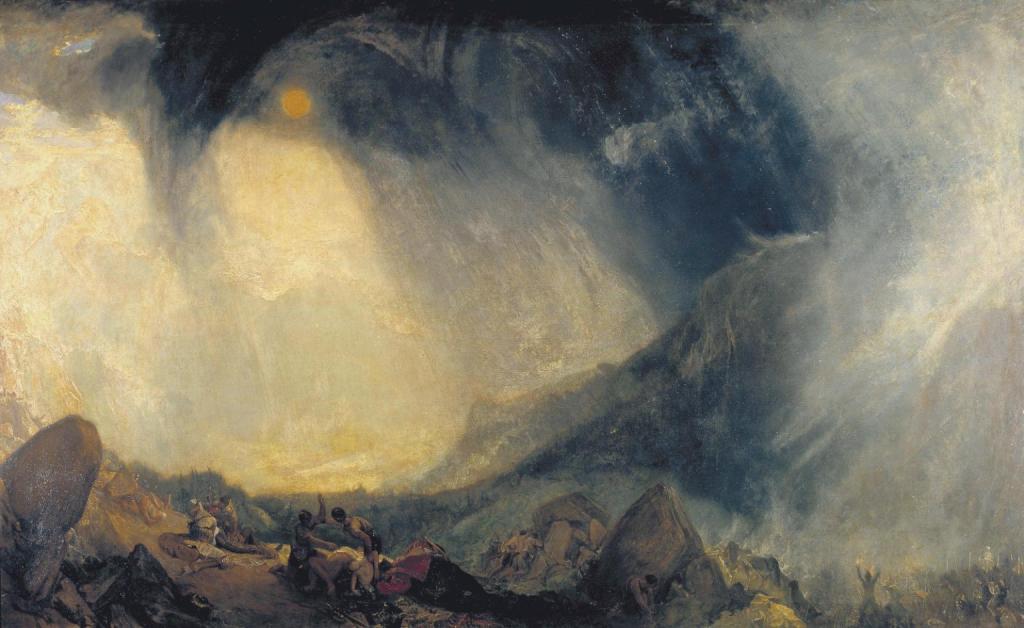
Snow Storm: Hannibal and his Army Crossing the Alps exhibited 1812 Joseph Mallord William Turner 1775-1851. Accepted by the nation as part of the Turner Bequest 1856
The Roman Republic, and subsequently Empire, dominated almost all of the known world from 753 BC to 1453 AD. Throughout that period Rome’s power was always present and often absolute, and although the Romans suffered several military reversals and defeats, they never shied away from confrontation. However, there was one man who caused them to almost panic and sink into despair, and whom they ultimately had a grudging respect for, and that was Hannibal Barca of Carthage (247 ~ 182 BC).
Carthage was an ancient city in Northern Africa, in what is now Tunisia, and was one of the most important trading hubs of the Mediterranean, and one of the most affluent cities of the classical world. Before 264 BC, Rome and Carthage coexisted peacefully, but when Rome started to expand as a nation state in the Mediterranean, it decided it needed to annex the wheat-rich island of Sicily, and so declared war on Carthage, the occupying force.
The Punic wars were a struggle for dominance of the Mediterranean region by the two great trading and military powers, Carthage and Rome (Punic comes from the word Phoenician, and was the name given to the citizens of Carthage, who were of Phoenician ethnicity). The 1st Punic War lasted 23 years, causing untold loss of life, massive disruption to trade, and at one point near starvation in Rome as the wheat supply dwindled, until ending in 241 BC with the Carthaginians defeat. The Second Punic War began in 218 BC after the Rome threatened Carthage in their endeavour to build an empire in silver-rich Hispania, and saw Hannibal crossing the Alps and invading mainland Italy in retaliation.

Hannibal was the son of the Carthagenian general Hamilcar, who had made his eldest son swear lifelong enmity to the Romans, and he was to give Carthage its finest hour. He is ranked alongside Alexander the Great, Julius Caesar and his Roman adversary Scipio Africanus, as one of the greatest military strategists of the ancient world, and his crossing of the Alps is the main reason why.
Hannibals army was a huge (estimated at around 90,000 men), eclectic group made up of Carthagenians, Greeks, and included some 8000 Iberians, 2000 Balearic slingers, 8000 Gauls, Ligures, various Italian tribes who were opposed to what they saw as Rome’s toxic expansion, Sicilians, 4000 Numidian cavalry, skilled in horsemanship and armed with javelins, and around 500 Libyan – Phoenician (North African) cavalry.
To get this army, and it’s baggage train across the Alps and down into the foothills of northern Italy, was an incredible undertaking. Most of what we know about it comes from the written accounts left by the historians Polybius (c200-118 BC) and Livy (59 BC-17 AD). Polybius was known to interview and record the stories from the survivors of Hannibals army, and what they told him was truly harrowing.
Because of the snow and of the dangers of his route [Hannibal] lost nearly as many men as he had done on the ascent,” writes Polybius. “Since neither the men nor the animals could be sure of their footing on account of the snow, any who stepped wide of the path or stumbled, overbalanced and fell down the precipices…the track was too narrow for the elephants or even the pack animals to pass, [and] at this point the soldiers once more lost their nerve and came close to despair.”
Hannibal attempted to traverse the terrifying slopes to either side of the path, but the snow and mud was dangerously slippery. So his troops constructed a road, and after backbreaking labour he got the men, horses and mules down the slope and below the snowline. The elephants were not as easy to deal with – it took another three days to make a road wide enough. Finally, says Polybius, Hannibal “succeeded in getting his elephants across, but the animals were in a miserable condition from hunger”.
The soldiers that formed Hannibals army were used to the warmth of Northern Africa and marched with a determination through Spain, France and the snowbound Alps, holding at bay a mountain tribe called the Allobroges, a warlike group intent of looting Hannibals baggage train, that set ambushes, hurling spears at the army, and raining huge rocks down upon their heads.

Worse was to come, as the weather conditions worsened, it became a matter of life and death whether to continue or not.
On a bitterly cold morning, in the Western Alps, the remainder of Hannibals army gathered to hear what their twenty-nine year old commander was going to say. “It’s a wonder Hannibal didn’t get a spear in his back,” says Bill Mahaney of York University in Toronto. “By the time he delivered his speech [urging on his men] at the top of the pass, many of his mercenaries were either dead, starving to death or suffering from hypothermia. Yet Hannibal didn’t lose a single elephant.”
The Romans had presumed that the mountain range created a natural barrier against an invasion of their country. There are so few routes over the mountains that an army of 90,000 men, 15,000 horses, 37 North African forest elephants, and a baggage train of hundreds of mules and donkeys could possibly take, that to hear that Hannibal had descended the mountain slopes into Italy, after just a sixteen day crossing, threw the Romans into a mild panic.
This hazardous invasion was one of the greatest military feats in history, and is still discussed today in military training schools. But one thing that has always caused the historians a problem is they cannot agree on the precise route Hannibal took.
In 2010, an international team of scientists, led by Mahaney, uncovered evidence that Hannibals route was across the Col de la Traversette – the highest route in the Alps, reaching 2947m above sea level. Polybius and Livy both mention that an impasse faced by Hannibal was created by fallen rocks. Polybius describes the rockfall in detail, saying that it consisted of two landslides: a recent one on top of older debris. Mahaney found from field trips and aerial and satellite photography that, only the Col de la Traversette had enough large rockfalls above the snowline to account for such an obstruction.

”But then they reached a place which was so narrow that it was impossible for the elephants or the baggage animals to move forward at all. There had been a landslide some time previously across nearly one and half stades of the mountainside, and this had been made worse by a second and more recent landslip”.
Polybius – Histories, Book 3

By examining the sediment, which was mostly soil matted with decomposed plant fiber, genetic materials were identified that contain high concentrations of DNA of Clostridia, a bacteria that typically makes up only 2-3 % of peat microbes, but more than 70 % of those found in a horses’ gut. The bed of excrement also contained unusual levels of bile acids and fatty compounds found in the digestive tracts of horses and ruminants.
Having established in his mind the Col de la Traversette was the crossing point, Mahaney looked for clues that a huge number of animals had passed here, albeit a long time ago. They started looking into a peaty bog 2,580 meters high and just below the Col. It’s one of the very few places where Hannibal’s army could have rested after the crossing, being the only place in the vicinity with rich soil to support the vegetation needed for grazing horses and mules. There he found embedded 16 inches deep in the bog, a thin layer of churned-up, compacted scat that suggests a large footfall by thousands of mammals at some point in the past. If thousands of horses, mules and elephants did graze here, they would have left behind a mass animal deposition, essentially a huge midden.
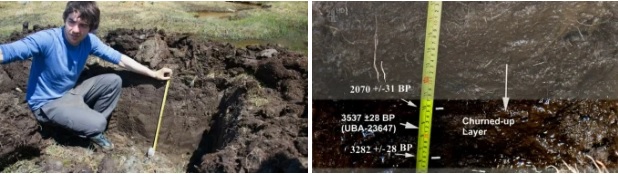
What is most exciting is the isolated parasite eggs that were discovered, eggs that are associated with gut tapeworms, preserved like tiny genetic time capsules. “There is even the possibility of finding an elephant tapeworm egg,” says Mahaney’s long-term collaborator, microbiologist Chris Allen of Queen’s University Belfast. “This would really be the pot of gold at the end of the rainbow.” It’s just a shame, he adds, that “the pot of gold is actually a layer of horse manure”
The DNA detected in the scat can survive in the soil for thousands of years, and can be radiocarbon-dated – and the timeline fits almost exactly to 218 BC, given by the historical records as the time of Hannibal’s alpine crossing.
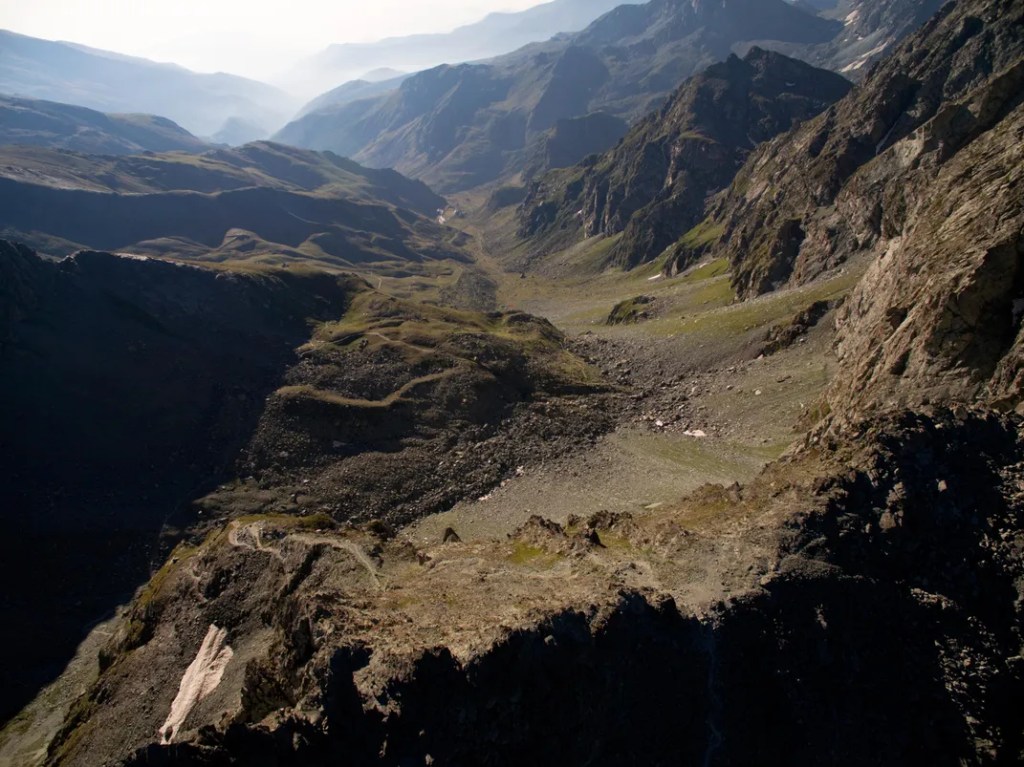
If Mahaney can secure firm evidence – such as the microbial imprints of elephant faeces – it would be the culmination of a personal quest. “The Hannibal enigma appealed to me for the sheer effort of getting the army across the mountains,” he says. “I have been in the field for long periods with [up to] 100 people, and…it can be pandemonium. How Hannibal managed to get thousands of men, horses and mules, and 37 elephants over the Alps is one magnificent feat.”
After he made the crossing, Hannibal occupied most of southern Italy for 15 years, during which time he inflicted upon Rome it’s largest and most decisive defeat at the Battle of Cannae in August 216 BC. Afterwards, the Romans, led by Fabius Maximus, avoided directly engaging him, instead waging a war of attrition (now called the Fabian strategy). Unfortunately for Hannibal, Carthaginian defeats in Hispania prevented him from being reinforced, and he was unable to win a decisive victory, eventually having to be withdrawn back to Carthage.
Interesting fact:
Hannibals name inspired such fear that, whenever disaster loomed Romans would exclaim “Hannibal ad portas” (“Hannibal is at the gates!”) to emphasise the gravity of the emergency, a phrase still sometimes used in modern language. It was first heard in Cicero’s Philippics and again in Livy’s Ab urbe condita.
For a comprehensive breakdown of The Army of Carthage during Hannibal’s Time click here
Enemy of Rome is a book written by Leonard Cottrell, about Hannibals’ adventure in crossing the Alps, that was first published in January 1960, and is still widely available. It is well worth a read.
 everythinglatin.co.uk
Leave a comment