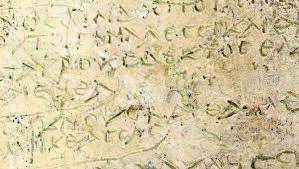
The clay slab believed to date from 3rd century AD, that was recently discovered near the ancient Greek city of Olympia, is believed to be the earliest record of Homer’s incredible tale of the aftermath of the Trojan War, reported the AFP in Athens, in July 2018.
Archaeologists have unearthed an ancient clay tablet engraved with 13 verses of the Odyssey in the ancient city of Olympia, southern Greece, and it is believed to date back to the 3rd century AD, during the Roman era.
“If this date is confirmed, the tablet could be the oldest written record of Homer’s work ever discovered in Greece,” the Greek culture ministry said.
The extract, taken from book 14, describes the return of Odysseus to his home island of Ithaca. During his tortuous ten-year journey Odysseus, amongst other ordeals, encounters the witch Circe, who turns his crew into pigs, the Sirens who try and steal him away from his quest to return home, and Polymephus the Cyclops, and son of the Sea God Poseidon (who incidentally is angry with Odysseus because of the Greek desecration of the Temples of Troy).
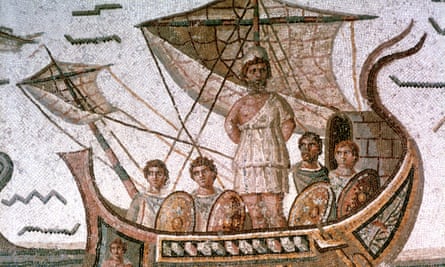
Roman mosaic, 3rd century AD, Tunis.
The tablet was discovered after three years of surface excavations by the Greek Archaeological Services in co-operation with the German Institute of Archaeology, and was found close to the remains of the Temple of Zeus at Ancient Olympia, in the western Peloponnese, the birthplace in 776 BC of the Olympic Games.
Composed orally during the 8th century BC, the epic poem – attributed to Homer – was transcribed during the Christian era on to parchment of which only a few fragments have been discovered in Egypt. As to the identity of Homer himself, no one really knows for sure whether he actually wrote the poem, if it was a collaboration with others, or indeed if he is just a fictional character himself. Many accounts of Homer’s life have been put forward; the most widespread is that he was a blind bard from Ionia, on the western coast of Anatolia, Turkey, and he was born in the 8th century BC, but most scholars today believe these accounts legendary.

Hellenistic original of the 2nd c. BC. Stored in the British Museum.
Interesting fact;
When Odysseus arrives at the island of Aeolus, the God of the Winds, he is welcomed and hosted for a month. When Odysseus leaves, Aeolus blesses his journey with a favourable wind and hands him a sack containg all the unfavourable ones, so he can continue his journey home safely.
However, as they are approaching Ithaca, Odysseus’ men open the bag, causing a storm that destroys many ships and sweeps Odysseus back out to sea. Today Greeks use the expression “opening the sac of Aeolus” to describe an adverse situation with uncontrollable consequences, similar to the English one “opening a can of worms”.
 everythinglatin.co.uk
Leave a comment